Bodies that don't matter
The displaced, migrants, colonists, and travellers
Curated by Nora Ancarola for the Xarxa de Museus d'Art de Catalunya
Background
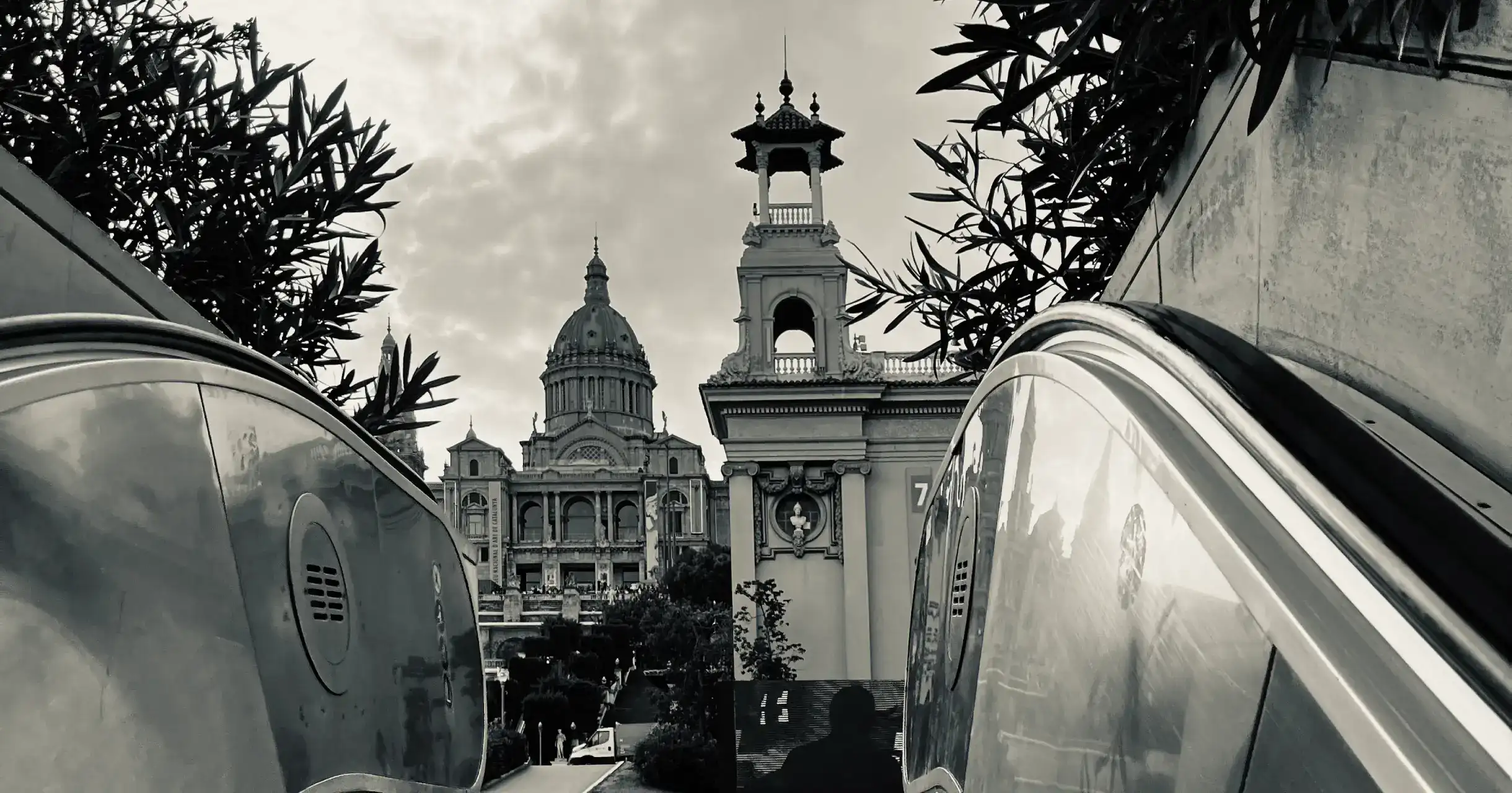
Walking up the stairs to the Museu Nacional d’Art de Catalunya (MNAC) with a copy of Walter Benjamin’s The Work of Art in the Age of Mechanical Reproduction, a book conceived and written the same year as the grand opening of the Museum and published two years later, may seem paradoxical, but it’s not. Benjamin wrote this essay when Adolf Hitler was already the Chancellor of Germany, having assumed the position in 1933, in an effort to describe a theory of art that would be useful for strategically constructing revolutionary demands within the politics of art. In the absence of any ritual or traditional value, art would have political repercussions in the age of mechanical reproduction, especially through photography and the new cinema, which no one had previously foreseen. Far from the debate stirred up in modernity about being for or against unique works of art or for or against technology, here the author talks about the importance of art as a political instrument.
I continue climbing the stairs, this time in my own imagination, that could lead me to any one of the museums in Catalonia. I think about why it is necessary to bring together such an important part of Catalonia’s heritage within these buildings through small or large collections, usually private ones, from the struggles of local agents to preserve their own culture or the desire to add up everything and more. Thinking of them as places that archive what has already been stated, but which at the same time contain, care for, and hide the archive of what has not yet been revealed gives us a broader view of their contents. Based on this idea, there are multiple possible and even contradictory readings.
I have to confess that my favourite museum is the one that conceals within it important and unique histories, but also personal tales of everyday life; a small, accessible museum that aims to document the importance of pieces in explaining what words cannot say, that which remains in the realm of the unnameable and which is what guides us when we change places, when we seek shelter, and something remains among us to decipher individually and collectively.
Approach to the project
Currently, there are 68 million people who have been forced to leave their place of origin due to economic, religious, or political reasons or because of their sexual orientation. Human movement is a historical constant that takes place and acquires specific forms depending on the time and the place in which it happens.
Migratory movements are, to a greater or lesser extent, a part of our everyday life. Migrations from the countryside to the city, between cities, countries and continents affect us all. The consequence is that they lead to situations that are painful to varying degrees along with tensions that evoke an inevitable sensation of not belonging.
Although migrations do not erase the memory of one’s personal identity, on the contrary they reinforce it, we could speak of exile as a suspension of the identity that establishes the new order in which many artists create their work.
Yet migration has not always been understood in that way. The links between trauma and migration go beyond matters of adaptation or belonging or a nostalgic sense of loss. Exploring migration as an embodied wound, as a wound made visible through language and languages is the task that has kept me occupied the last few years. Nevertheless, in this case, my goal is focused on considering migration as a small guiding thread through the history of social dysfunction concerning the other, which is always revealing.
Including the economic, social, and living circumstances of migrant bodies as well as the characteristics of the receiving place within this analysis will allow us to diversify migrations into different categories, including exoduses, exiles, colonisations, movements, drifting and, even, journeys.
Based on the works of art in the collections of the Xarxa de Museus d’Art de Catalunya, this online exhibition seeks first to narrate what is behind the movements of the creators and to what extent the artists reflect these travels in their works.
The idea of exoticism and the vision of the different other will be another focus of attention, aiming to start repairing the symbolic representation of colonialism which, in many cases, is the starting point of so many collections. Some of the clues of how this is represented from a clear perspective of exclusion will be identified as the exhibition unfolds. We will once again show that a colonial aesthetic exists, something which will allow us to ponder the following question: how can we avoid falling into a new decolonial aesthetic?
Another aim is to explore the myth-making associated with certain journeys. Could we thus speak of nomadic life, so commonplace among certain artists, as a depoliticised migration? If immigrant artists choose to hide their precarious state, could we say that it is an aestheticised way to conceal what is truly a social anomaly and a failure of cultural and migration policies? In many cases, these travels are journeys undertaken with the hope of changing one’s life. However, too often these hopes clash with national laws. Changing one’s status from an immigrant without rights to a foreigner with rights is what many times makes the journey a “masquerade”.
In short, the spheres I have proposed aim to indicate possible lines of exploration among different migrant realities. Framing migration in an ontology situated in the body that rethinks relationships concerning vulnerability, labour, creation, social relations, social class, and the idea of belonging will allow us to find a relational perspective within the museums while also featuring works that will be read and interpreted from my own perspective as a migrant.
The project entitled BODIES THAT DON’T MATTER is a reflection on the subjectivity of migrant bodies with or without the awareness of the realities of migration itself.
I would also like to note that today, more than eighty years after the end of the Spanish Civil War and, therefore, the beginning of exile for so many republican artists whose absence left a void in the cultural life of our society, the process of restitution is finally taking place, albeit too slowly in certain cases.
Certain museum foundations which are dedicated specifically to some of these artists and created based on collections donated by the artists themselves, their families, or their friends, in many cases have been essential for this recovery. The Generalitat de Catalunya is currently undertaking a significant effort to create a national art collection of the post-Spanish Civil War and second avant-garde period to include artists in exile, covering these unjust voids, at least in part.
Finally, the artistic practice that articulates works of art with the political work of artists within the same activity and not as moments separated from daily life (artivism?) seeks other types of representations in which language and action enable criticism and activism at the same time. Here, the creator’s experience is the driving force and what many times defines their political position. This is why many works that can be considered as artivist come from artists who experienced violence, exile, or diasporas. In today’s world, the body is often the means to question these constructions and cross borders.
Historical exoduses
(foundational tales of different peoples?)
The following text comes from the Old Testament of the holy book for Catholicism. It tells the story of the liberation from slavery of the Israelites in Egypt and their exodus led by Moses towards the promised land. One of its most popular passages reads:
[…] “21 Then Moses stretched out his hand over the sea; and the Lord caused the sea to go back by a strong east wind all that night, and made the sea into dry land, and the waters were divided. 22 So the children of Israel went into the midst of the sea on the dry ground, and the waters were a wall to them on their right hand and on their left. 23 And the Egyptians pursued and went after them into the midst of the sea, all Pharaoh’s horses, his chariots, and his horsemen. 24 Now it came to pass, in the morning watch, that the Lord looked down upon the army of the Egyptians through the pillar of fire and cloud, and He troubled the army of the Egyptians. 25 And He took off their chariot wheels, so that they drove them with difficulty; and the Egyptians said, ‘Let us flee from the face of Israel, for the Lord fights for them against the Egyptians.’ 26 Then the Lord said to Moses, ‘Stretch out your hand over the sea, that the waters may come back upon the Egyptians, on their chariots, and on their horsemen.’ 27 And Moses stretched out his hand over the sea; and when the morning appeared, the sea returned to its full depth, while the Egyptians were fleeing into it. So the Lord overthrew the Egyptians in the midst of the sea. 28 Then the waters returned and covered the chariots, the horsemen, and all the army of Pharaoh that came into the sea after them. Not so much as one of them remained” […]
The foundational stories of many cultures recount migrations that preceded the formation of the people to whom the tales pertain. Exodus, i.e. the Jewish people escaping Egypt, is considered the foundational event of the Israeli people. Yet we have to take into account that the starting point for exodus is oppression. Thus, understanding the element of migration as a foundational pillar of a people, even if it is in fact the case, does not seem as real as the mythical imagination would have us believe. The Jewish people were not Egyptians oppressed by Egyptians, but rather foreigners who laboured under the Egyptian empire. Although several generations had already settled down there, they continued to be foreigners. The laws that prohibit the mistreatment of foreigners arose due to their unfortunately widespread and evident mistreatment. The lingering memory of their identity as foreigners and their experience mark the barriers that a foreigner will have in order to exercise their rights and to reach the social and political decision-making spaces.
Furthermore, the experience of exile profoundly marks the lives of the displaced, and their bonds with the place transforms into an ongoing personal and social conflict, both in terms of identity and survival.
-
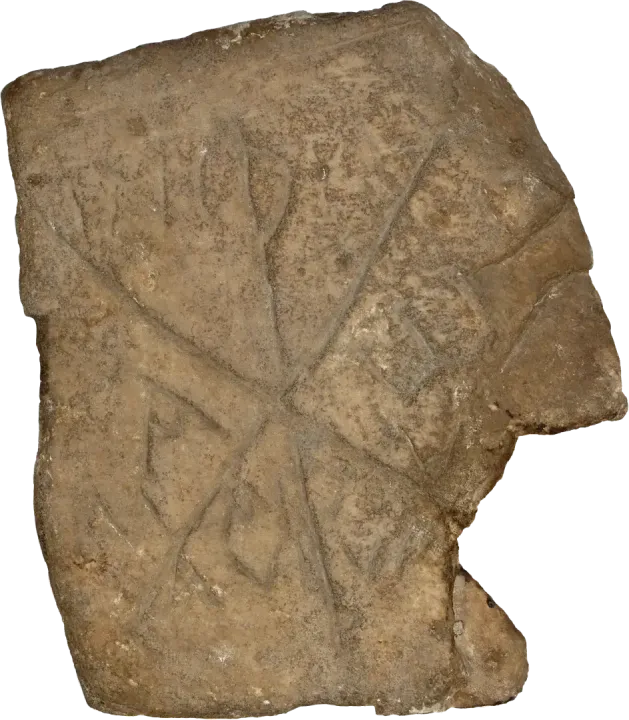
Unknown, fragment of a Paleo-Christian tombstone, 4th century C.E.
Carved white marble chiselled with inscriptions
Empúries, l’Escala (Alt Empordà)
Museu d’Art de GironaThis fragment of a white marble tombstone was found in 1896 outside the western wall of the ancient city of Empúries. It has been dated to the 4th century C.E., an era when the Roman Emperor Constantine had proclaimed freedom of religion, as a good part of the imperial court had in fact embraced Christianity, including his mother, Helena. It is believed to be the oldest piece of Christian iconography in the diocese of Girona.
Freedom of religion and Constantine’s decision to halt the persecution of Christians made it possible to stop the torture, arrests, and punishments, and, thus, the forced migrations. At the same time, it marked a turning point after which Emperor Constantine became a sort of patron of the Christian Church.
-
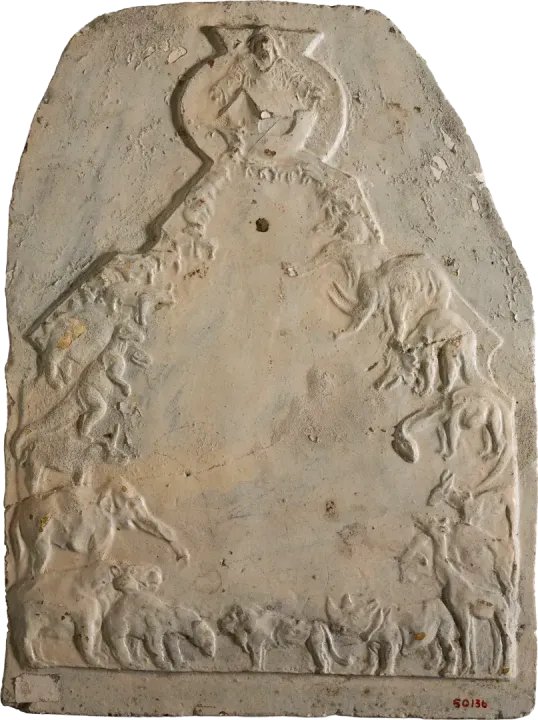
Ismael Smith, Noah’s Ark, undated.
Museu Nacional d’Art de Catalunya (MNAC)
Donation by the artist, 1955
© The artist or their heirsCertain psychoanalytic theories equate Noah’s Ark with the mother’s womb, as life emerges from it amidst fluid. Yet, it is also important to recall that the water will do its work and will only let some survive.
-
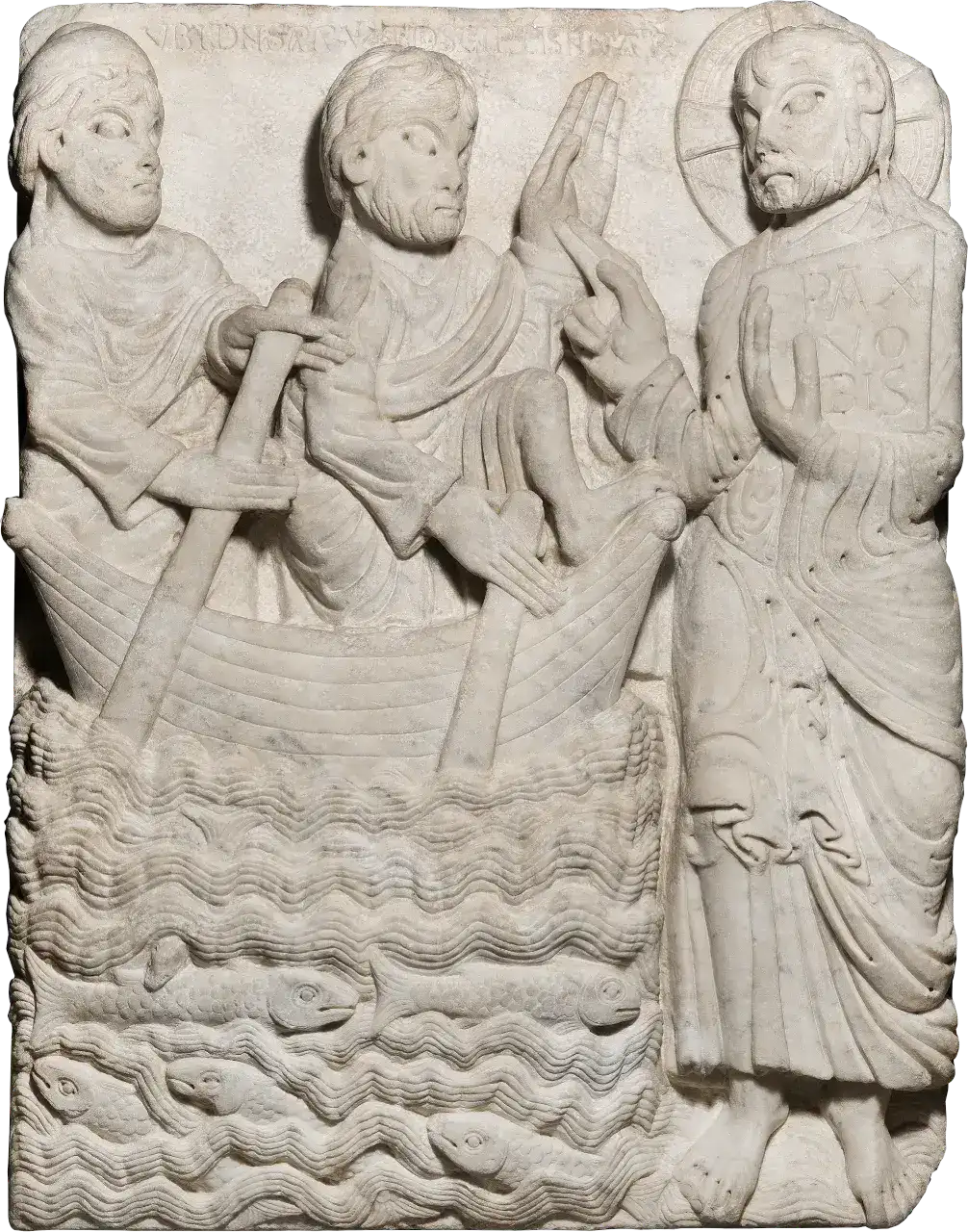
Master of Cabestany, The appearance of Jesus to his disciples at sea
Portal relief
Second third of the 12th century
Marble
Sant Pere de Rodes Monastery (Girona)
Donated by the Friends of the Museums of Catalonia by popular subscription (1960)
Obverse: Museu Frederic Marès. ©Photo: ArtWorkPhoto.eu
Reverse: Museu Frederic Marès. ©Photo: Ramon MuroThe relief, carved into a block of reused marble, narrates the appearance in which Jesus walks on water. This iconographic representation is corroborated by the inscription “UBI DOMINUS APPARUIT DISCIPULIS IN MARI”, which appears at the top part of the scene. A boat is sailing with a pair of figures on choppy waters full of fish. Water once again plays a prominent role.
-
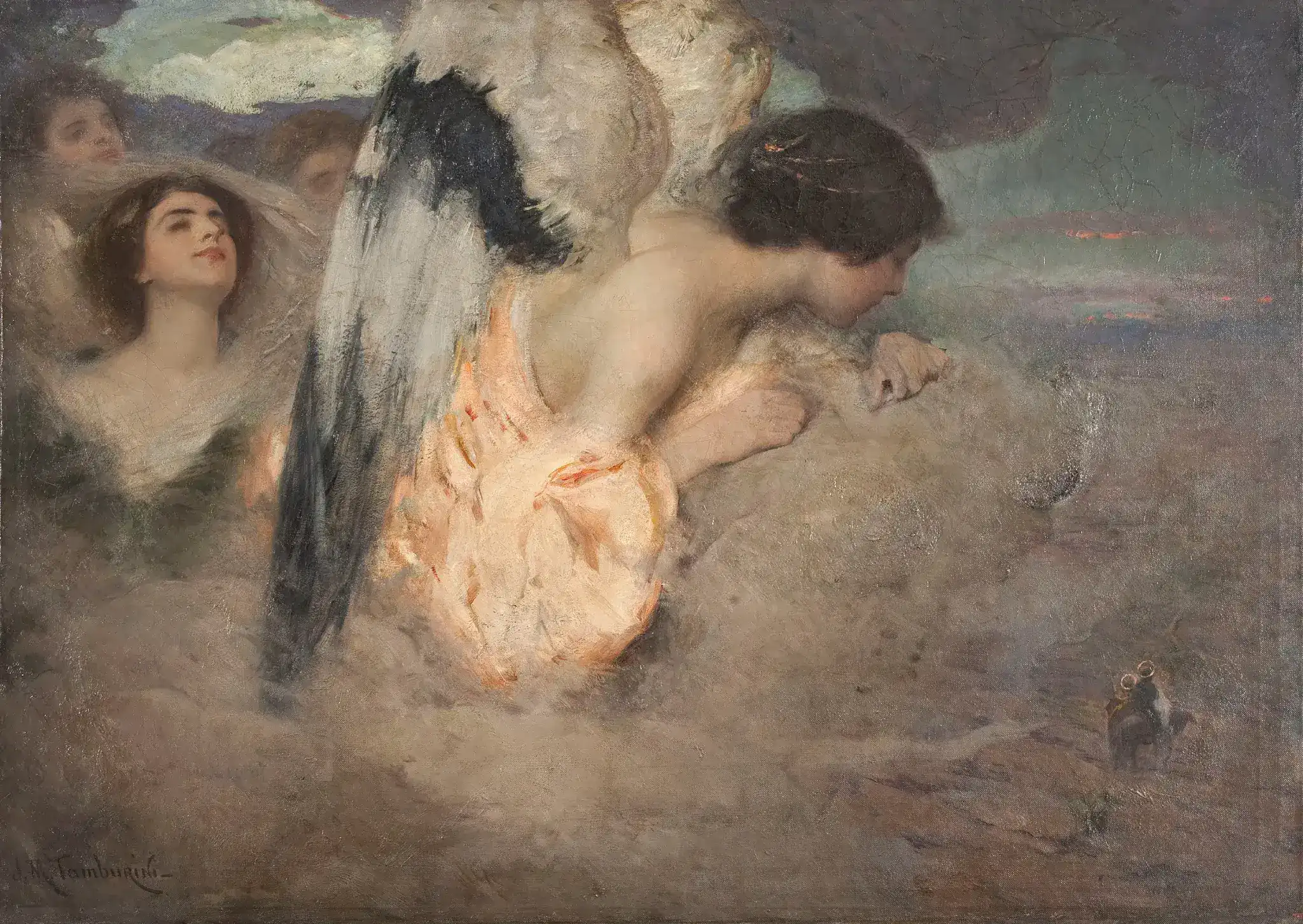
Josep Maria Tamburini, The Flight into Egypt, ca. 1911
Museu Nacional d’Art de Catalunya (MNAC)
Purchased at the “6th International Exhibition of Art”, Barcelona, 1911
Public domainThe Gospel also presents the Holy Family on the painful path of exile, seeking shelter in Egypt. Joseph, Mary, and Jesus experience the dramatic circumstances of being refugees, marked by fear, uncertainty, and hardship. When we observe the Holy Family of Nazareth as they are forced to flee, we cannot help but think about the difficulties faced by migrants and refugees who are victims of rejection and exploitation today, particularly those who are victims of human trafficking and slave labour.
-
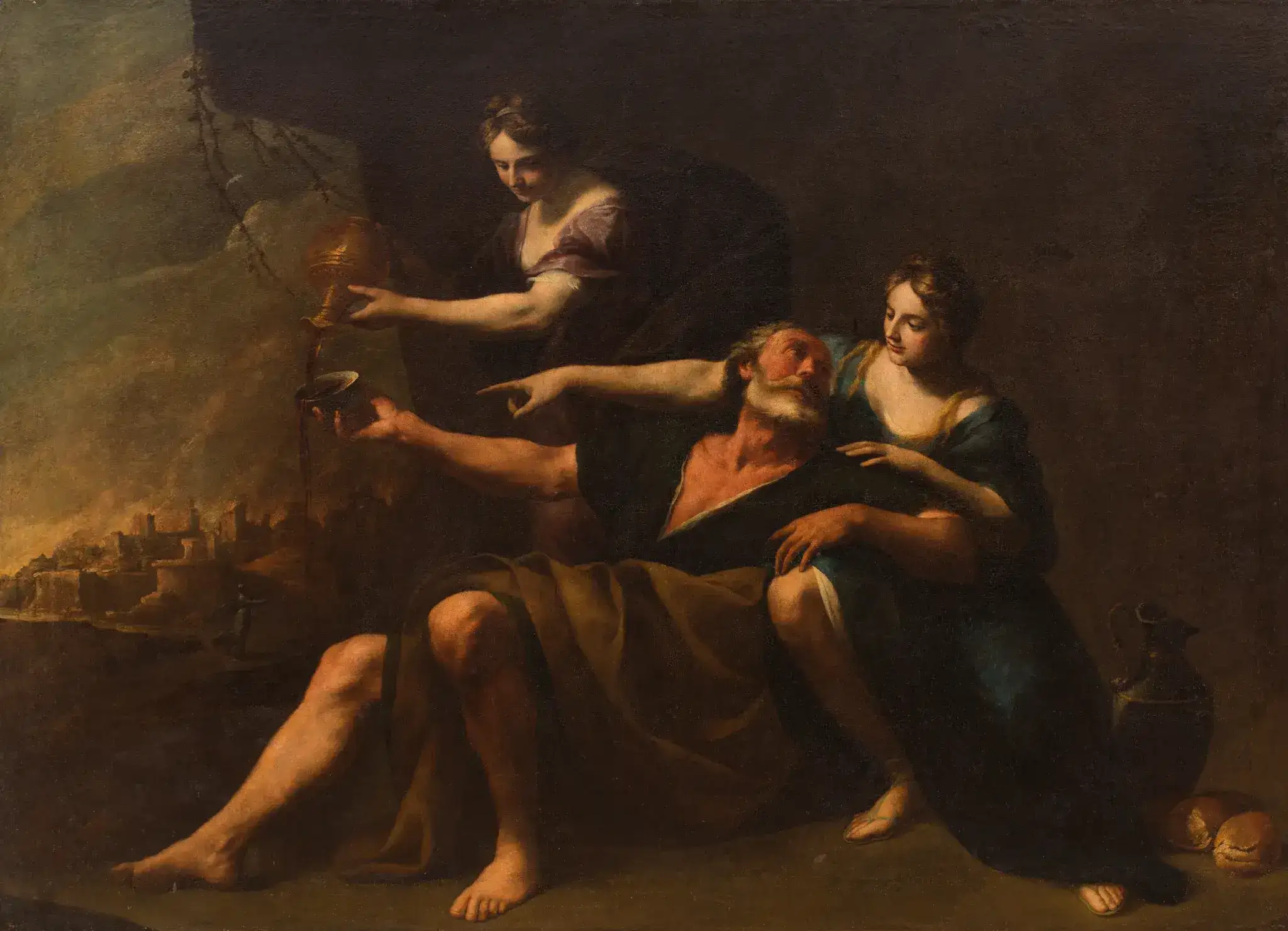
Lot made drunk by his daughters, c. 1620-1670
Andrea Vaccaro
Oil on canvas, 195 x 267 cm
Registry No. 130.755
Museu d’Art de Girona
Long-term loan, Museo Nacional del PradoLot and his family settled in Zoar, a city allied with Sodom. Shortly after, Lot and his two daughters fled Zoar and settled in a cave in the mountains. The daughters, who wanted to have children, got their father drunk two nights in a row to have relations with him. The two daughters each had one son: the older daughter gave birth to Moab, considered the ancestor of the Moabites; the younger daughter had Ben-Ammi, ancestor of the Ammonites, both predecessors of two peoples of the Near East.
Carriages and dinghies
(the medium is the message)
It wasn’t easy to take the decision to leave, but in the end, it was the only solution if I didn’t want to see my family left without any hope. After two years earning just enough to scrape by, I understood that if I wanted my children to study so they could have the opportunity for a different life from mine, I had to leave, I had to find a job […]. I didn’t want to come to Italy, I wanted to go to a rich country to stay there three or, at most, four years and earn the money I needed so my children could study, but everything has been harder and more painful than I had imagined […]. In Senegal, after all, I was fine. I want to go home, even though with the money I have earned it is not enough; there is no place for me here.
Carriages
The Grand Tour was a widespread custom between the 17th century and the early 19th century which consisted of a journey through Europe taken by young upper-class Europeans interested in culture and art with Italy as a key destination. Considering this tour as kind of a formative journey, the origins of the Grand Tour could date back to the Renaissance, when humanist intellectuals and artists made trips to Italy with the goal of gaining a better understanding of classical culture. Initially, travellers took the trip in carriages, particularly the so-called Berline coupé, a name coined due to the journeys that Frederick William of Brandenburg made between Berlin and Paris in the 17th century.
This idea of “European” cultural education spread across space and time. In fact, many 19th and 20th century Spanish and Catalan artists considered it an important milestone in their career, to the point that, even in the darkest eras of Franco’s Spain, many travelling artists that fled the stifling cultural and social situation preferred to present themselves as grands touristes refusing to acknowledge their status as immigrants or exiles.
Dinghies
Never have so many people died by drowning at sea as they attempted to reach Spanish territory as in those first five months of 2024: 33 every day or 5,054 between January and May. Of the total victims, 154 were women, 50 were children, and 4,850 were men. This tragedy highlights the failure of the immigration control policies aimed at the Global South. Far from halting the movement, the policies provoke even higher levels of mortality. Furthermore, European countries seem to be locked in a competition to see which one can restrict immigration the most and manage to get rid of “undesirable” immigration.
All these people came to live a dignified life, to work and to get an education. Despite that, the increasingly xenophobic European “bunker” sees no limits in its decisions.
-
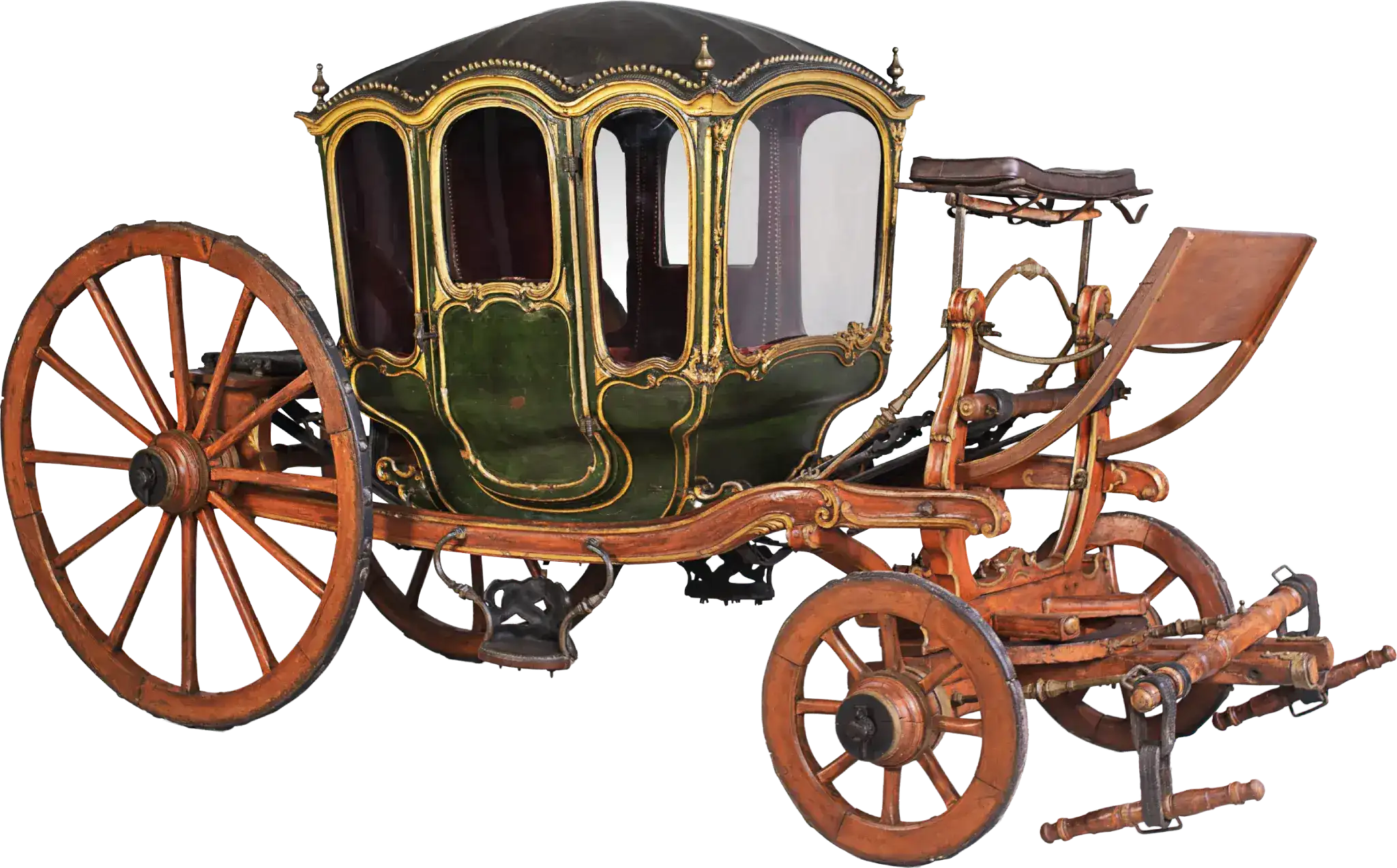
Berline coupé
Mallorca
Date: 1750
Dimensions: 247 x 187 x 470 cm
Carved, turned, gilded and polychrome wood; wrought and gilded iron; cast brass; studded and stitched leather; glass; velvet; canvas
Purchase, 1899
MADB 2952
Museu del Disseny-DHubThe Berline coupé is a closed carriage that was created, according to certain historians, in Berlin in the last quarter of the 17th century and which spread throughout Europe in the 18th century. The main characteristic of this carriage, which sets it apart from other models, including subsequent ones, is the connecting link between the front and rear axle. Previously there was a single, heavy beam in the central part, but this model featured two light rods, on either side, which carry out this function, a circumstance that allows the Berline coupé to be a lightweight, safe, comfortable, and suitable carriage for both ceremonies and journeys.
-
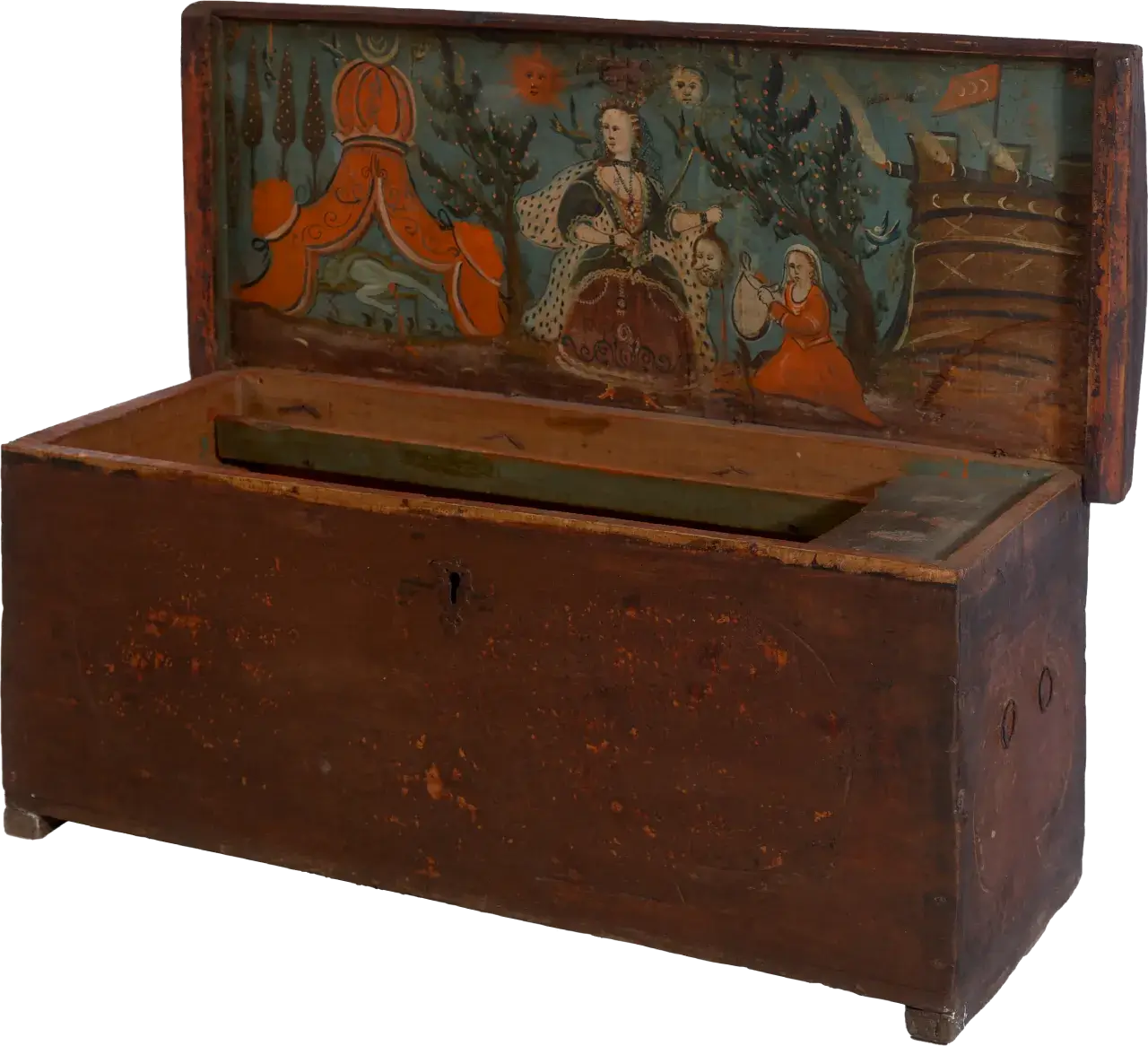
“Judith” sailor’s ditty box, c. 1780-1810
Unknown maker
Wood from the riverbank and oil paint, 51 x 118.5 x 48.5 cm
Registry No. 138.755
Museu d’Art de Girona
Fons Diputació de GironaDuring the long voyages to America, seafarers typically used “sailor’s ditty boxes” to transport their personal effects. The popularity of this type of furniture in the Mediterranean world runs parallel to the splendour of the Catalan maritime fleet in the 18th and 19th centuries. One particular aspect was that scenes were painted on the inside part of the lid. One of the most common motifs was the scene of Judith just after she had cut off the head of the warrior Holofernes. We can understand the use of this narrative device in the following way. The polychrome scenes on the boxes reflected the fears, desires and longings that came with the experience of setting sail. According to some opinions, this scene sought to recall the power that wives held over their sailor husbands, who spent long periods of time away from home, and might be tempted to fall into debauchery, violence, and infidelity.
-
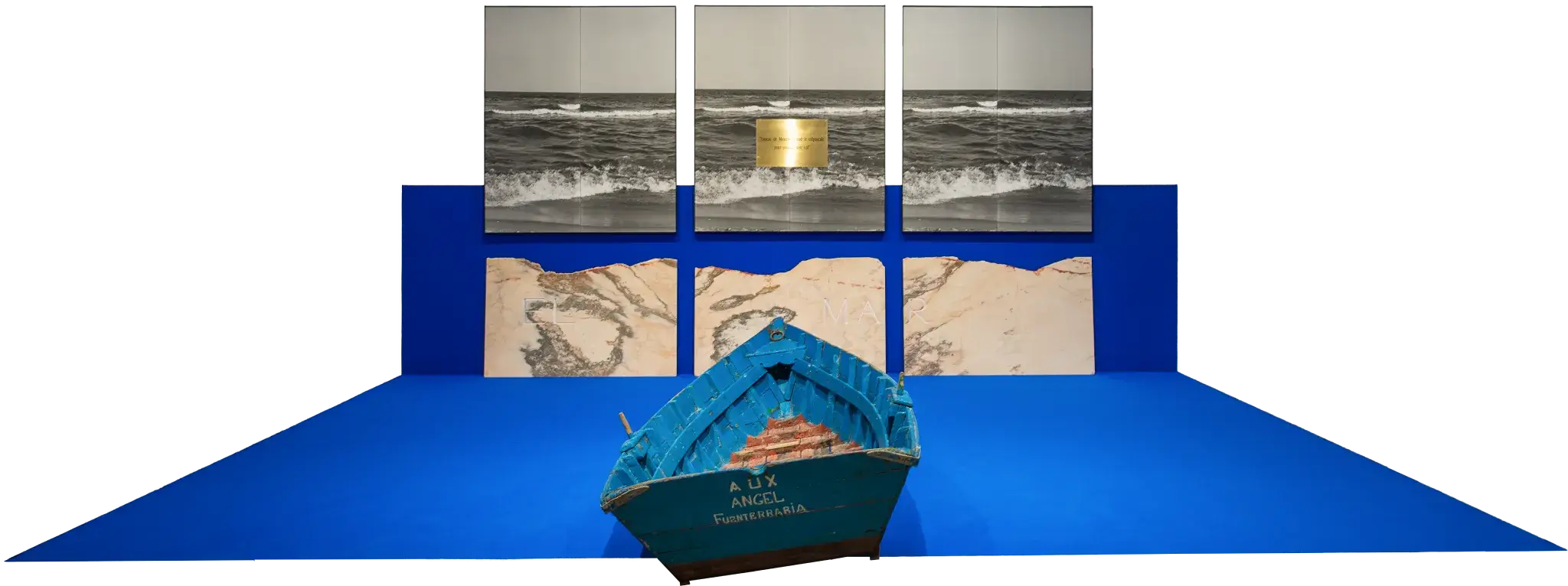
Francesc Abad, Blockhaus-Blocblaus. Parallel stories [Marseille]
1988
Enamelled wooden boat, marble plate, and gelatine silver print on paper
3 photographs: 160 x 130 cm each; 3 marble pieces: 80 x 130 cm each; boat: 58 x 310 x 135 cm
MACBA Collection. Museu d’Art Contemporani de Barcelona. Long-term loan by the Ajuntament de Barcelona. Donation by Rafael Tous
© Francesc Abad, VEGAP, Barcelona
Aesthetic migrations
(journeys as a masquerade)
The doors may be locked; but the problem will not disappear, however tight the locks. Locks do nothing to tame or weaken the forces that cause displacement and make humans into refugees. The locks may help to keep the problem out of sight and out of mind, but not to force it out of existence.
⏤Zygmunt Bauman, Society under siege
Many times, travel also represents the possibility of traversing an imaginary space where precisely no borders exist. In this case, literature itself can become a way of travelling; in fact, one can “travel the world through reading”. However, it is completely impossible to “migrate through reading”. Exile and migration, through the displacement of the body, create a loss of the place of origin, one that is greater than the distance itself, as they entail a difficult process of uprooting the person that can leave a scar.
Throughout the history of art, the experience of travel has always been an important topic in educational and professional paths, as a motif for artistic inspiration or as an escape, or as exile in search of places more conducive to creation. These travels weave networks of exchanges in which artists enrich the societies that welcome them, but also, on their return home, they bring back with them a series of experiences to share in their places of origin. At the end of the nineteenth century and in the twentieth, many artists travelled to Paris, London, or other European locales. In precious few cases did they speak about or express in their works the difficult situation in which they lived, the conditions of their departure or the political situation of their country, apart from a scarce few who underscored their political commitment, while many of them maintained a melancholic tone.
In many cases, the journey is transformed into a glamorous mask that obscures an eminently political work, whether from more activist endeavours to more community- and cultural-based works, such as the work of Apel·les Fenosa, which we will see in another section.
-
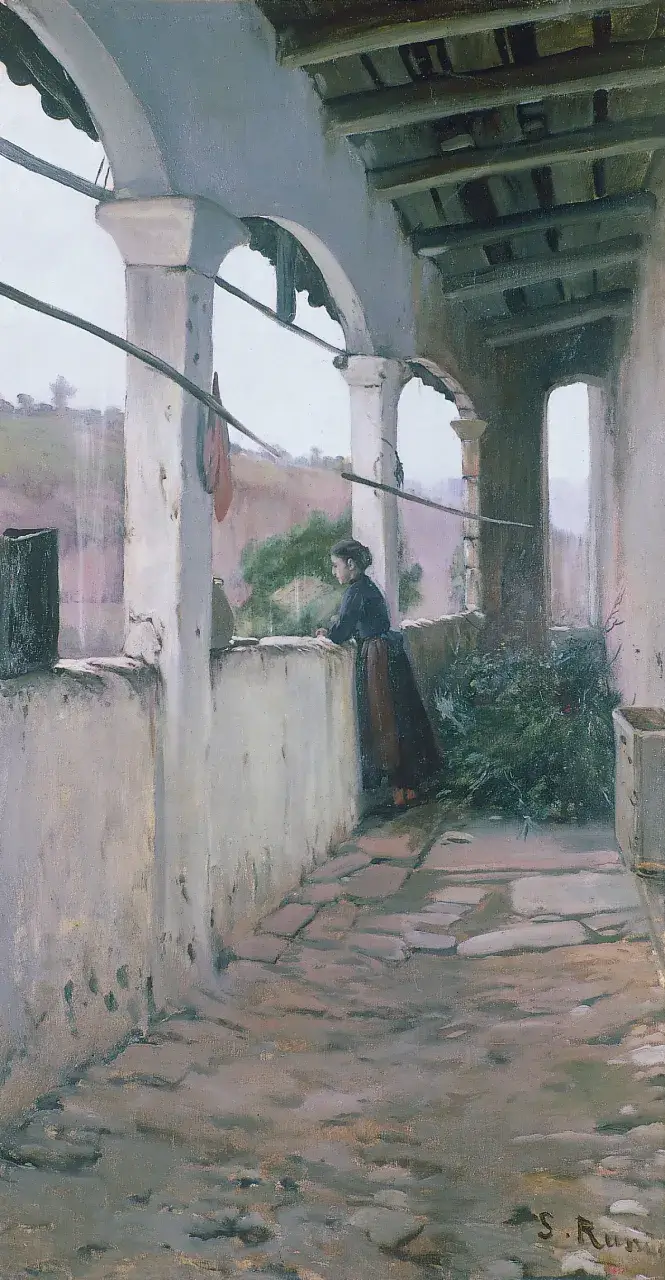
Rusiñol i Prats, Santiago, Barcelona, 1861 – Aranjuez, 1931
The Garden Porch or Rainy Afternoon
Painting. Sitges, 1889
Oil painting on canvas. Gilded wooden frame
Biblioteca Museu Víctor BalaguerThis piece was painted during a carriage trip through Catalonia with Ramon Casas. It was exhibited in the Sala Parés together with the work entitled The Widow by Ramon Casas along with other works by modernist artists in 1890. Shortly after that, the artists themselves gave the works to Víctor Balaguer for his museum.
The scene shows us the porch of a Catalan country house featuring a young woman gazing at a rainy landscape. The fog and the grey atmosphere grant the solitary character a feeling of sadness that conveys melancholy.
-
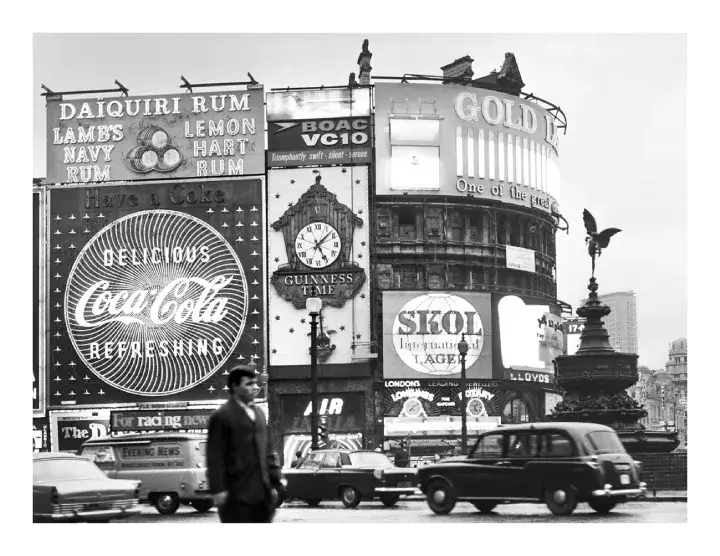
Josep Jové Calvera. London. Piccadilly Circus, 1967. Black and white photograph, 30 x 40 cm
MORERA. Museu d’Art Modern i Contemporani de Lleida, 3519
Donation by the Jové Pla Family, 2015Jové took countless trips abroad, often to some of the countries furthest removed from Franco’s Spain, such as the Soviet Union, places that he notably documented with his own camera. Based on this facet of his photography, the Museum boasts a collection of images from the nineteen sixties in Paris and London.
-
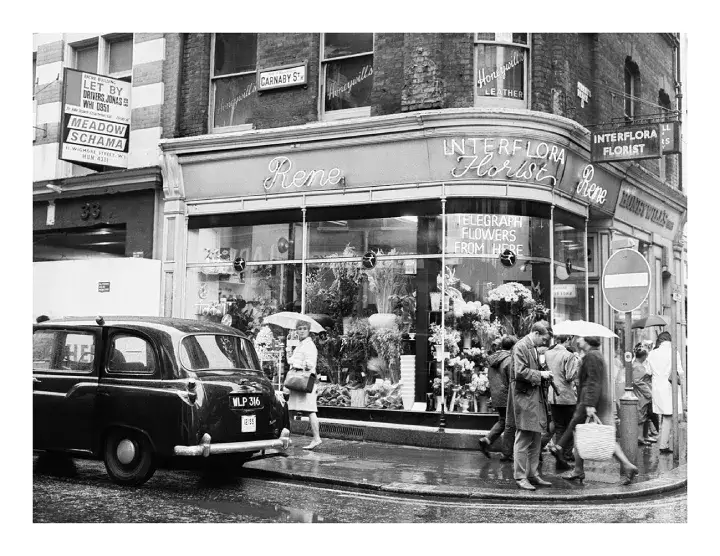
Josep Jové Calvera. London. Carnaby Street, 1967. Black and white photograph, 30 x 40 cm
MORERA. Museu d’Art Modern i Contemporani de Lleida, 3520
Donation by the Jové Pla Family, 2015 -
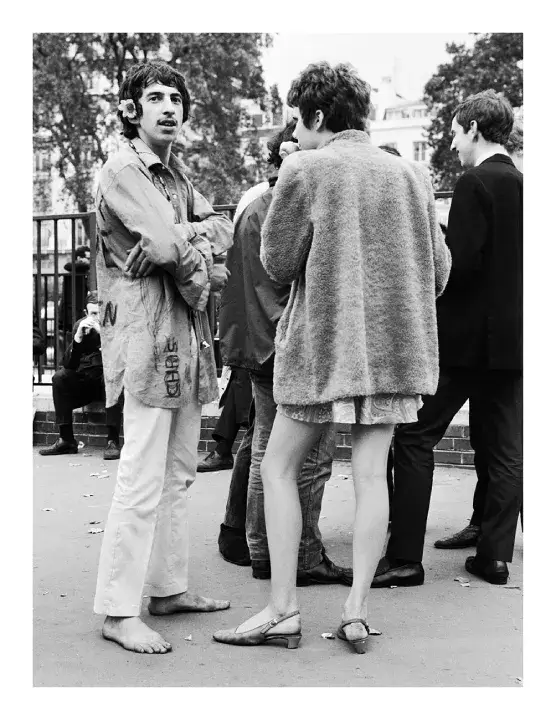
Josep Jové Calvera. London. Youth, 1967. Black and white photograph, 40 x 30 cm
MORERA. Museu d’Art Modern i Contemporani de Lleida, 3521
Donation by the Jové Pla Family, 2015
Migrations and uprooting
(precarious life, a life worthy of mourning)
Of course there are mothers and then there are mothers. Mine was a wise woman. I had to spend two years in the hospital. My whole face was burnt, pierced like a sieve with shrapnel, my thighs, my stomach… my entire body. And my mother only showed my head and my face to the doctors. Because if they had seen my entire body, burnt as if it were a battlefield, they would have told her that I couldn’t be healed, they would have given up on me, and I would have had to leave the hospital. That’s why my mother burnt cotton wool at home and collected the ashes. She used them to cover my wounds so that they wouldn’t bleed, get infected, or stick to my clothes. Every day she put new ashes. Every day. Patience is also a way of being wise. I don’t know if I’d call it stubbornness precisely… rather I’d say that she had a lot of faith, she was certain that I could be healed and that I could do many things in my life. I’m already doing them and I can still do a lot more!
⏤ Nadia Ghulam, in the introduction to the book Contes que em van curar [Tales that healed me]
The countless crises in the 20th and 21st centuries have contributed to feeding a society of risk, characterised by labour flexibility, the weakening of the middle class and increased social exclusion. Among these conditions, the dynamics of migration show us how mobility, as well as immobility, have taken on a role as markers of social stratification.
Little by little, artists’ journeys were transformed into highly precarious states, surrounded by a cloud of “bohemian artistry” that the artists themselves nurtured.
In the second half of the 20th century, migratory journeys demonstrate more clearly the inner and outer situation in increasingly radicalised political works, though the 21st century is the one that reveals the reality of migration and exile. Works that cruelly reflect the migratory movements are taking centre stage, placing the theme as central in the problems addressed, opening the space to colonial reflections and broader exclusions.
-
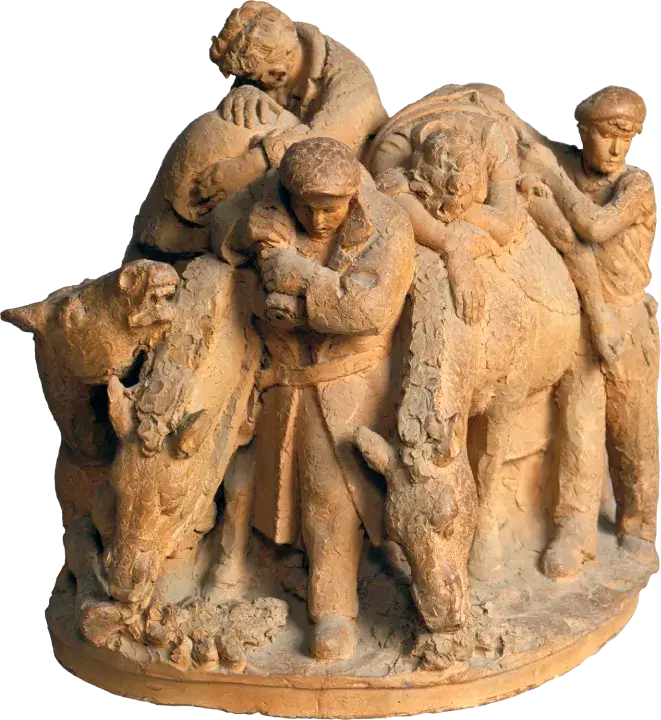
Josep Viladomat, Flight to France: crossing Coll d’Ares, ca. 1942-1943
Museu Nacional d’Art de Catalunya (MNAC), Bequeathed by Santiago Espona, 1958
© The artist or their heirsLike many other artists, Josep Viladomat fled to France in 1939, before later settling in Andorra. One year later, in Prada de Conflent, he modelled the sculpture of Pau Casals playing the cello. Starting in 1950, he went back and forth between Andorra and Barcelona, while he gradually abandoned themes related to the suffering of the war to create a catalogue that included Equestrian Statue of Francisco Franco, from 1963.
-
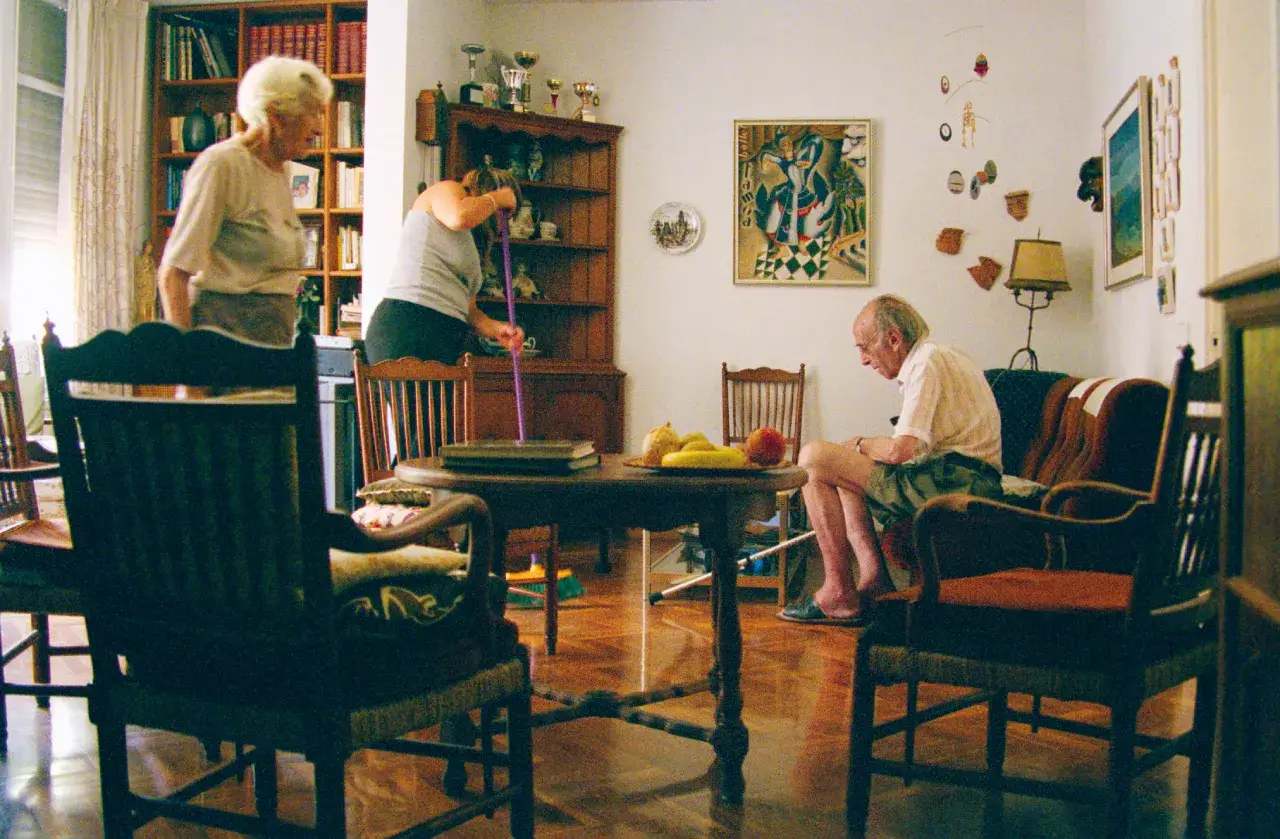
Shibli, Ahlam
Dependence no. 20
Ms Eugenia, from Argentina, sweeping the fitting room of her employers, Ms Pilar Morales Vila and Mr. Oleguer Galí Figueras, with them around her. Carrer Doctor Roux, Sarrià, Barcelona, 27.7.2007
2007
C-print
38 x 57.7 cm
MACBA. Museu d’Art Contemporani de Barcelona. MACBA Consortium. Donation by Ulrich Loock, Bartomeu Marí and Lourdes Iglesias
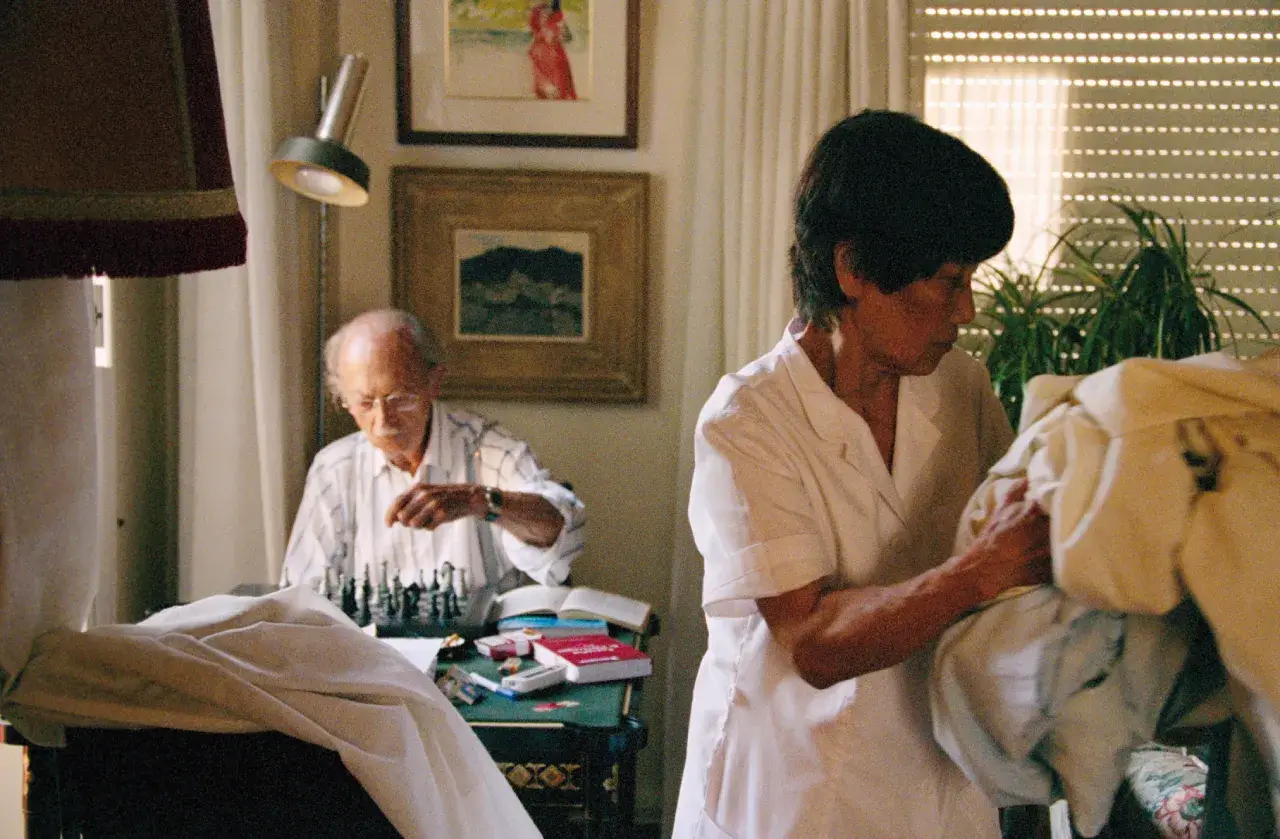
© Ahlam ShibliIn 2007, as part of the project entitled Metropolitan images of the new Barcelona, the MACBA requested various photographs that captured the ways of life in the contemporary city. For the project, the artist Ahlam Shibli focused on the relationships between people, almost all of them immigrants, who take care of the elderly in the city. That is why she contacted different home caretakers to portray them in everyday situations. The result, the photo series Dependence, speaks for itself. This project places the focus on the displacement of people against the backdrop of the globalised economy and on how the relationships of power between middle and lower classes remains in place, albeit with new forms.
-
Shibli, Ahlam
Dependence no. 21
Ms Manin Robles, from the Philippines, handling the white sheets for covering the living room furniture before her employers Ms Carmen Valera and Mr José Manuel Deó Ridruejo, leave for their summer holiday, while he is playing chess. Passeig Sant Joan, Eixample, Barcelona, 23.7.2007
2007
C-print
38 x 57.7 cm
MACBA. Museu d’Art Contemporani de Barcelona. MACBA Consortium. Donation by Ulrich Loock, Bartomeu Marí and Lourdes Iglesias
© Ahlam Shibli -
Biemann, Ursula
Performing the Border
1999
Single-channel video, colour, sound, 43 min
MACBA. Museu d’Art Contemporani de Barcelona. MACBA Foundation. Work purchased thanks to Taller de la Fundació
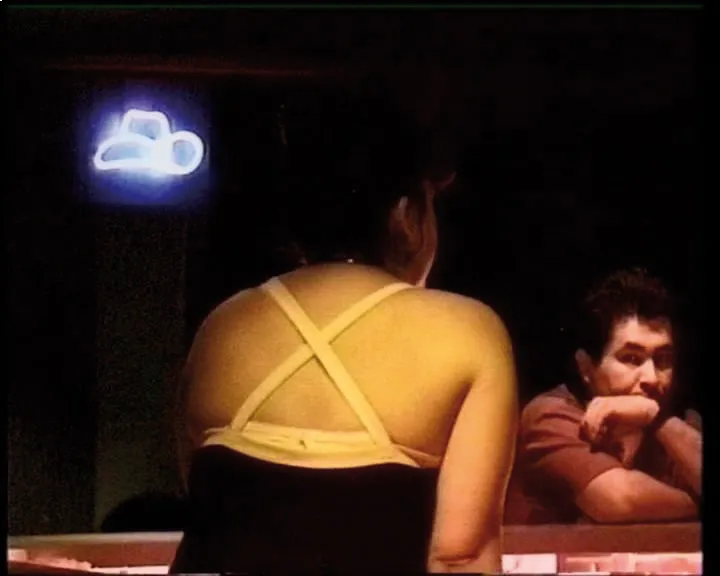
© Ursula BiemannUrsula Biemann documented female labour issues in Ciudad Juárez, a city where many teenage girls arrive from central Mexico hoping to cross the border into the United States and finally arrive in El Paso, Texas. Exploited as cheap labour in the numerous maquilladoras companies, many of these women complement their income with prostitution. Biemann exposed the perils, abuses, and fragility in which these women live, caught between factory work in the IT industry and life in the slums. For the artist, the border is a discursive construction articulated through the border crossing and the power relationship between the two nations. Biemann also addresses the serial murders and rapes of young women in Ciudad Juárez that has been ongoing since 1993.
-
Bajevic, Maja
Double Bubble
2001
Single-channel video, colour, sound, 3 min 40 s
MACBA. Museu d’Art Contemporani de Barcelona. MACBA Foundation. Work purchased thanks to María Entrecanales
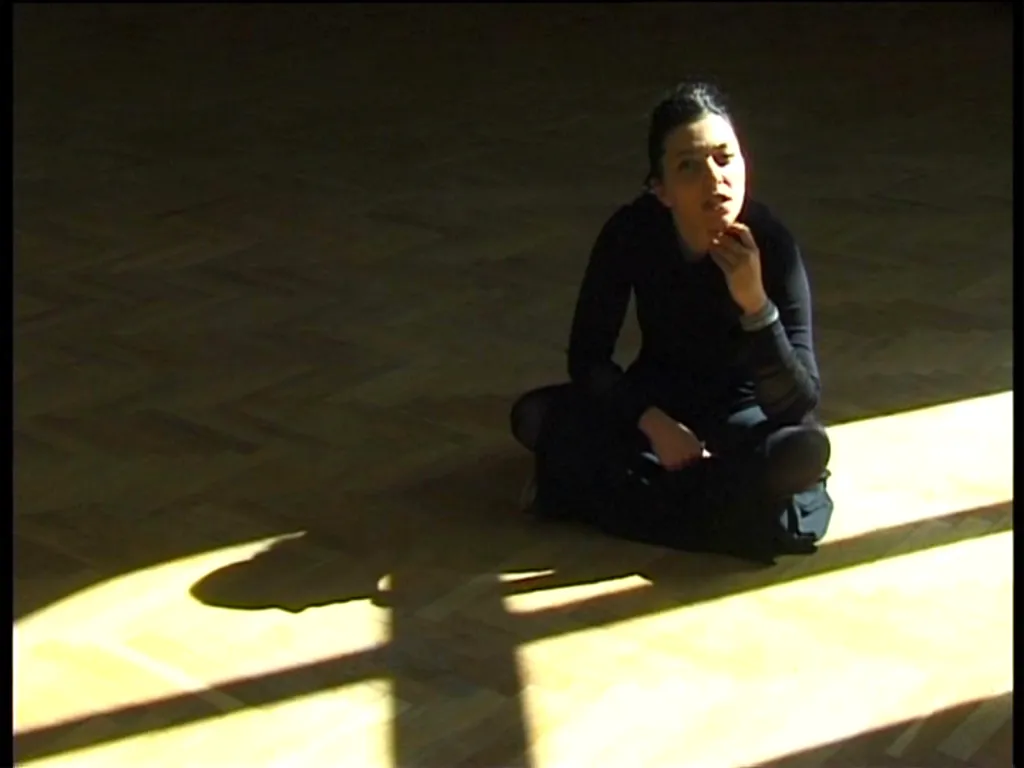
© Maja Bajevic, VEGAP, BarcelonaMaja Bajevic focuses her work on the poetic revision of social and historical fractures arising from conflict and war, specifically the wars that arose from the former Yugoslavia during the 1990s. Her actions and installations explore the dramatic impact of wartime conflicts on the daily lives of the people who suffer them, thus seeking to raise awareness among viewers.
-
Palacín Lahoz, Mabel
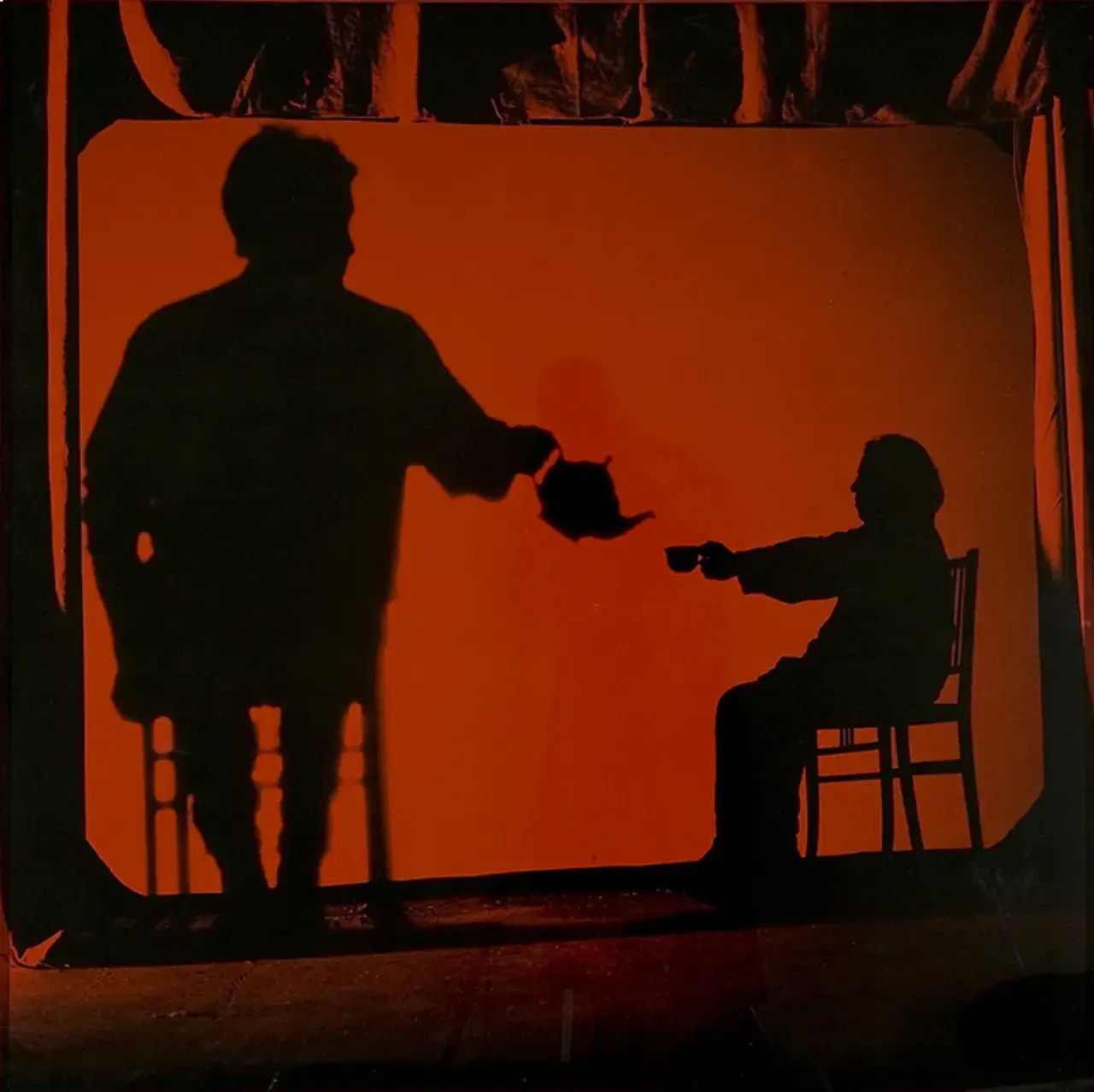
Untitled. ‘Sur l’autoroute nº 1’ Project. Edition 2/3
Photo print 1998-1999
120 x 120 cm
Museu de l’Empordà -
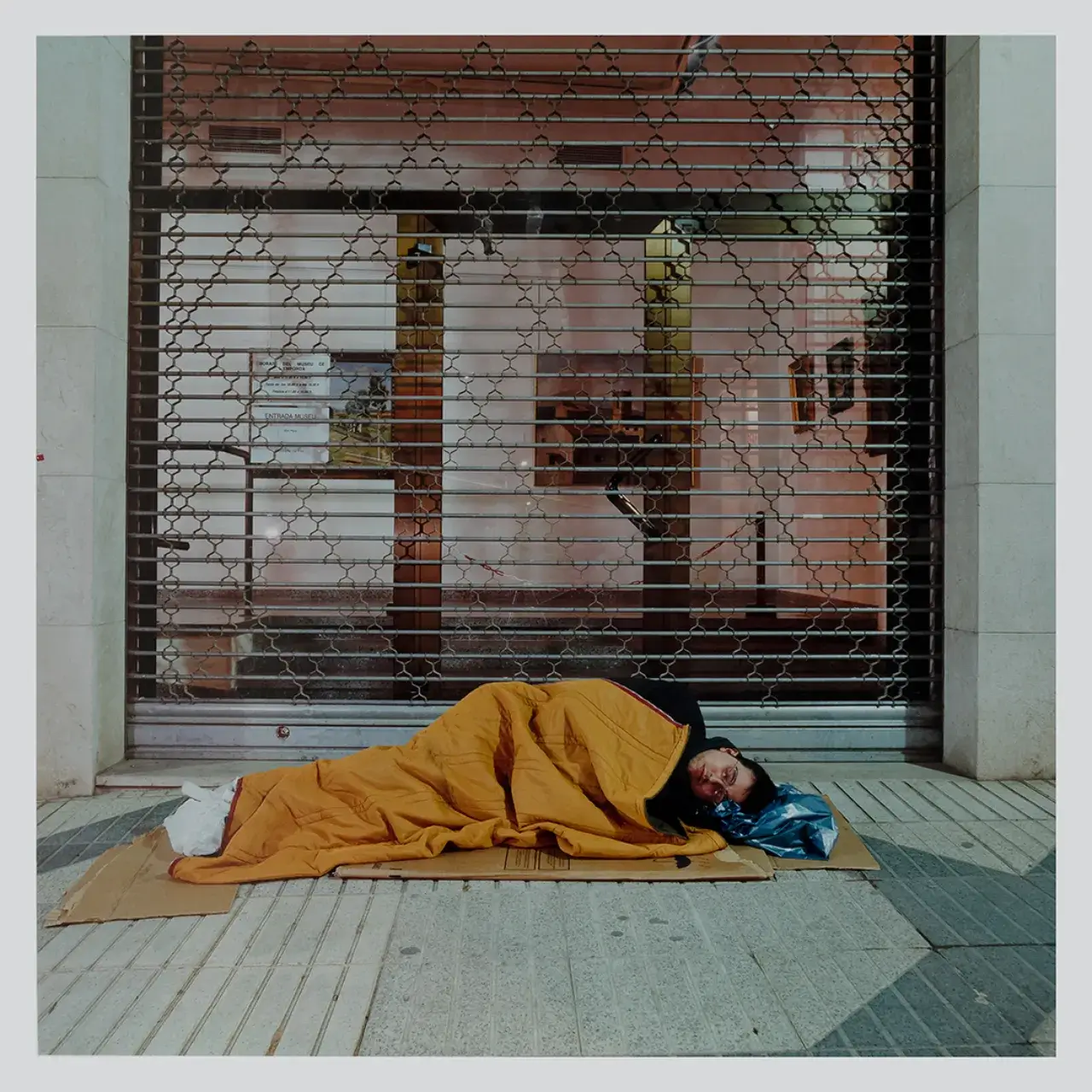
Mitjà, Jordi
Mⱥusøłeu, 1996
170 x 170 cm
Museu de l’Empordà
Migrating within your own country
(from outside/inside)
“The Spain of the harcas never had any poets. Franco has had and continues to have archbishops, but not poets. In this unfair, unequal, and forced division, the bishops fell in line behind the harcas, while the poets remained on the side of the exodus”
⏤ León Felipe
We can clearly see how a generation of creators from the Western world, who spent most of their life in the second half of the 20th century, was more conscientious of the topic of exile. The theme appears in numerous writing and artworks, both directly and indirectly.
In this second half of the century, we also encounter another highly significant character (already present since the texts of Ovid in the confines of ancient Rome), which involve the people who lose their surroundings, the references that give their life meaning and their context. In these cases, there is no physical displacement, no change of spatial coordinates, yet the feeling of exile is clearly present. This is what we call insilio, or internal exile, which is substantively defined by the same sensations and the same feelings as the people forced into exile. It is the same sensation of “feeling displaced”, strange or as a stranger, but in one’s own country. Many Spanish republicans who could not go into exile for various reasons in 1939 and who suffered the repression of the military dictatorship in Spain remained in internal exile, or in insilio, as described in “Era mucha indiferencia, y eso dolía”. Las poetas del insilio desde la Transición (There was a great deal of indifference, and that hurt. The poets of insilio since the Transition), by Laura Lozano Marín, referring to a group of female poets who bore witness to the Spanish Civil War as children or adolescents and who lived in Spain during Franco’s dictatorship, with its mechanisms of repression and self-censorship that rendered them invisible.
-
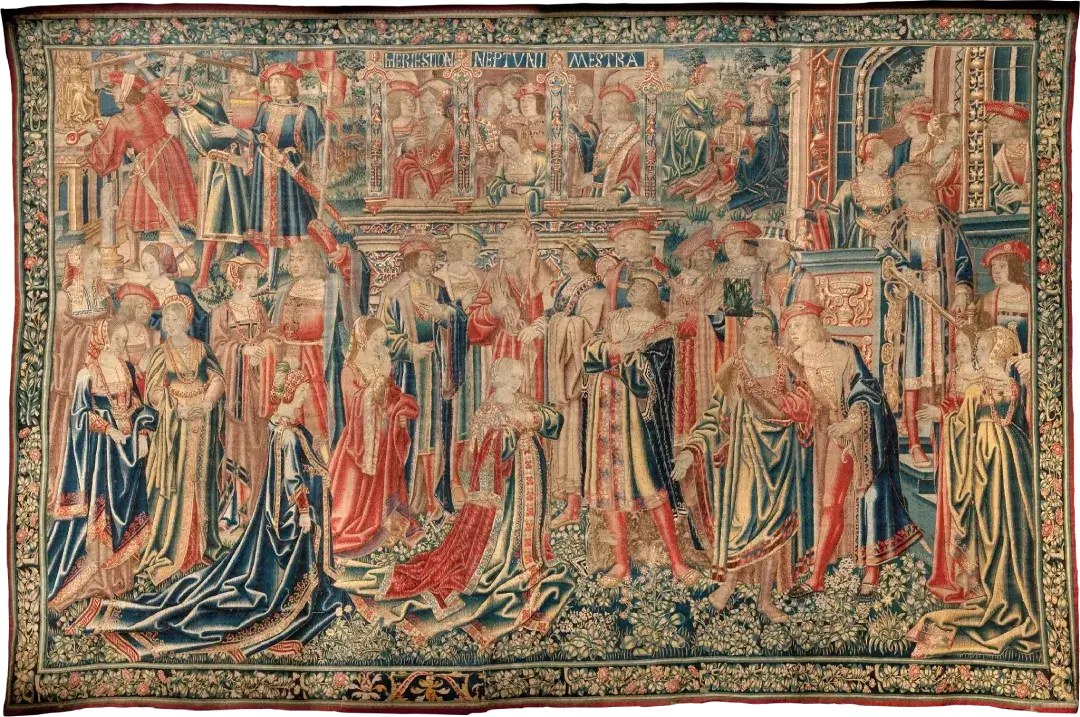
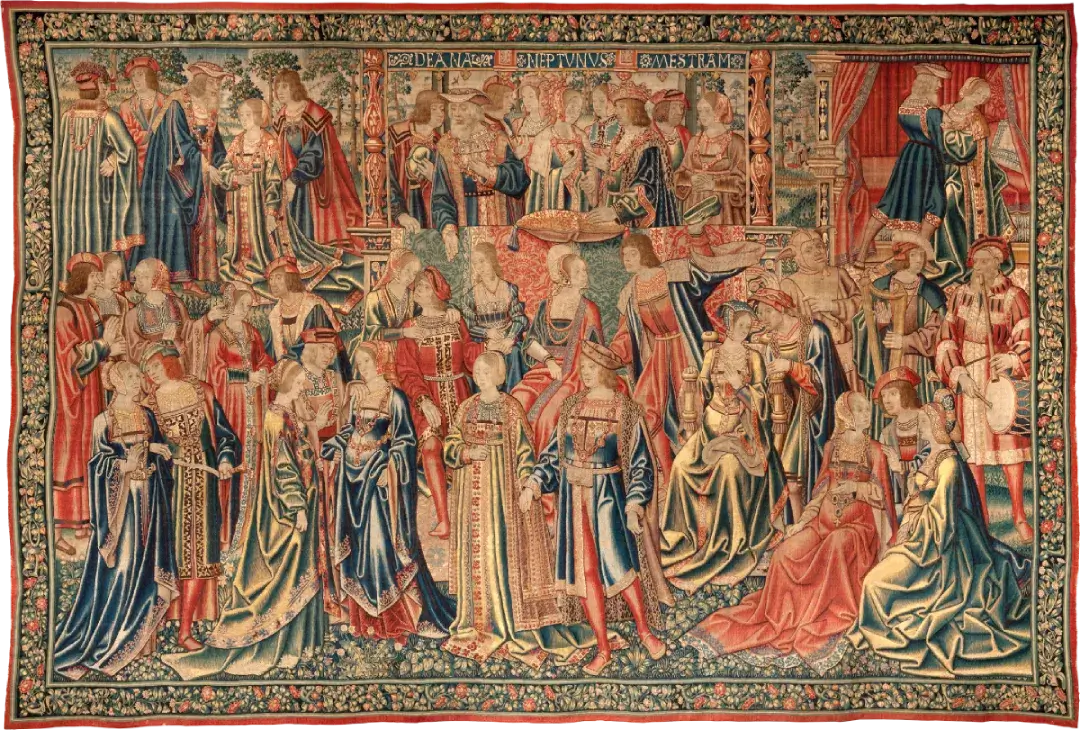
Story of Mestra: The Supplication of Mestra (inv. 2033) and The Marriage of Mestra (inv. 2034)
Jan van Roome
Between 1515 and 1518
Linen, wool, and silk tapestries
345 x 434 cm (inv. 2033) and 344.5 x 525 (inv. 2034)
Museu de LleidaThese two tapestries tell the tale of Mestra, from Ovid’s Metamorphoses, a girl of extraordinary beauty, sold into slavery so that her father, Erysicton, could appease his insatiable hunger that he suffered as punishment for having cut down a forest of oaks consecrated to Demeter. However, thanks to the help provided by her old lover, the god Neptune, Mestra had the permanent gift of transmutation, which always allowed her to escape from the home of the owner who bought her and return to her house, to once again be sold and consistently provide her father with new resources.
-
-
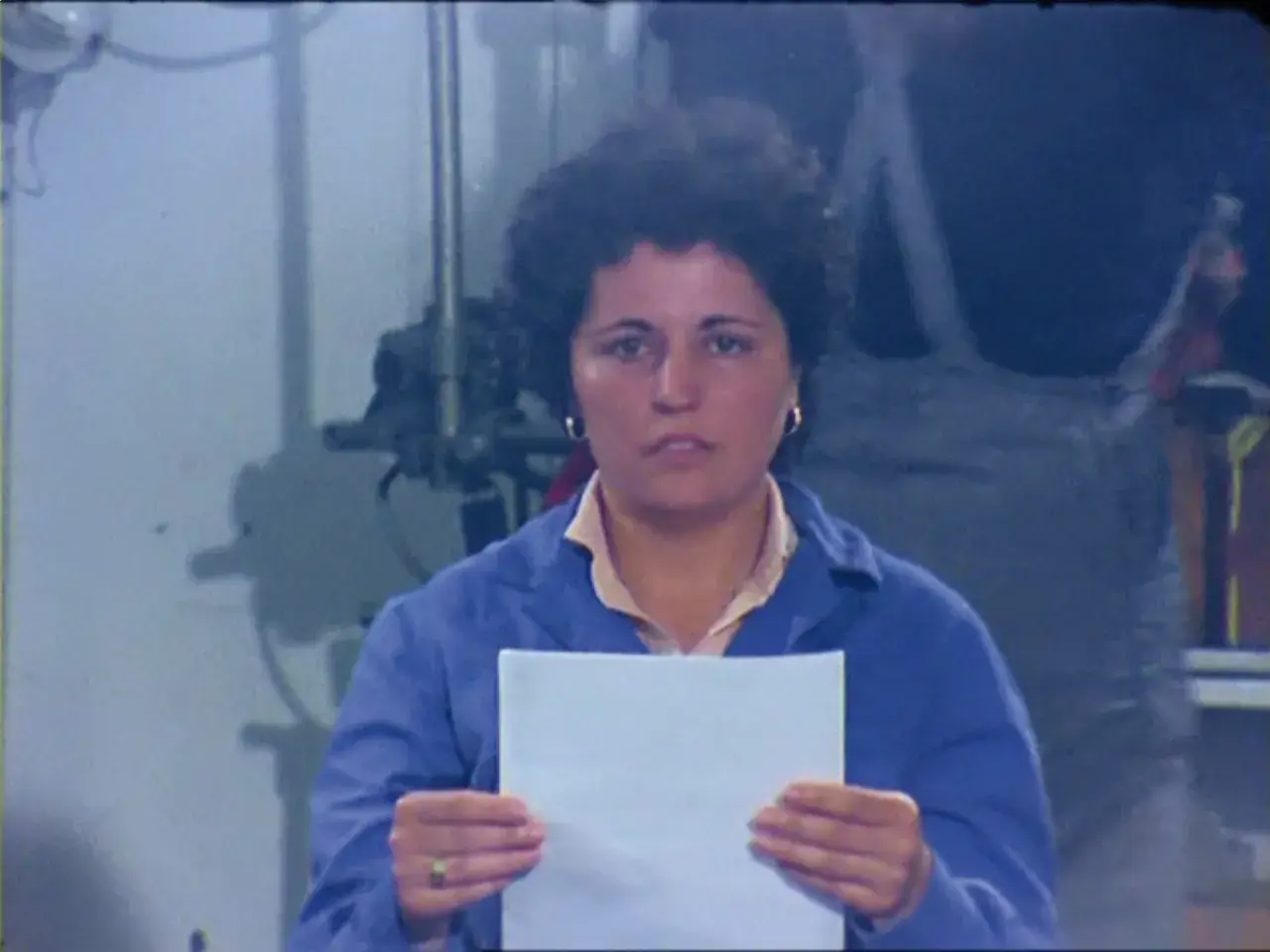
Jordà, Joaquim
Numax presenta…
1979
Single-channel video, b/w, sound, 105 min
MACBA. Museu d’Art Contemporani de Barcelona. MACBA Foundation
© Heir of Joaquim Jordà (Maria Antònia Madroñero)In 1979, Joaquim Jordà filmed a documentary about the employees in the Numax home appliance factory, who occupied and managed the factory on their own for two years, from 1977 to 1979, in response to and as a protest against its forced closure by the owners, two Germans who had supported Nazism and who had fled to Barcelona in the nineteen fifties. Numax presenta… became a testament to the transition to a democracy that had betrayed the working class’s aspirations for social change. The history of resistance in the Numax factory is that of a labour movement that aspired to a transformation of the political and social system after Franco’s death.
-
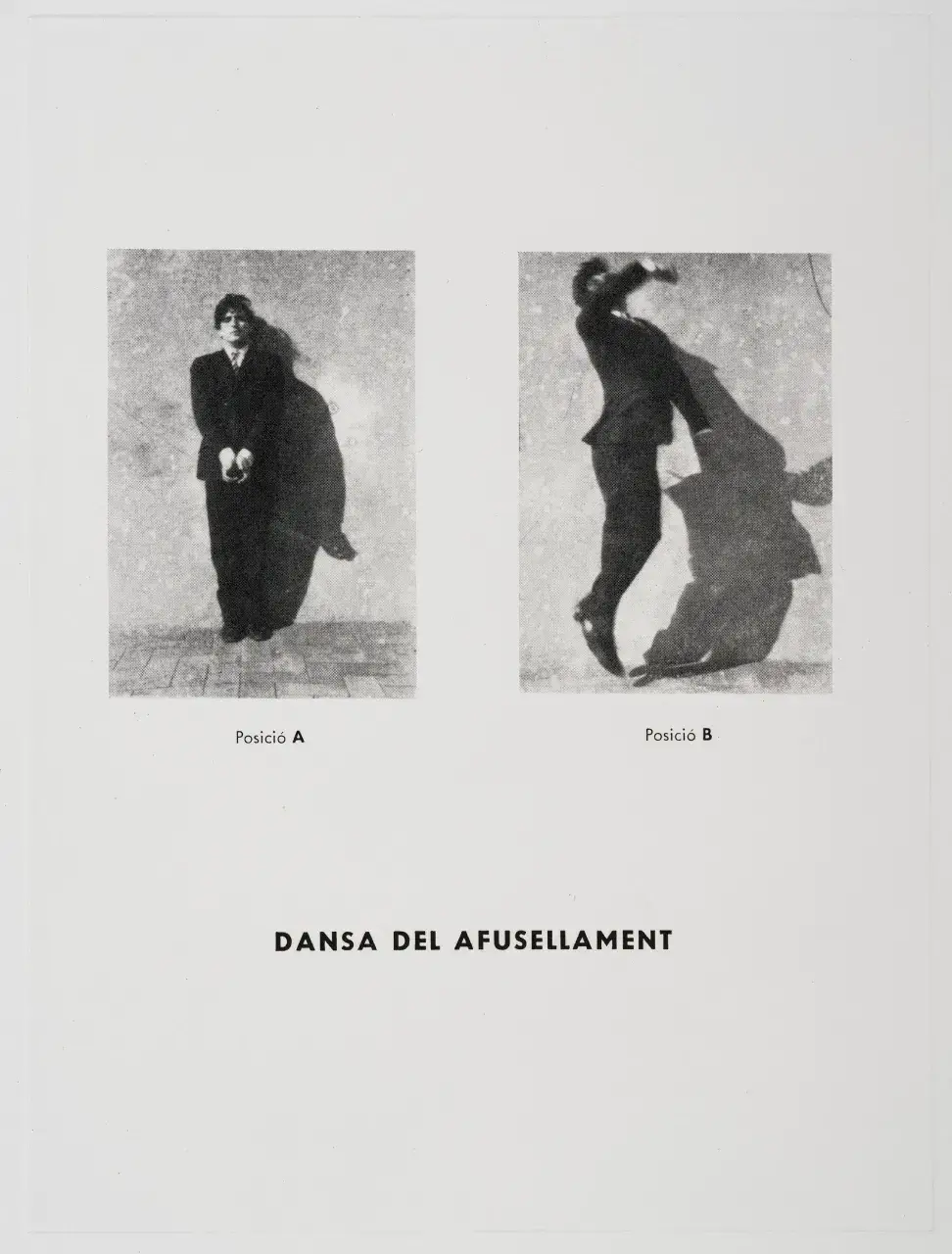
Gonçal Sobrer, The Firing Squad Dance, 1966 (2023 print run)
Museu Nacional d’Art de Catalunya (MNAC)
Donation by the artist, 2023
© The artist or their heirs“When I was young, from my bedroom at night, I heard the trucks that passed loaded with people; I could hear the gunshots day and night”, confessed Gonçal Sobrer, who acknowledged that this had a major impact on him. His dance, staged at Camp de la Bota, is a rejection and at the same time a form of resistance to forgetting what happened there.
-
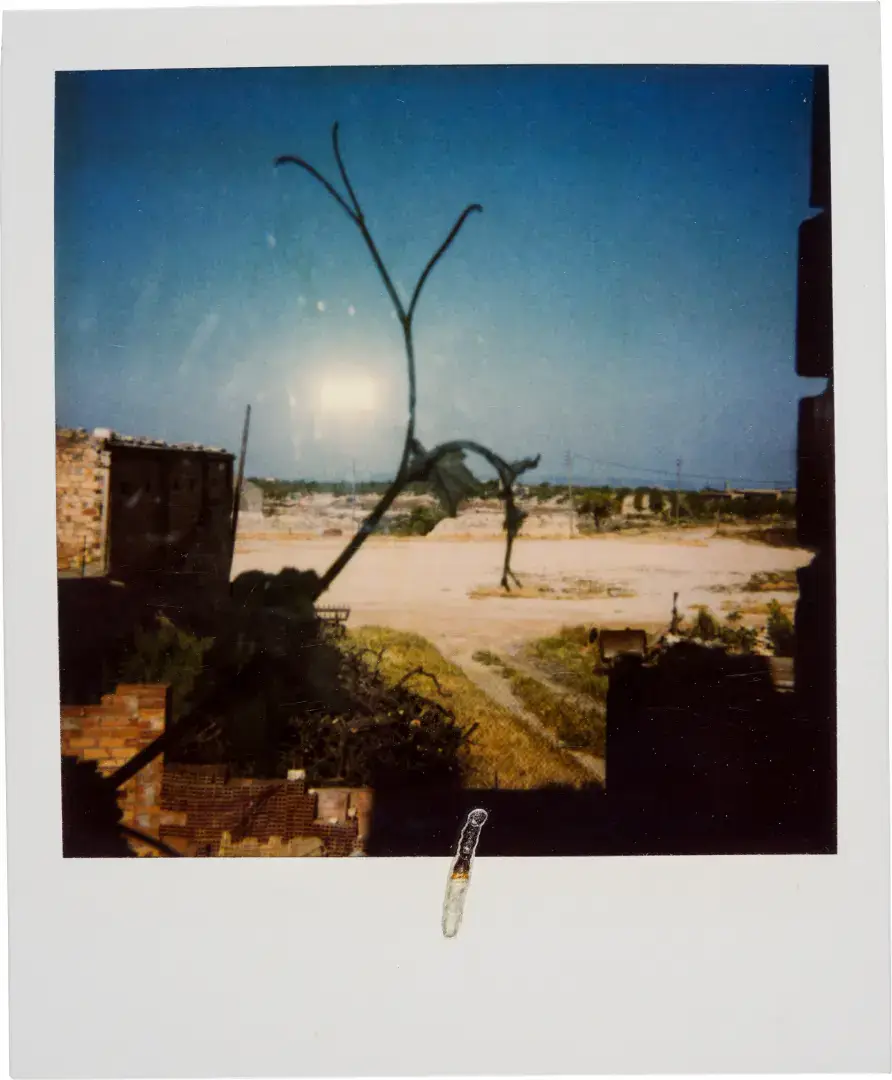
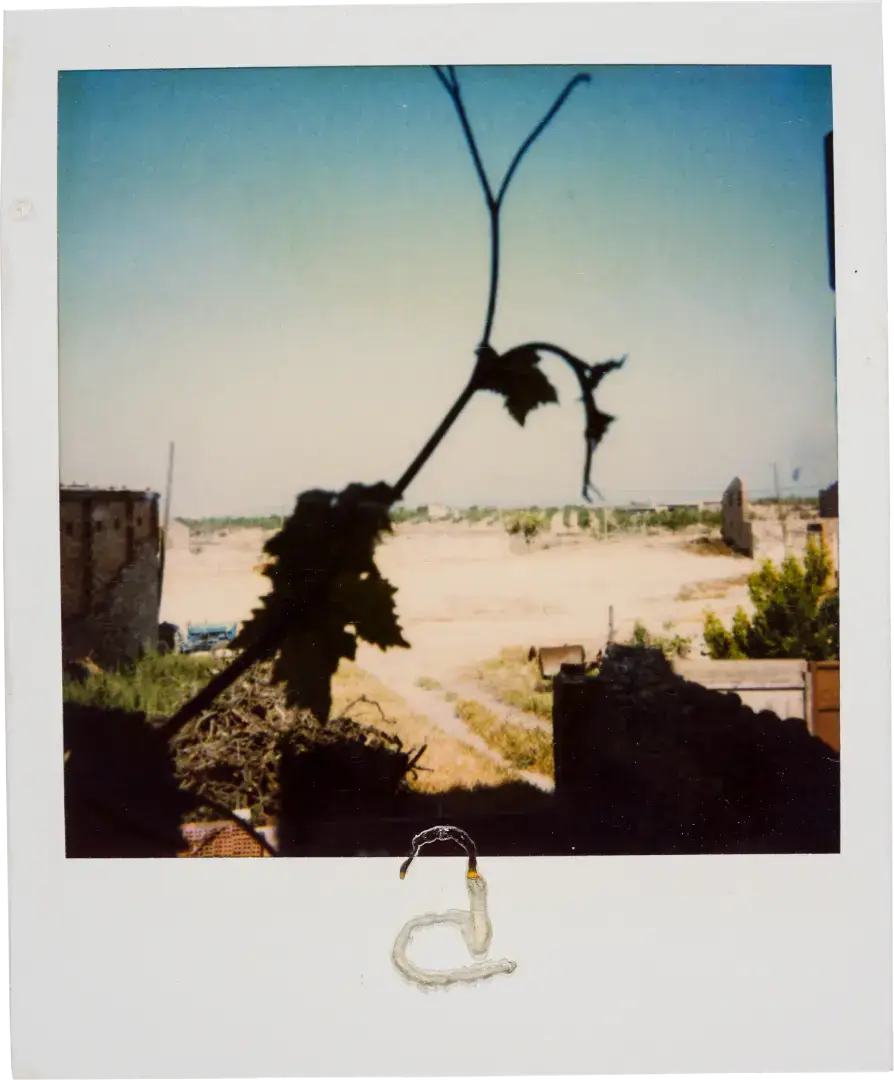
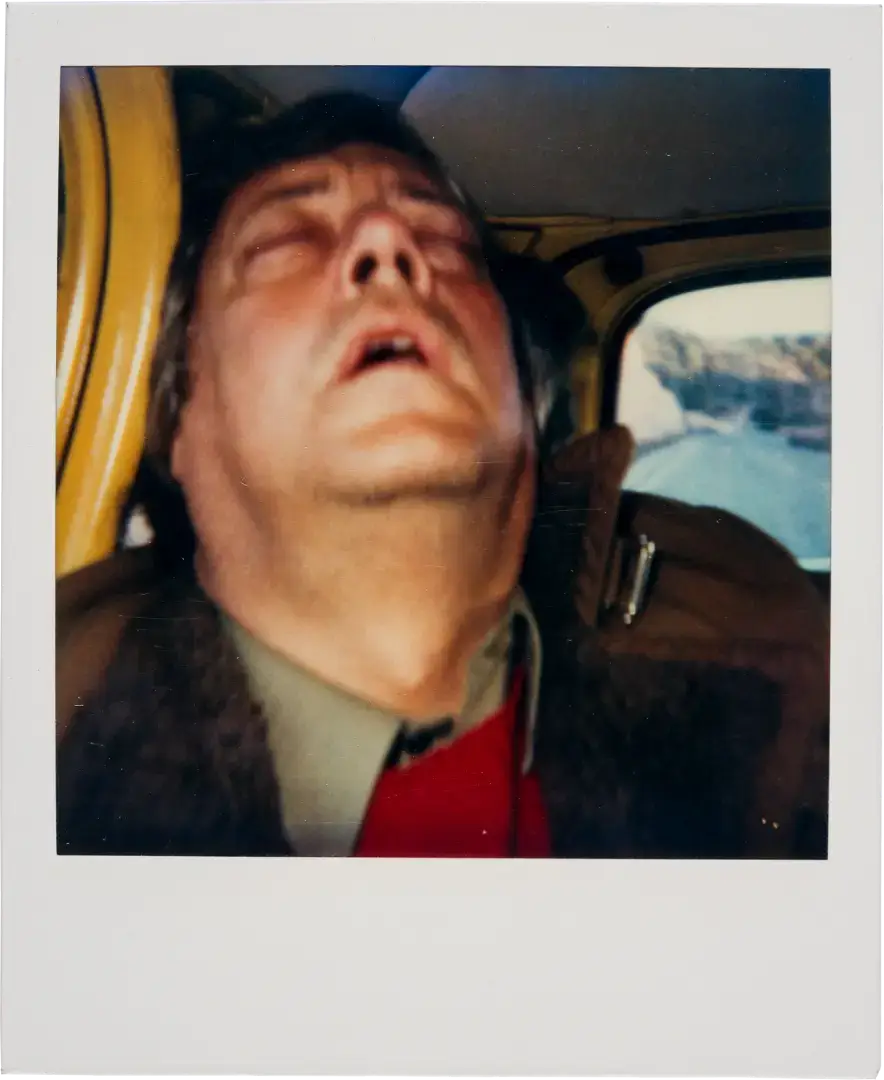
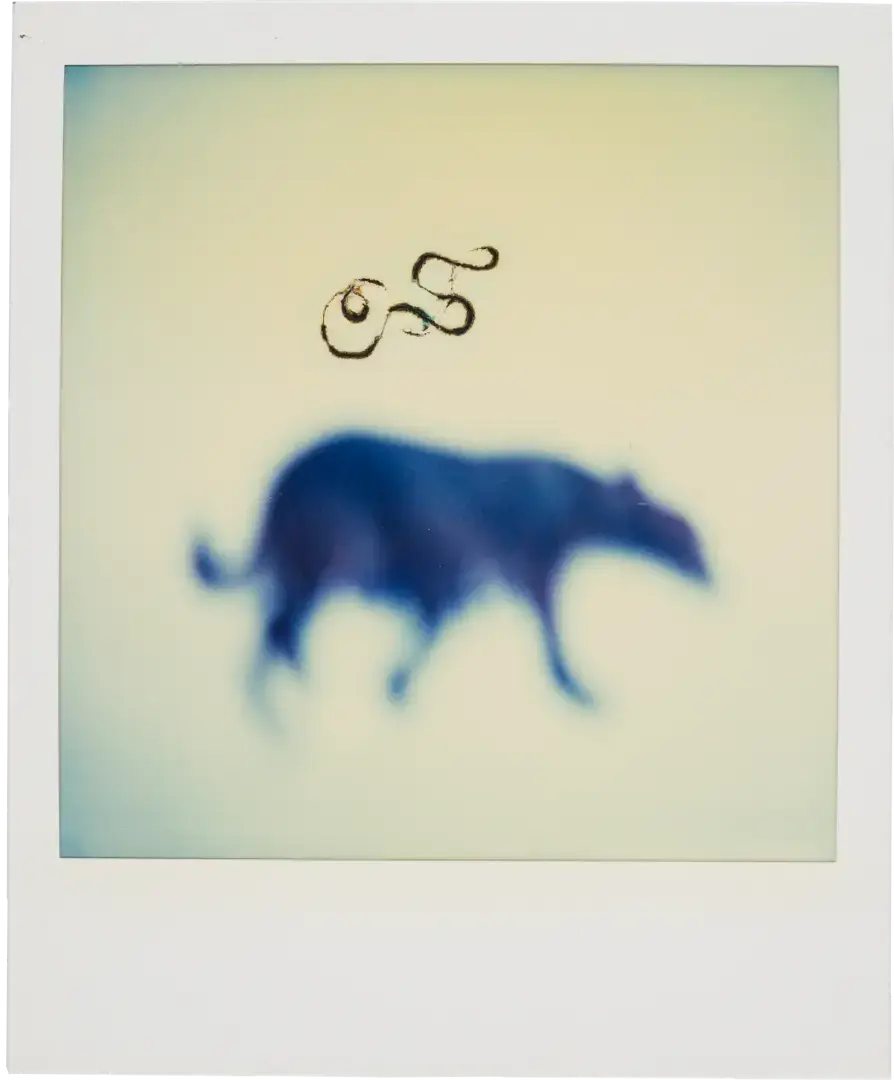
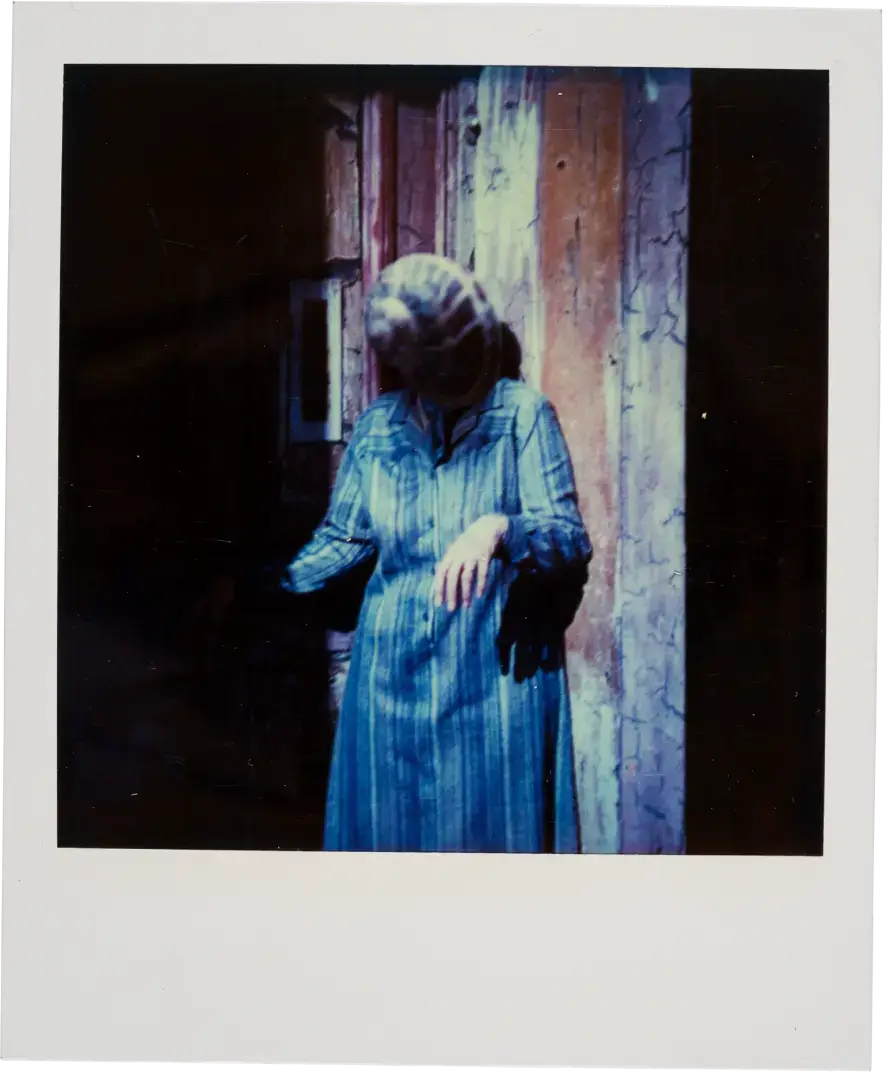
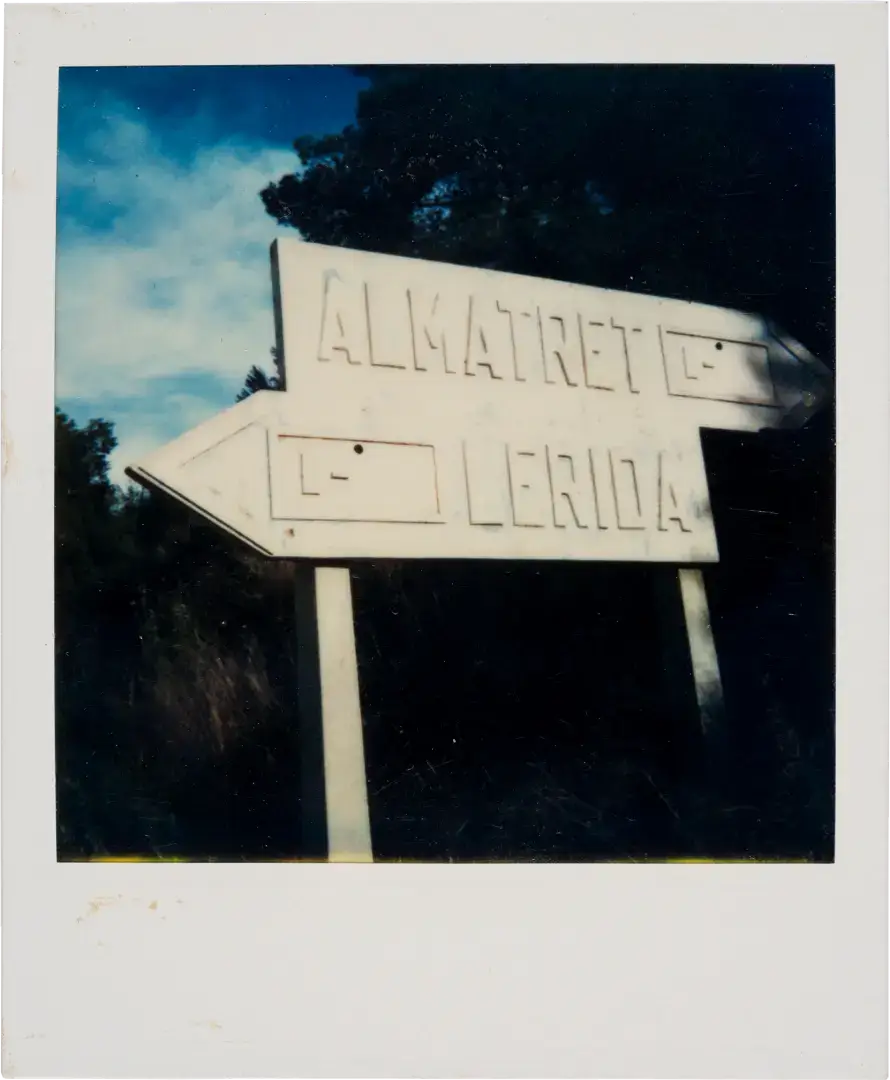
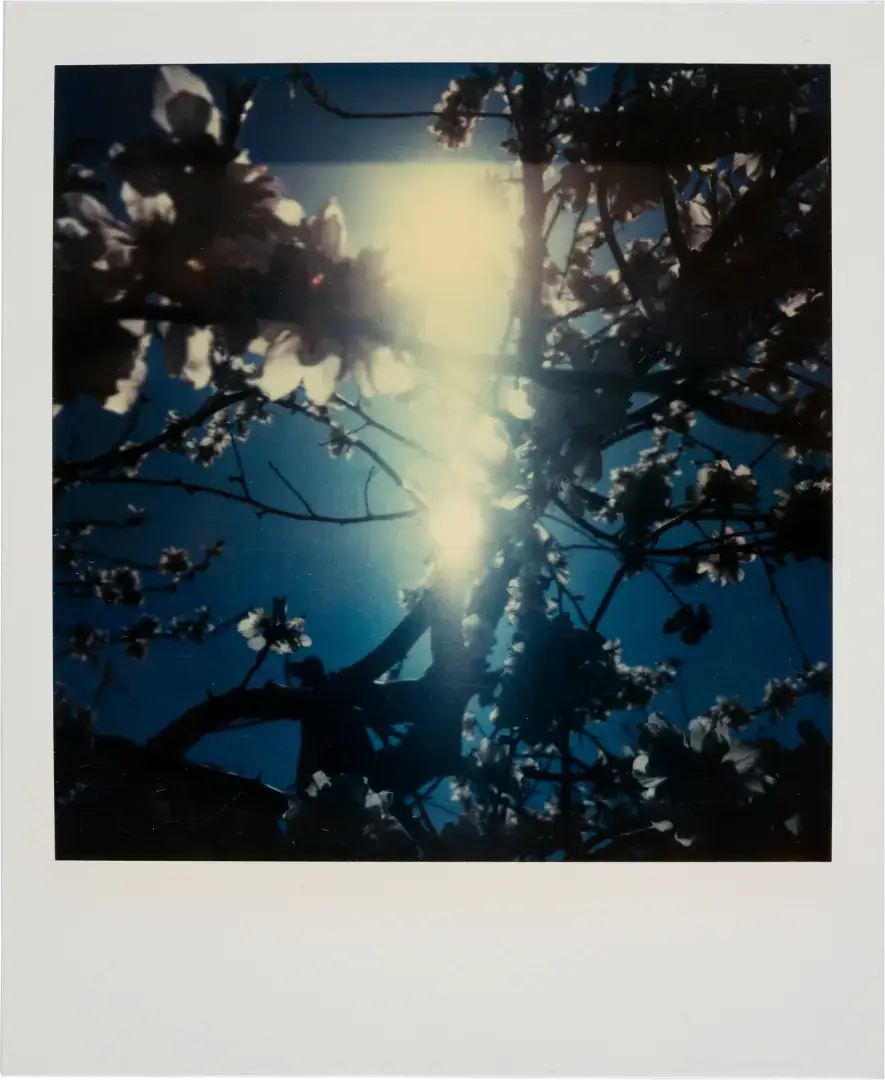
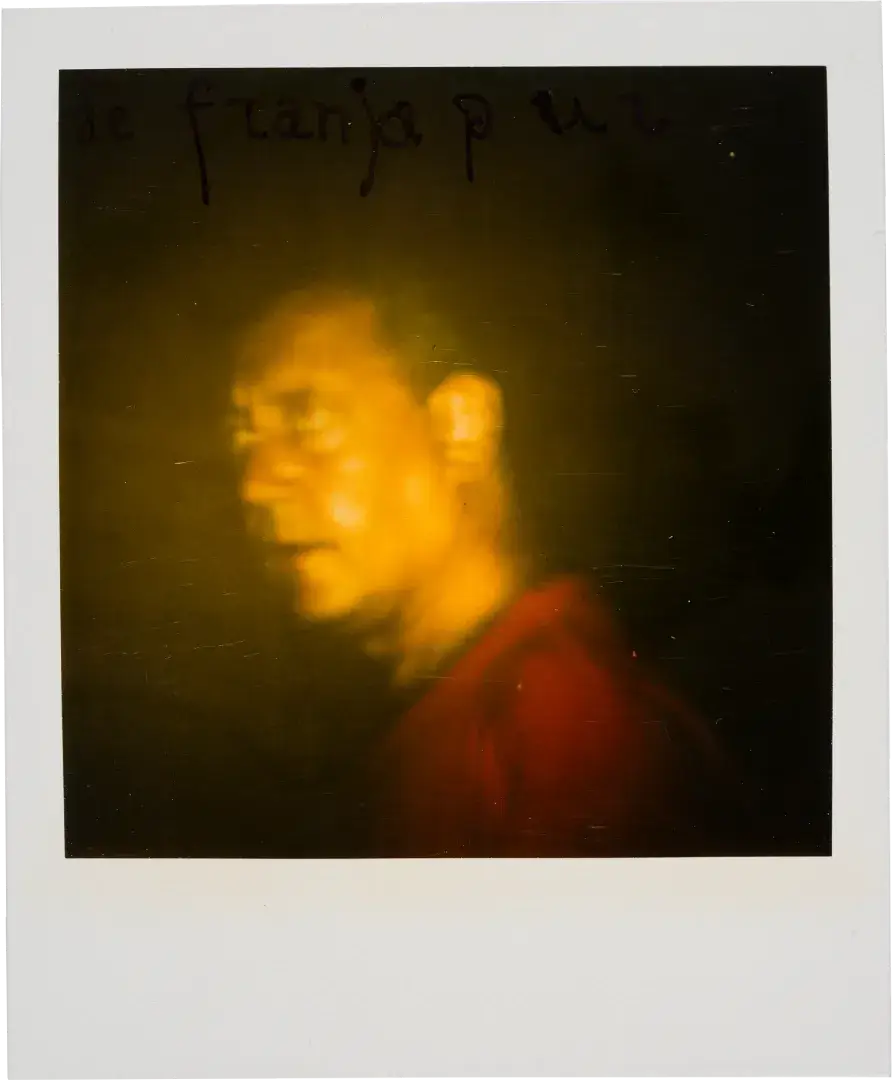
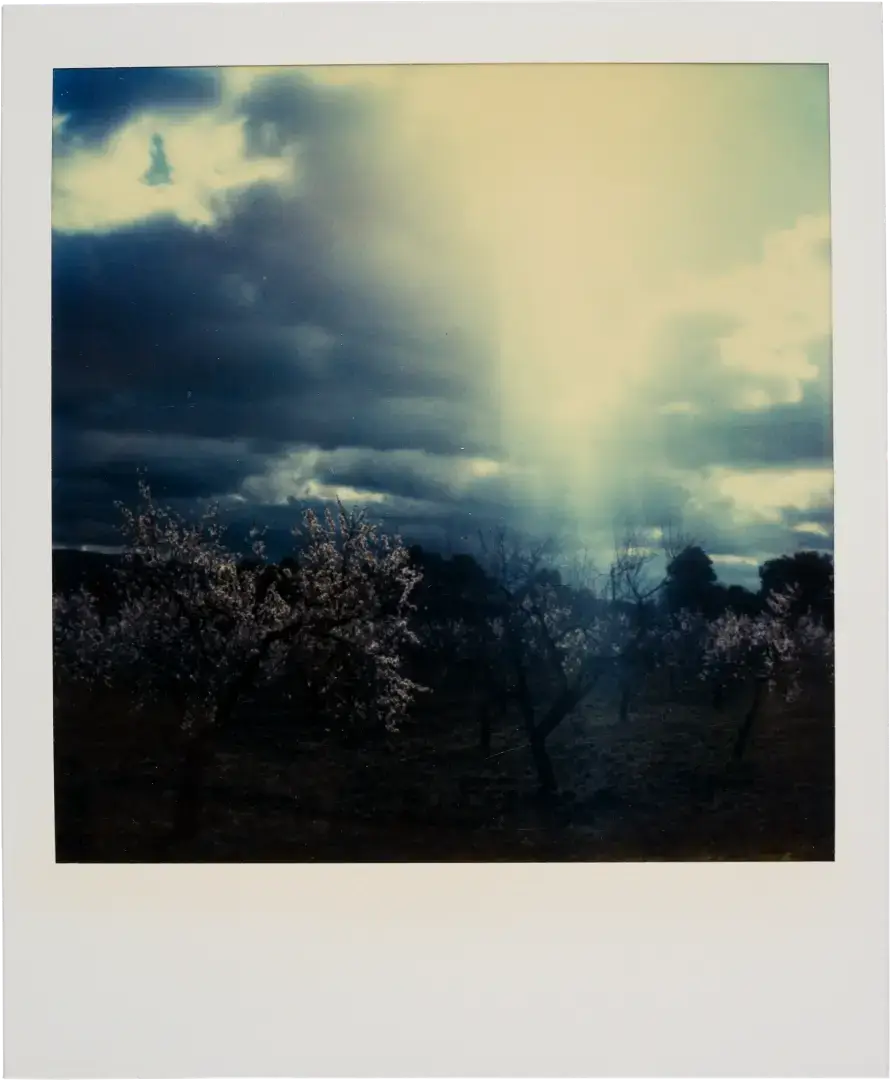
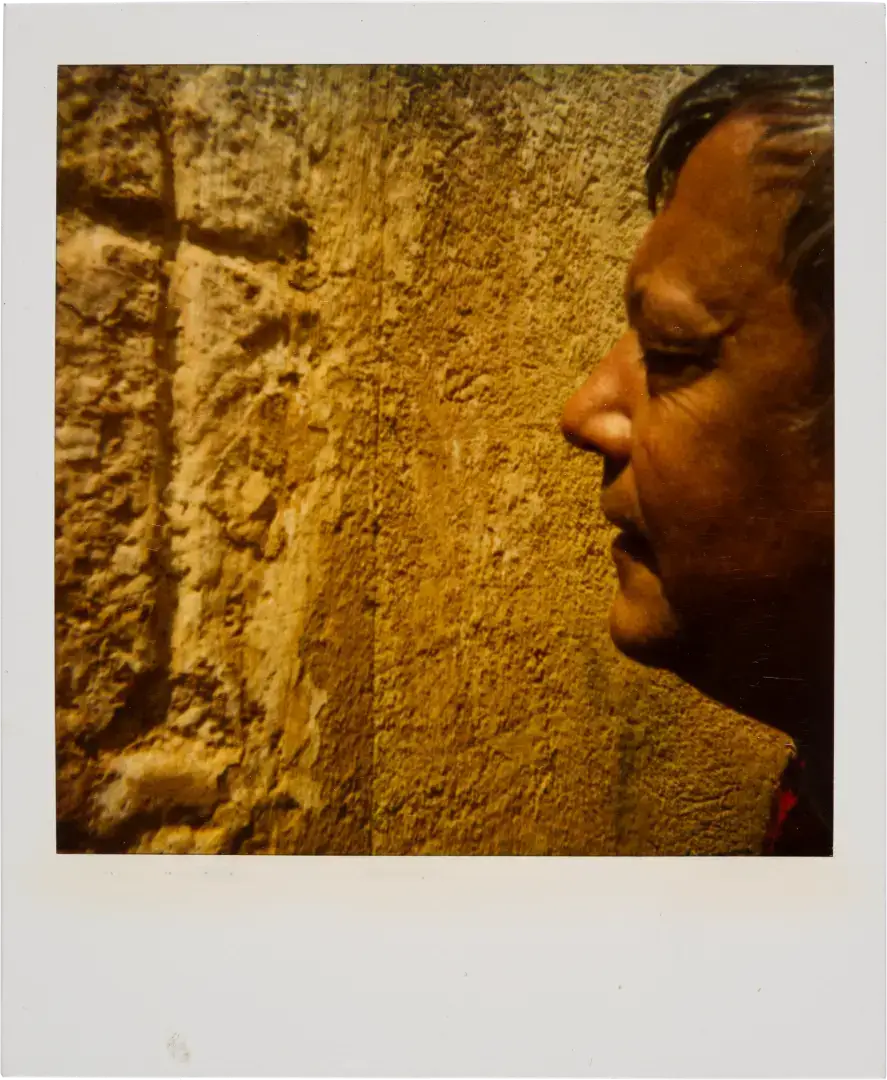
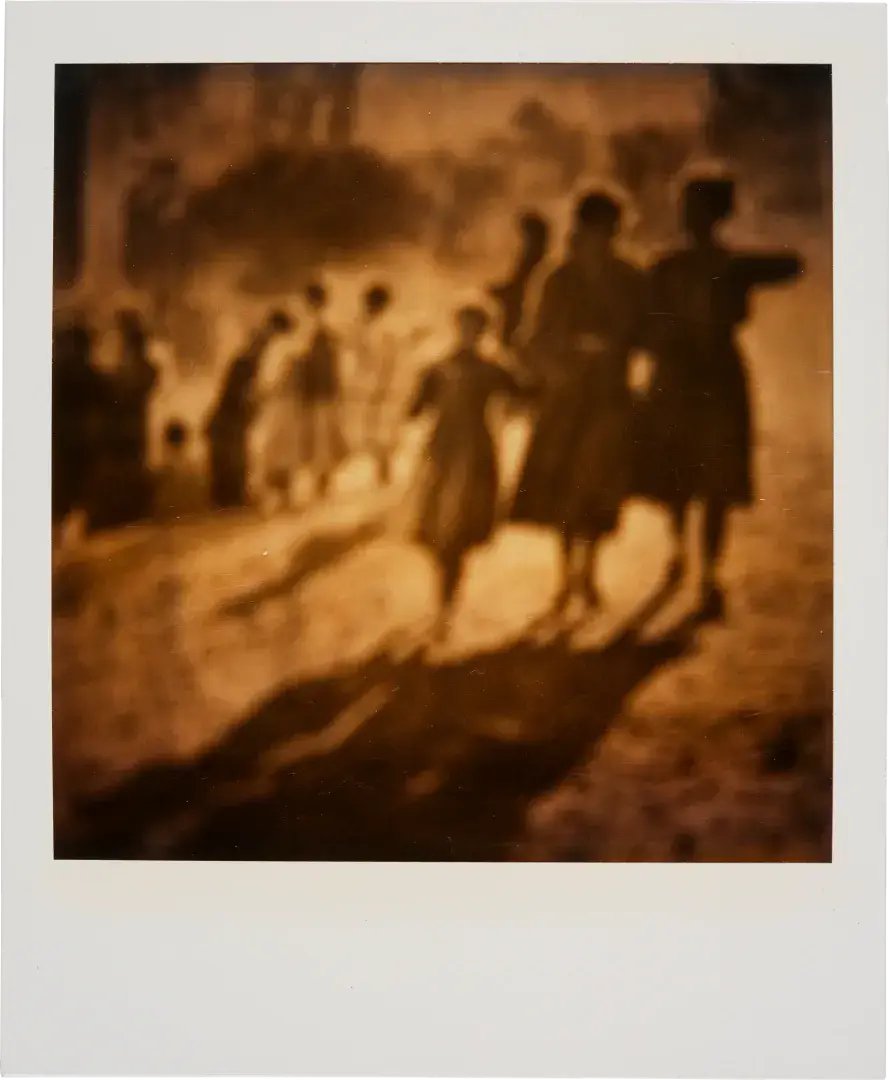
Àngel Jové, Polaroids (The Country of Maialussa), 1989
Colour Polaroid photographs, 10.5 x 8.5 cm
MORERA. Museu d’Art Modern i Contemporani de Lleida
Long-term loan from the Generalitat de Catalunya. National Contemporary Art Collection, 2022In 1989, Carles Hac Mor, Benet Rossell and Àngel Jové took a trip through the lands of La Franja and the south of Ponent. On this ten-day journey through the towns and countrysides of the counties of les Garrigues, el Segrià, el Baix Cinca, el Matarranya and l’Urgell, they aimed to carry out a series of anthropological, ethnographic, and linguistic studies through art, literature, and video. The resulting journey was almost a rite of initiation for the three artists which took shape in the project entitled “The Country of Maialussa”; a mythical land, a mental space, but also a concrete geographic and linguistic space, with a precise, delimited geography.
In the words of Maria Josep Balsach: “Images frozen in moments of travel suspended in an uncertain place and time. A land that is non-existent, yet still present in the reality of the borderlines of the Ponent: figures and faces charred by the sun and by the years, flocks, and ruined churches. Olive trees and ridges of blackened dust from the dry, earthy, rough land. Jové always places us within images that link memory and anti-memory, dream and reality, emptiness, and presence”.
-
-
-
-
-
-
-
-
-
-
-
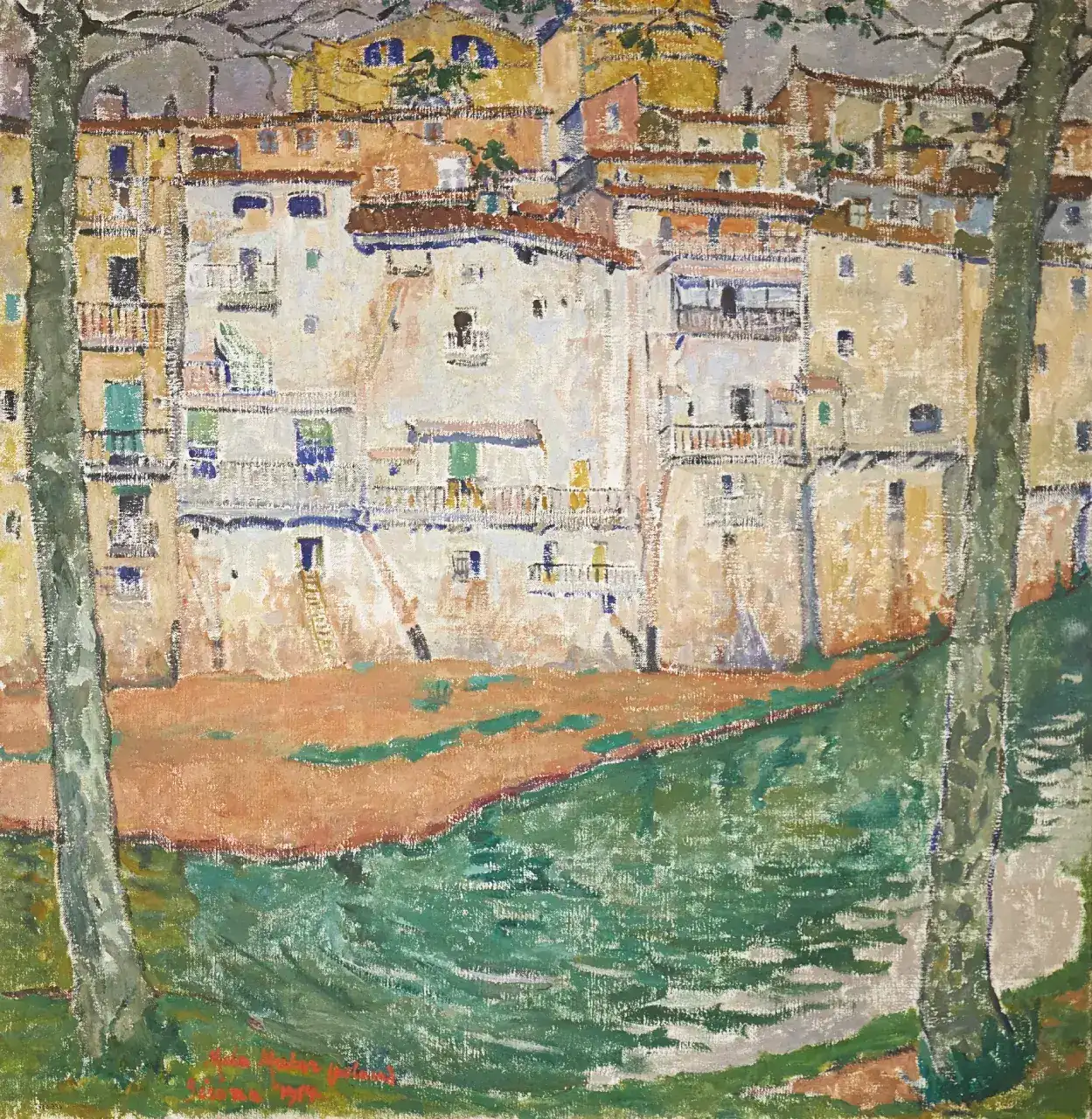
The Onyar in Girona, 1914
Mela (Maria Melania) Mutermilch
Oil on canvas, 100 x 100 cm
Registry No. 250.336
Museu d’Art de Girona
Fons Diputació de GironaUnder the pseudonym Mela, Melania Mutermilch was one of the first Polish women who worked as painters. Settled in Paris since 1901, she became a key figure of the avant-garde movements of the nineteen twenties and thirties. In 1914 she was invited to exhibit at the Sala Athenea in Girona. Three years previously she had exhibited at the recently opened Galeria Dalmau in Barcelona with notable success. Having moved to Girona for a short period of time, her time in the city entailed a change in her artistic practice, as that is where she painted her best landscapes, according to the artist’s own words. This view of the Onyar houses, painted from an uncommon perspective, comes from that era.
-
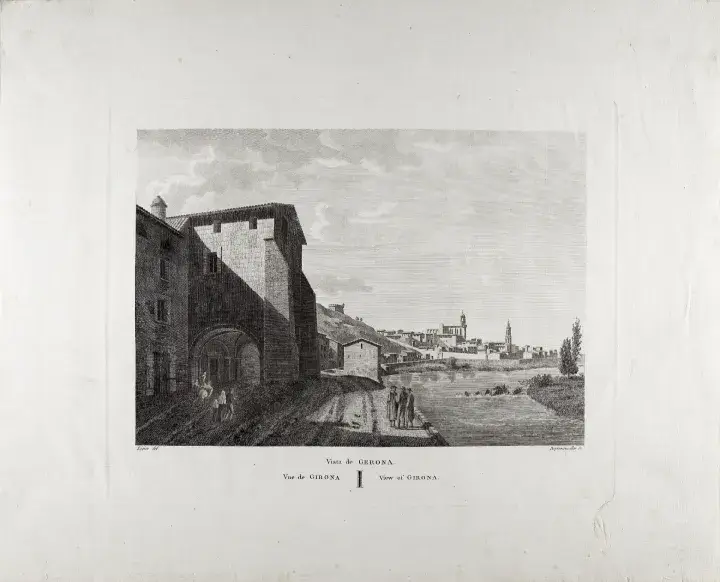
View of Girona, 18th century
Jean François Ligier
Etching on paper, 22 x 44.5 cm
Registry No. 251.834
Museu d’Art de Girona
Fons Diputació de Girona -
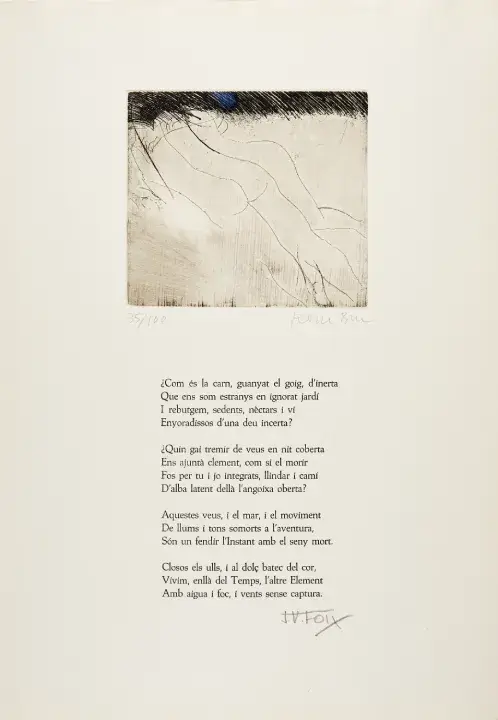
How lifeless is the body after pleasure… (Five poems, five etchings, first collection), 1979
Roser Bru Llop (engraver), Miquel Plana i Corcó (printer), Josep Vicenç Foix i Mas (J.V. Foix)
Etching on paper, 15.2 x 16.7 cm
Registry No. 131.098
Museu d’Art de Girona
Fons Diputació de Girona -
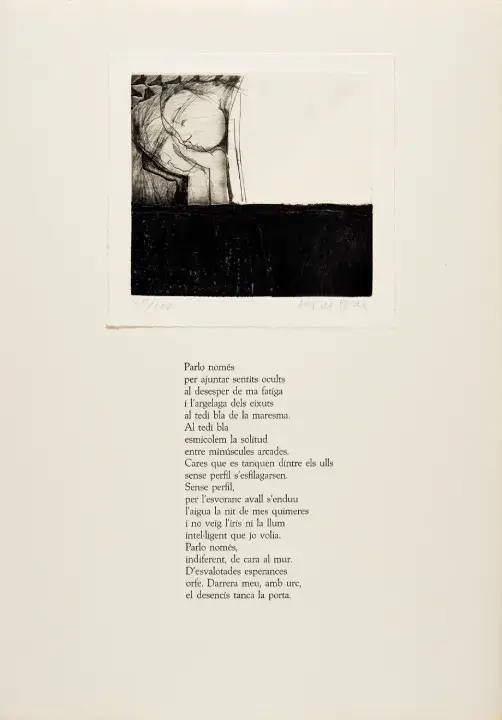
I speak only… (Five poems, five etchings), 1981
Roser Bru Llop (engraver), Miquel Plana i Corcó (printer)
Etching on paper, 19 x 19.7 cm
Registry No. 131.101
Museu d’Art de Girona -
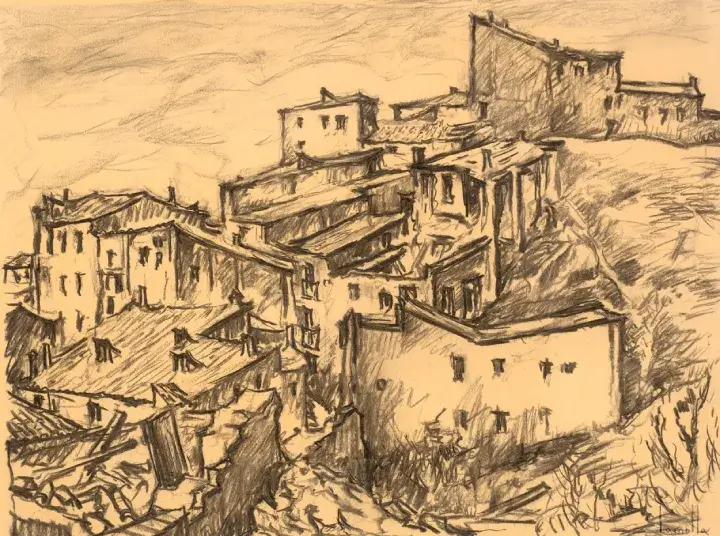
Antoni Garcia Lamolla, View of El Canyeret, c. 1960
Charcoal on paper, 45 x 60 cm
MORERA. Museu d’Art Modern i Contemporani de Lleida, 0582
Donation by Yolanda Garcia-Lamolla, 1982 -
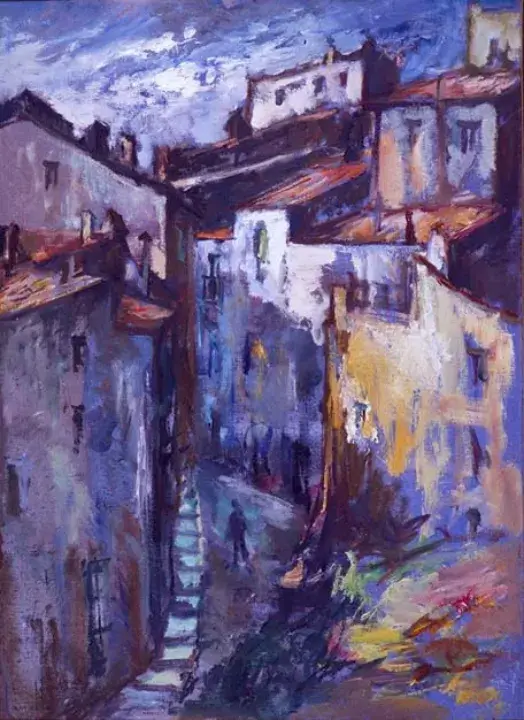
Antoni Garcia Lamolla, View of El Canyeret, c. 1960
Oil painting on canvas, 71.8 x 53 cm
MORERA. Museu d’Art Modern i Contemporani de Lleida, 0583
Donation by Yolanda Garcia-Lamolla, 1982 -
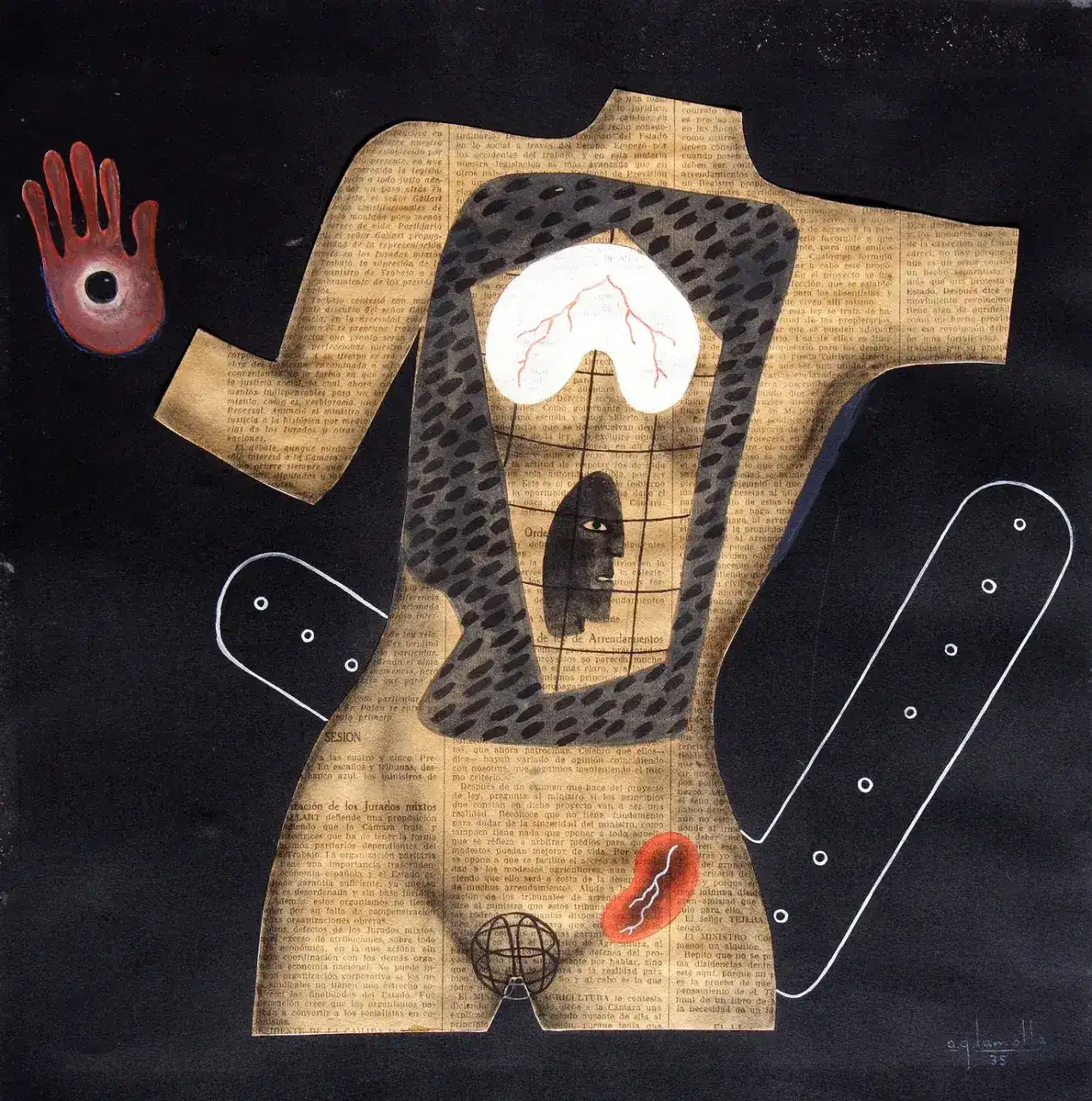
Antoni Garcia Lamolla, Diary of a psychoanalyst, 1935
MORERA. Museu d’Art Modern i Contemporani de LleidaIn 1935, Lamolla tried out a singular work compared to the rest of his pictorial production. The splendid collage entitled Diary of a psychoanalyst owes to a fully subversive approach compared to his entire previous oeuvre, although afterwards he would find no continuity in his work, as it would follow fully pictorial paths. This piece is indebted to the papiers collés created by Cubist painters, who stuck flat pieces of paper, fabric and more on paintings with the shape of the object they wished to represent. The seemingly innocent act of including a piece of newspaper as a motif that generated and structured the work, which represented an absolute innovation in Lleida at the time, involved introducing a reality from the outside world within the painted reality of the work. This intrusion became revolutionary, not because of its disconcerting nature, but rather due to what it means to appropriate reality and turn the work itself into an object made of objects.
-
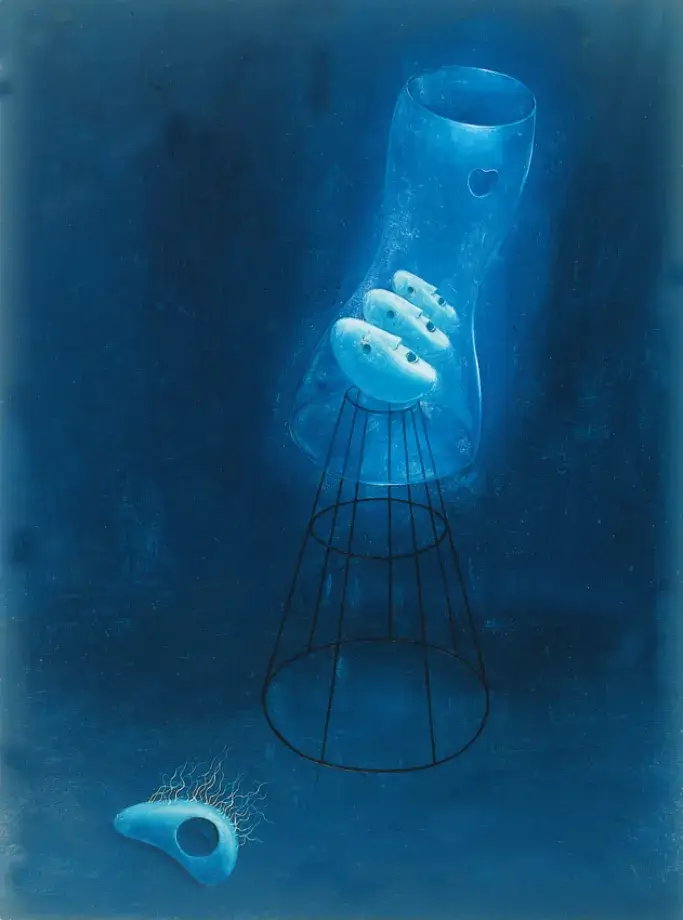
Antoni Garcia Lamolla, The spectre of the three graces within a subtle aura, 1935-1936
Oil on cardboard, 49 x 37 cm
MORERA. Museu d’Art Modern i Contemporani de Lleida, 3481
Acquisition, 2012Lamolla joined this group of artists, although the radical subversion of his representation, in line with the postulates of surrealism that challenged many of the received “truths” throughout history about the creation of visual beauty, proposed a shift from what is visible to what is invisible, from figurative elements to spectral ones.
-
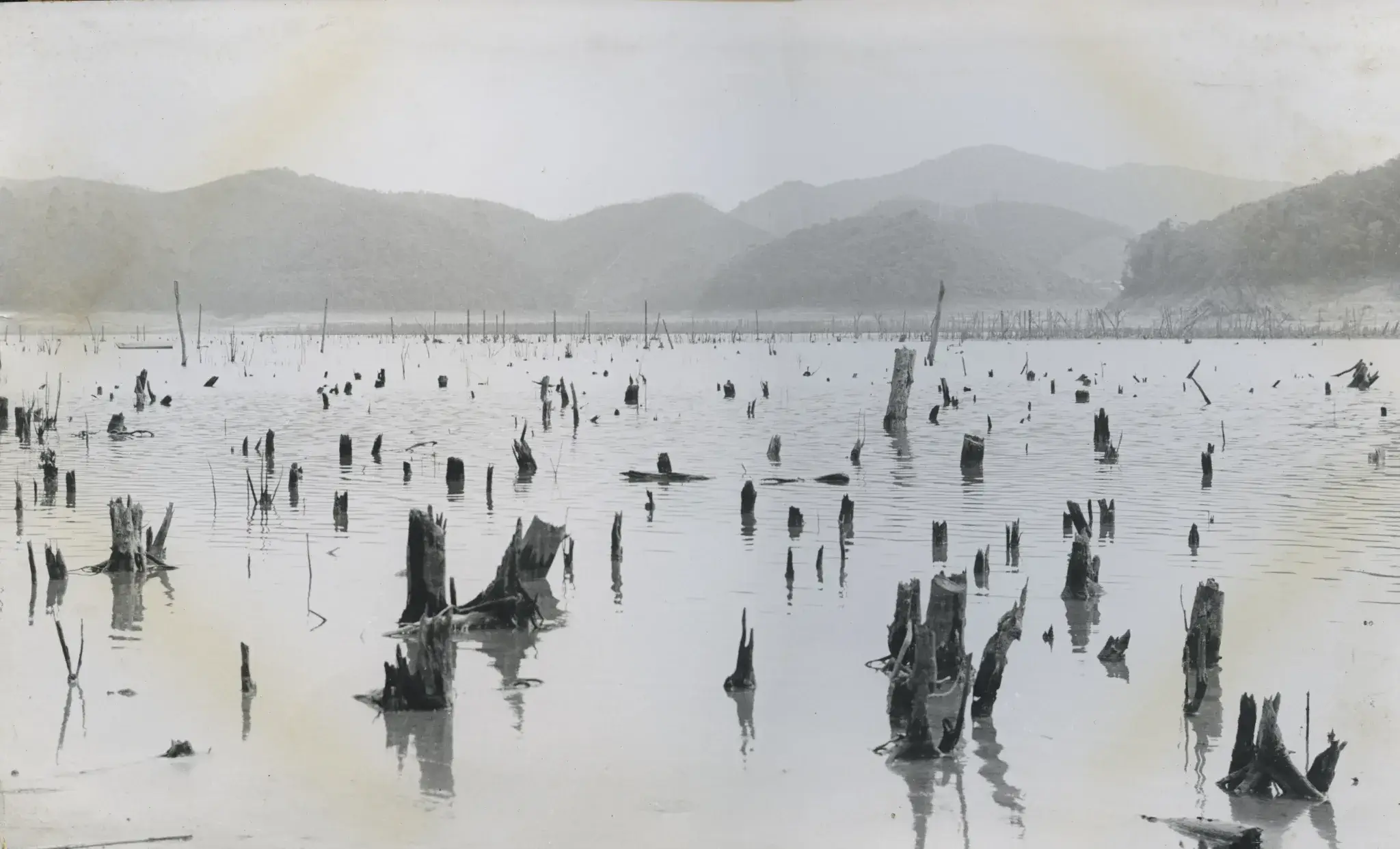
Palmira Puig, Desolation, c. 1950
Black and white photograph, copy from the era, 20 x 40 cm
MORERA. Museu d’Art Modern i Contemporani de Lleida, 4874
Long-term loan from the Generalitat de Catalunya. National Photography Collection, 2021 -
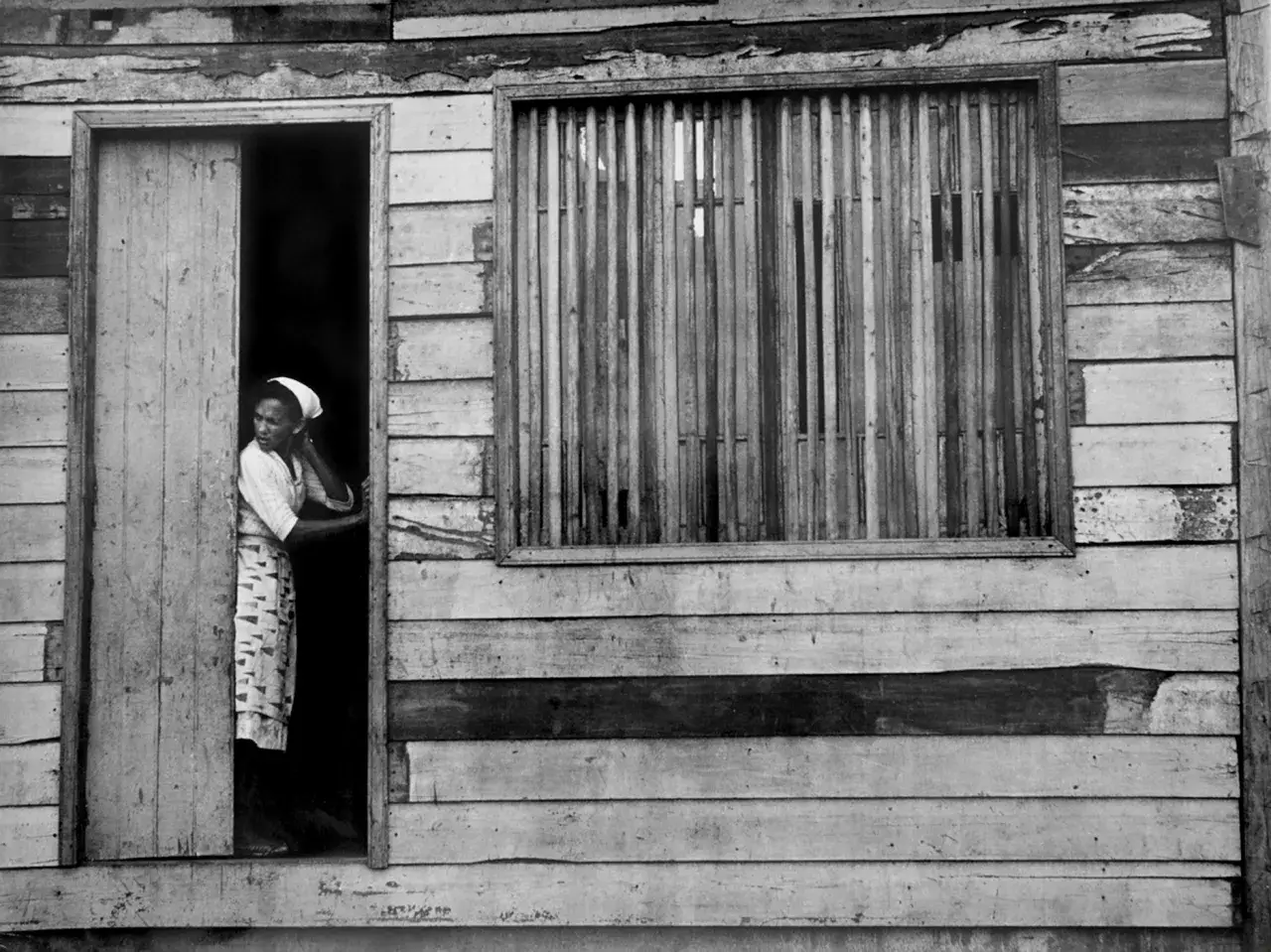
Palmira Puig, Waiting for my daughter, c. 1950
Black and white photograph, later copy, 30 x 40 cm
MORERA. Museu d’Art Modern i Contemporani de Lleida, 4967
Transfer by the Diputació de Lleida, 2022
Exiles without refuge
(large migrations without an end in sight)
“I had to leave my home to be able to find myself, to find my own intrinsic nature, buried beneath the personality that had been imposed on me. (…) But I did not abandon every aspect of myself: I stayed true to my own roots”
⏤ Gloria Anzaldúa
More than ten million people in the world are not recognised as citizens of any country. This reality leaves them in an extremely vulnerable situation. Thousands of these individuals live closer to us than we imagine.
What do the writer Gioconda Belli, a Kosovar gypsy, a Kurdish woman from Syria and a Sahrawi man have in common? All of them are, or have been at some point, stateless. In other words, they are not recognised as citizens of any country, something which means that they do not have the rights conferred by citizenship. Of course, not all of them fell into this situation in the same way, nor will they be able to get out of it with the same ease. Because class exists even for victims of state oppression.
Statelessness is a circumstance that turns millions of people across the planet invisible and almost non-existent, in many cases throughout their entire lives. In the rich and colonialist Western countries, we do not ask ourselves how we acquire our nationality. We are born and we have it. A stateless person encounters difficulties to work legally and does not enjoy access to education or the healthcare system.
According to figures from the United Nations, there are more than ten million stateless people in the world. The Rohingya population from the west of Myanmar —a Muslim group in a majority Buddhist country— represents the largest group of stateless people in the world. On many occasions, the key is a matter of sex. Twenty-five countries in the world do not allow women to pass their nationality to their children under the same conditions as men. In fact, this is one of the main causes of childhood statelessness.
When the Sahara was recognised as a Spanish province, many Sahrawis acquired Spanish nationality, but later lost it after the territory was relinquished by the Spanish government, thus becoming stateless.
Although not having documentation (i.e. not having papers) is not the same as being stateless, not having a birth certificate entails a risk of statelessness, as birth certificates or records show an individual’s place of birth and kinship, the information required to determine their citizenship.
Being undocumented and living as a citizen with full rights is not possible in the Western world, but being stateless by choice is also difficult, as Núria Güell explains in her work.
-
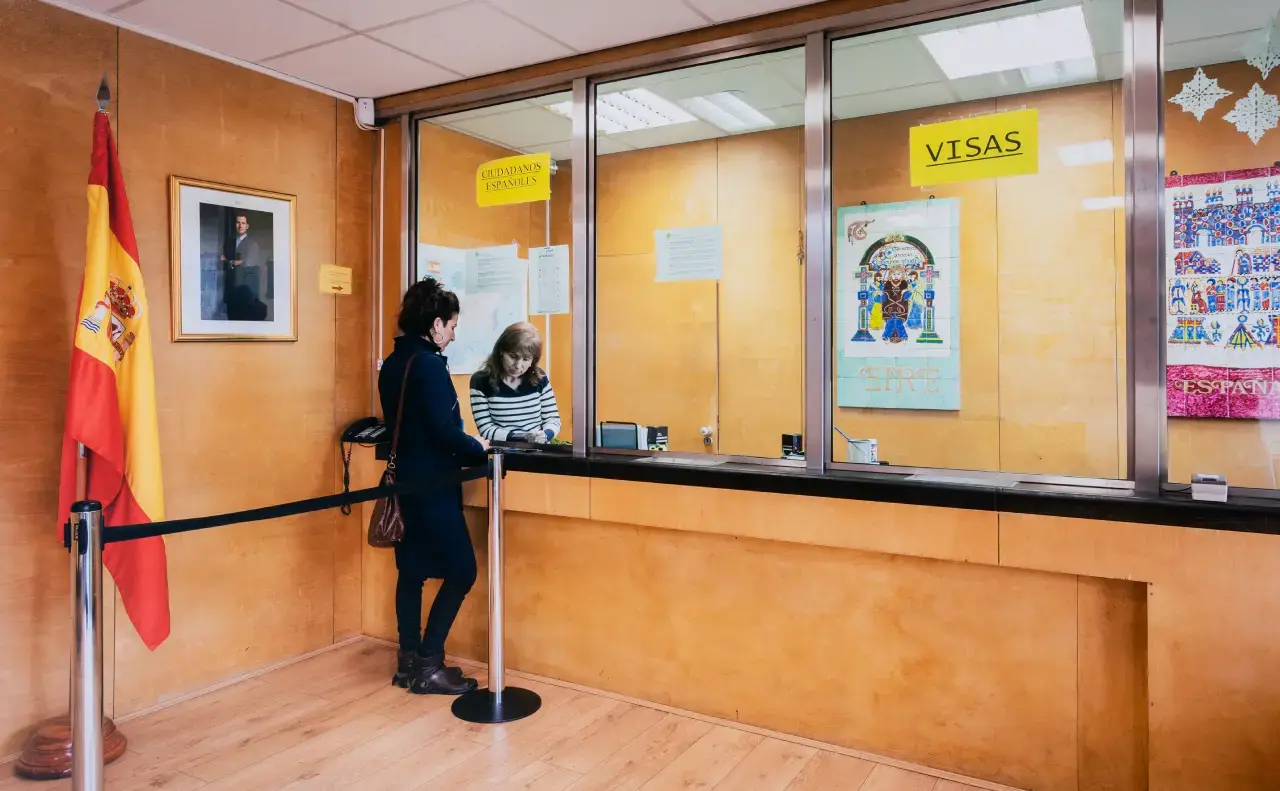
Núria Güell, Stateless by choice, 2015-2016
Colour photograph, 148.7 x 42 cm
MORERA. Museu d’Art Modern i Contemporani de Lleida, 4324
Long-term loan from the Generalitat de Catalunya. National Contemporary Art Collection, 2018The idea for Stateless by choice emerged from the artist’s lack of identification with the nation-state structure and her rejection of nationality as an imposed construction of identity. To give shape to this effort, the artist requested to renounce her Spanish nationality from various state institutions, with the aim of attaining stateless status. The request was summarily denied.
Faced with this rejection, Núria Güell hired an attorney to draft a report based on Spanish law, which revealed that the loss of nationality is only set forth as punishment imposed by the State, and under no circumstances can a person voluntarily renounce it.
-
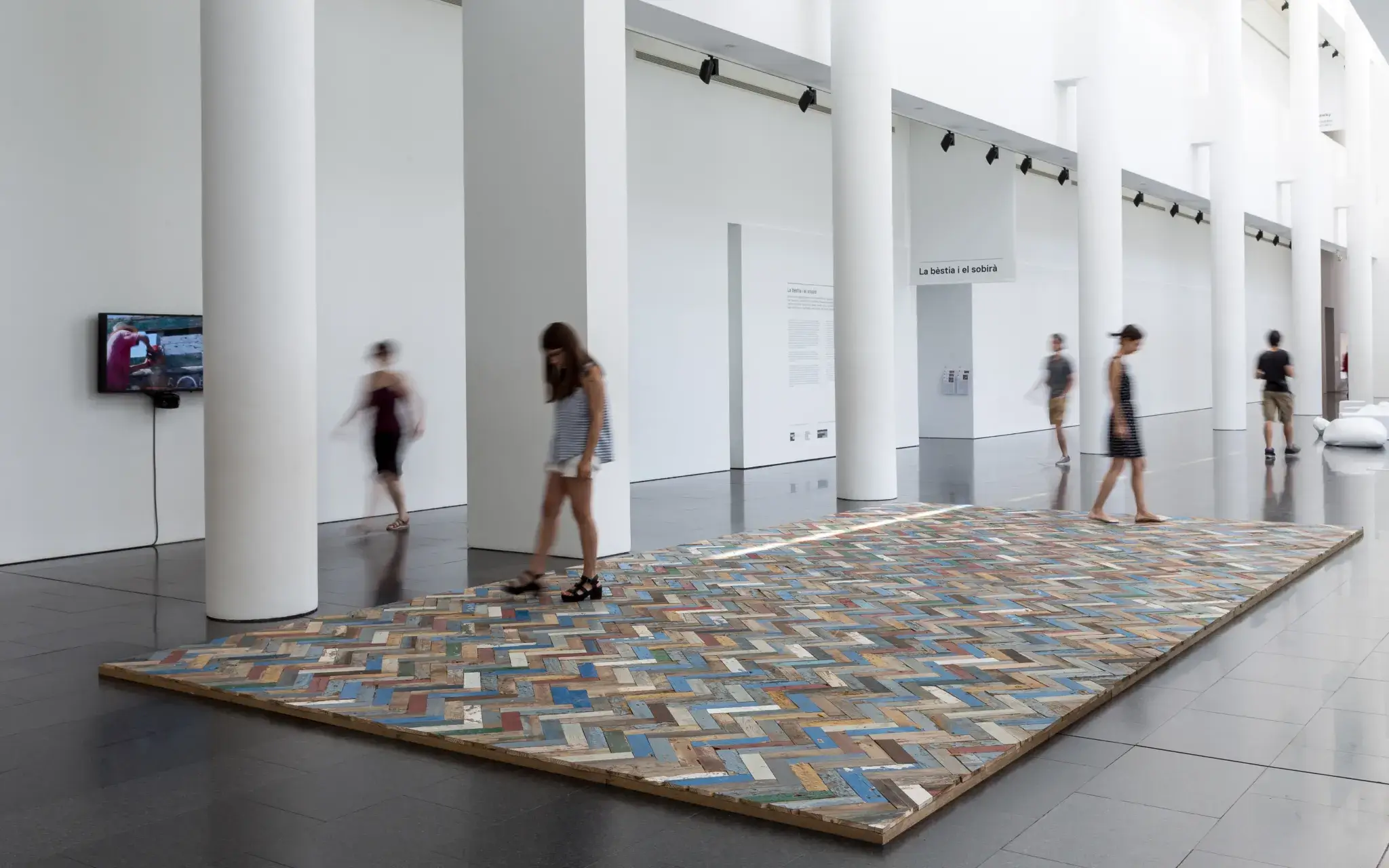
Aires, Carlos
Mar negro (Black Sea)
2013
Recycled wood from illegal dinghies coming from Africa or those found on the coasts of Cádiz
Single-channel video, colour, sound, 6 min 30 s
400 x 800 cm
MACBA. Museu d’Art Contemporani de Barcelona. MACBA Foundation. Work purchased thanks to the Havas Group
© Carlos Aires, VEGAP, BarcelonaMar negro takes collective pain and people’s geographic journeys as the raw material for the work. The piece is a floor made with wooden strips painted in various colours and arranged in a herringbone pattern. But a second element, a video that shows the origin of the wood, shatters any formal reading of the piece, and imbues it with important symbolic meaning. Carlos Aires has used wood coming from the scraps of dinghies and cayucos, or dugout canoes, abandoned on Spanish coasts. Specifically, the artist sought them in a Cádiz ship graveyard, where the vessels used to illegally transport immigrants end up. At the end of the video, viewers hear a subtle sound of a Moroccan radio as a reference to African immigration, reinforced by the title of the piece.
-
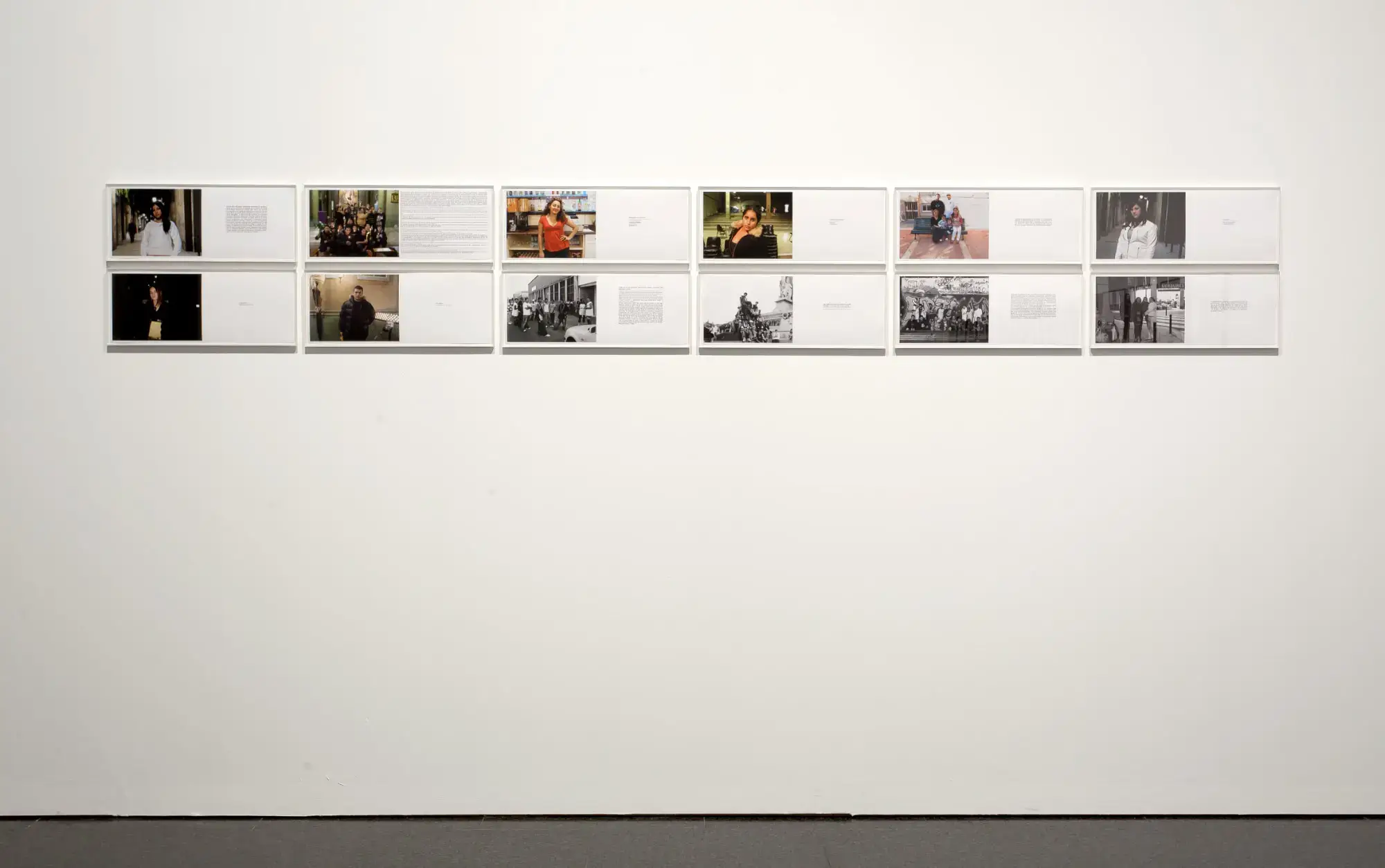
Schoellkopf, Jean-Louis
Document (The Latin Kings)
2007-2010
Inkjet printing on paper
20 photographs: 19 x 49 cm each
MACBA. Museu d’Art Contemporani de Barcelona. MACBA Consortium. Donation by the artist
© Jean-Louis Schoellkopf, VEGAP, Barcelona
Linguistic wounds
(I only have one language, it's not my own)
-We don’t say the same thing, you say.
-Precisely, I say. “Not precisely”.
-We never say precisely the same thing.
-We? Wewho? The one of us? The two of us?
-Always being good though never exactly the same,
the same mixture of beings.
-What’s more there are words that come out imprecisely about everything we are, like webs of piled-up inaccuracies from no-good-beings, especially when we are pushed, when we are dragged to the margins, to the extremes, to the indeterminable confines of the edges.⏤Hélène Cixous
Emotional effects are translated into language; we could call those which come about due to the impact of exile the “wounds of language”.
Referring to his own experience, Francesc Tosquelles, the great psychiatrist from Reus, referred to his way of speaking as a type of Catafranç, a sort of French with a strong component featuring the sounds from his native language. This state of a-structural language, foreign to communication yet so inherent to exile and the essential loss this entails, is present in the same structure of the migrant’s tale.
Jaques Derrida and Hélène Cixous, in Langue à venir, from 2004, work on the effects of language in relation with sexual difference and the issues of postcolonial social exclusion. Language in exile thus becomes a symptom; it leaves a trace, just like in the complex linguistic variations that occur in the literature of authors impacted by migrations and the terrible experiences of war, such as the works by Paul Celan, Cixous herself and Gloria Anzaldúa.
This way, language emerges as a need for coherence and transmission in the speech of migrants and their valiant struggle for individual survival, which inevitably seeks to preserve the nature of one’s identity.
-
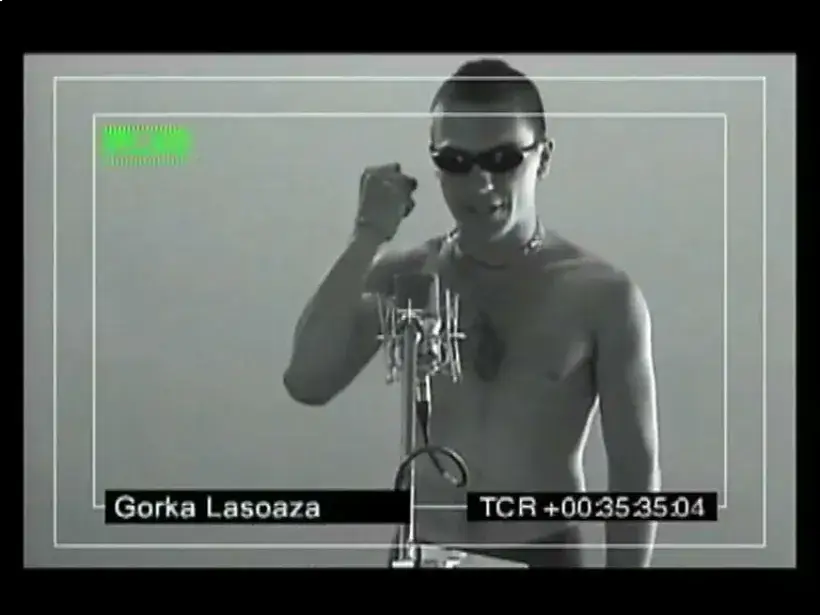
Fusco, Coco
The Reapers
2001
Single-channel video, colour, sound, 21 min 57 s
MACBA. Museu d’Art Contemporani de Barcelona. MACBA Foundation. Work purchased thanks to Taller de la Fundació
© Coco Fusco, VEGAP, Barcelona -
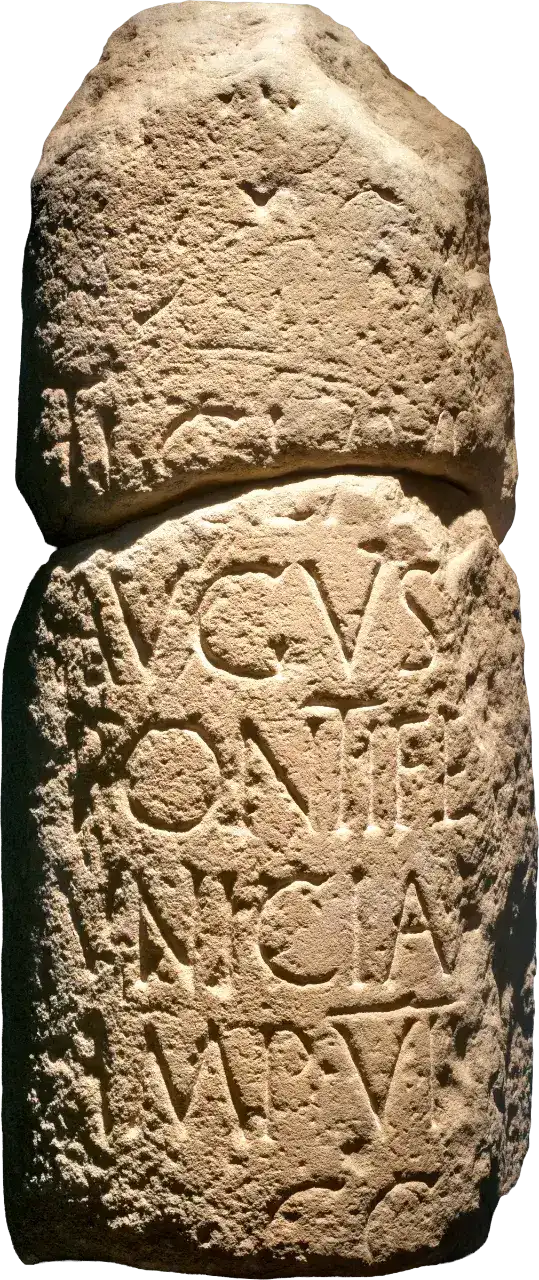
Miliarium, inv. 3398
1st century C.E. Roman High Empire
Limestone
128 x 49 cm
Part of a miliarium (the base and the lower part of the column are missing)
Museu de LleidaMiliaria were used in Roman times to let travellers know where they were on their route, though they were also used as propaganda tools for the emperor who had built or repaired the road. In this case, the miliarium was found in the Vallbona area of Tamarit de Llitera, in La Franja. Based on the inscription we know that it was built in 43 C.E. during the reign of Claudius, and that travellers were 246 miles away from a reference location.
-
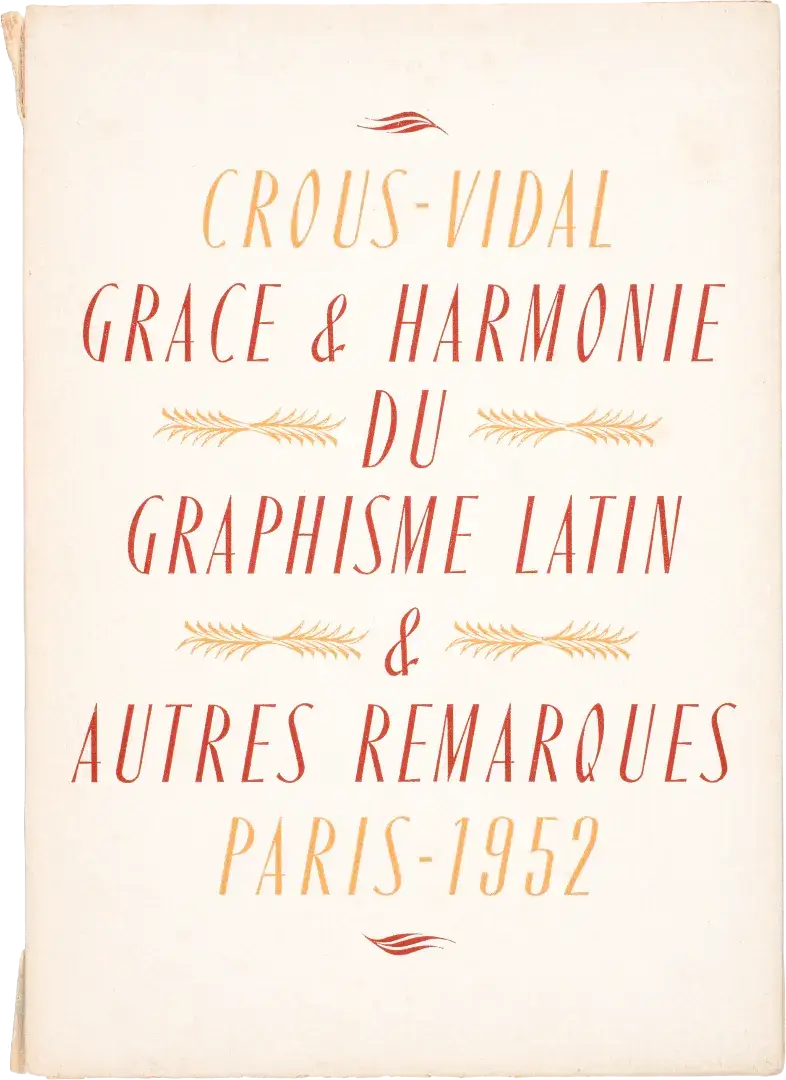
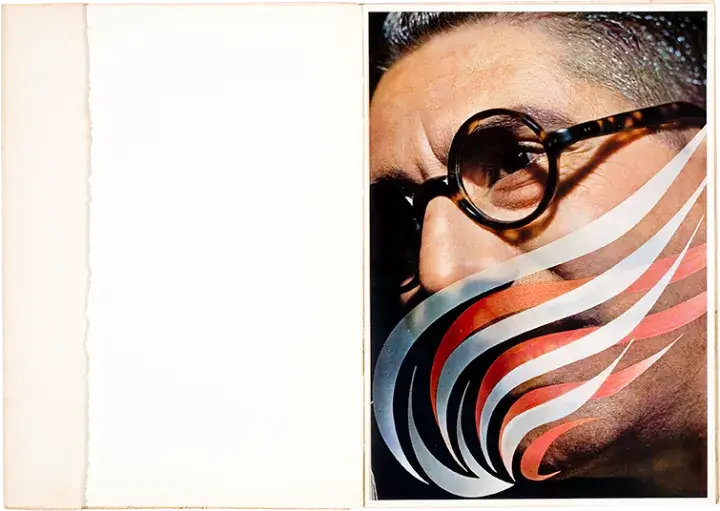
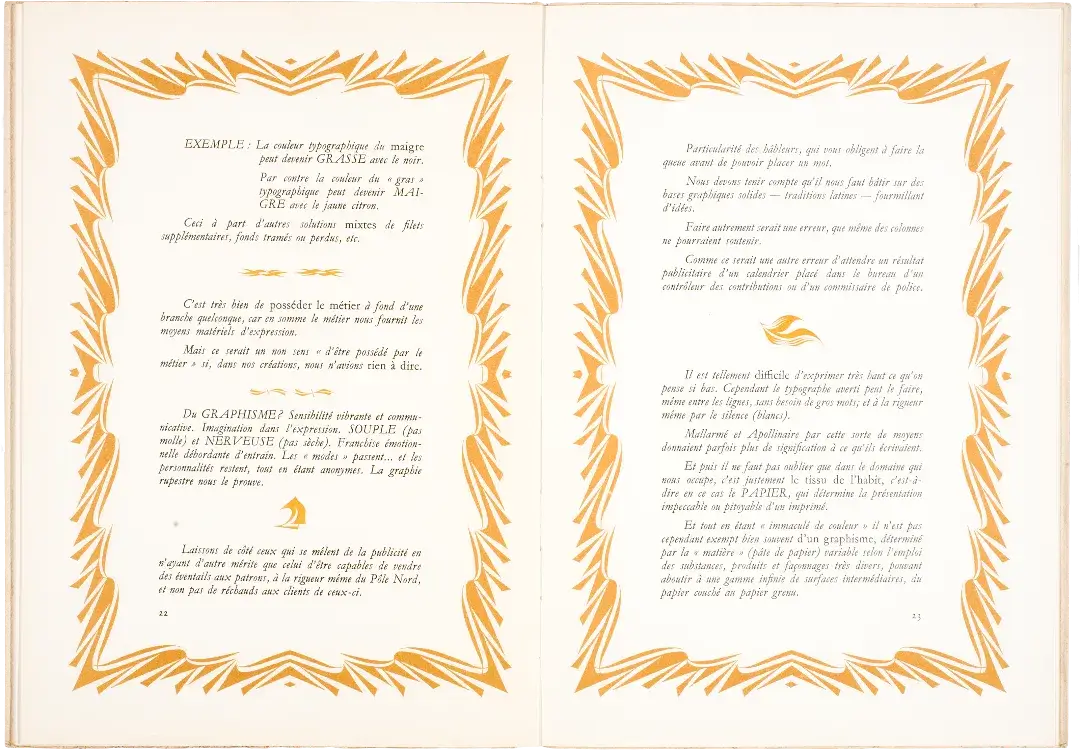
Enric Crous, Grace & Harmonie du Graphisme Latin & Autres Remarques, 1952
Publication, offset on paper, 29.6 x 21 x 0.7 cm
MORERA. Museu d’Art Modern i Contemporani de Lleida, 1330
Donation by Madeleine Kohler, 2001 -
-
-
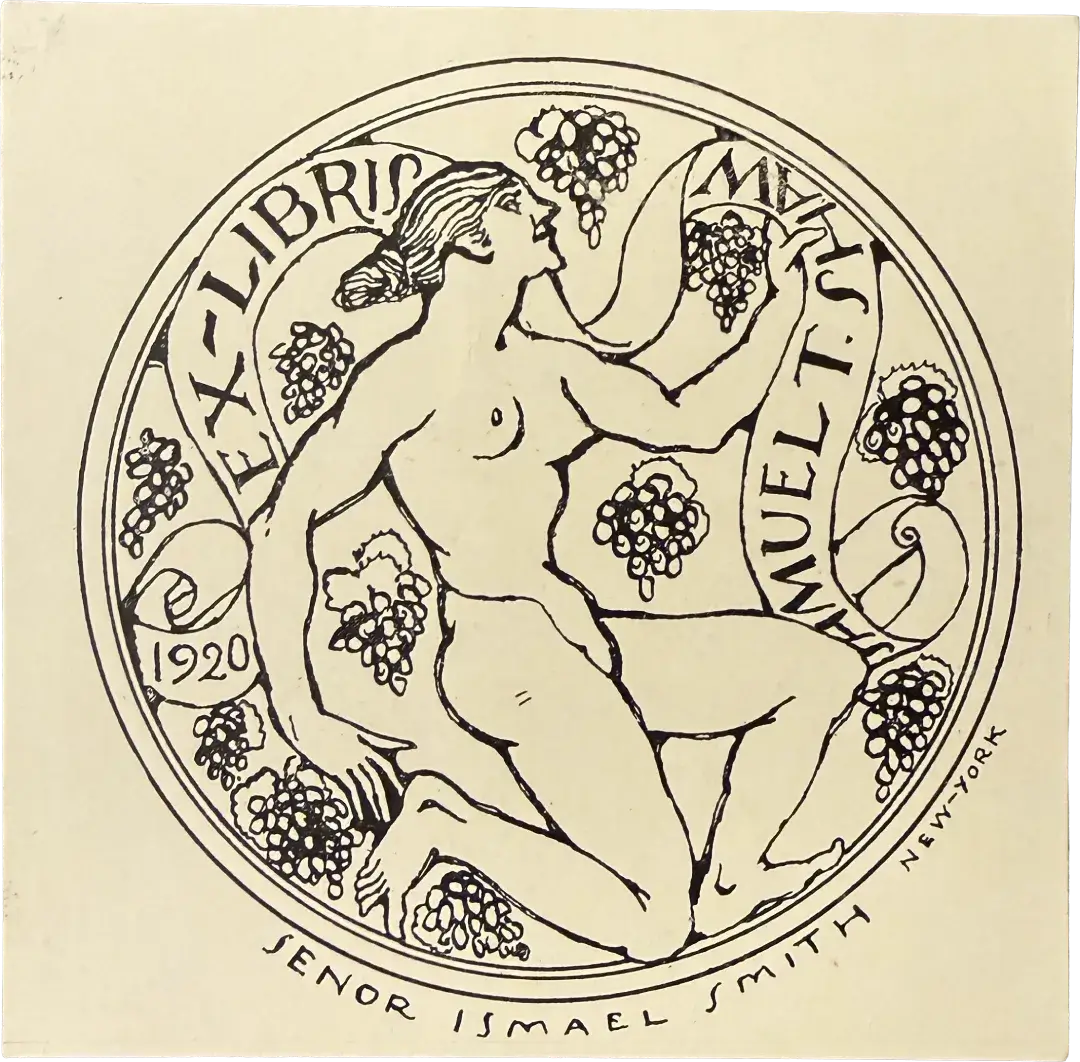
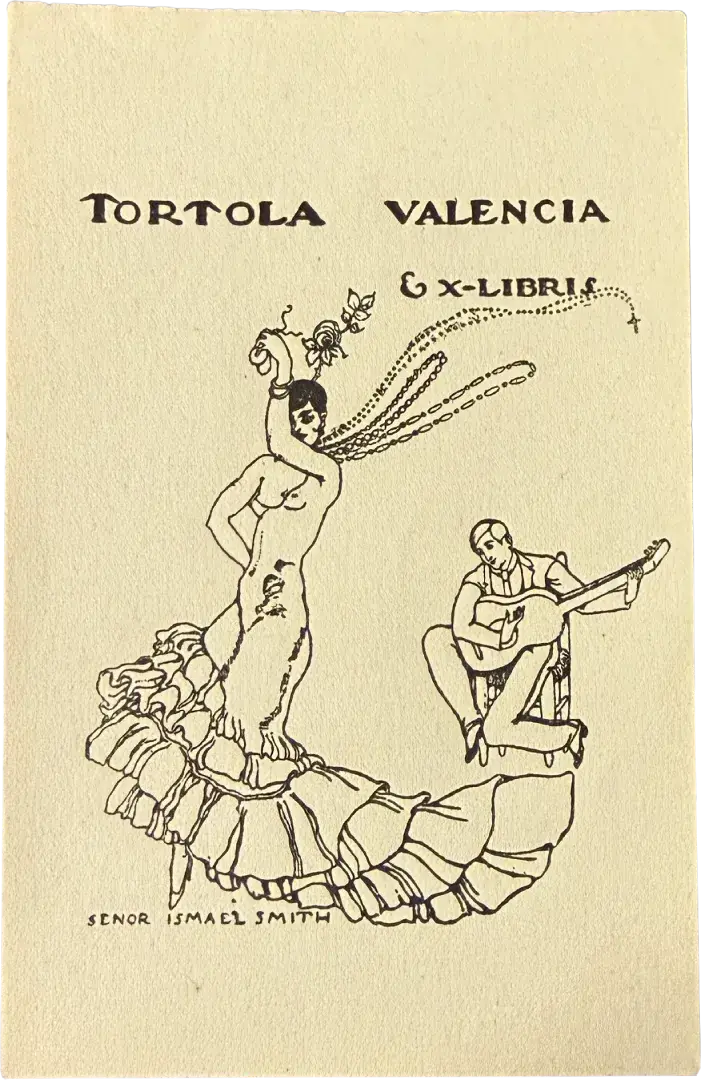
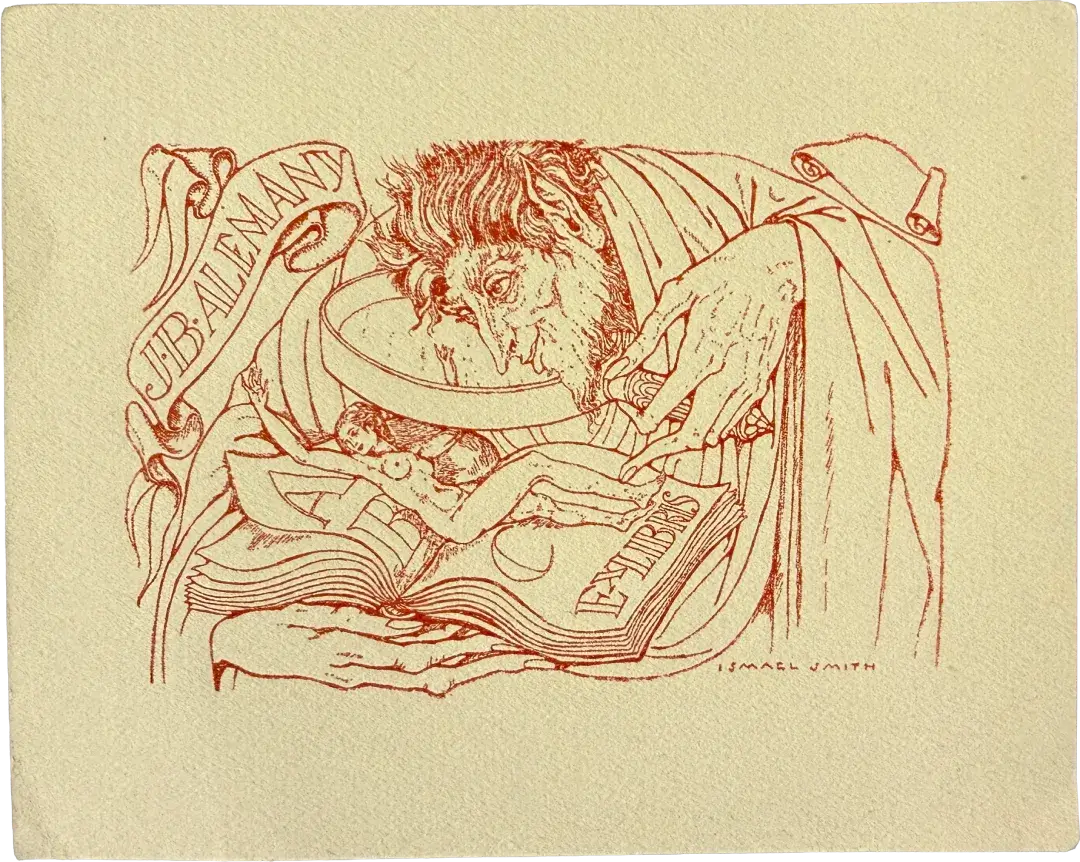
Ismael Smith, Ex-libris, ca. 1919
Museu d’Art de Cerdanyola, MAC -
-
Host countries
(survival, vulnerability, affection)
“She came from Granada, nothing is left of her cave in Guadix. So much hunger, war, and struggle behind her, so much freedom stolen in front of her eyes”.
These words mark the beginning of the song “María la Molinera” (María the Miller) which Queralt Lahoz dedicated to his grandmother, a woman born in Granada in 1917, who migrated to the Les Oliveres neighbourhood in Santa Coloma de Gramenet in the mid-20th century.
The “undesirables”. That was the name given to the Spanish refugees by the French authorities in 1939. The French ultra-right criminalised the republicans just as Syrians are criminalised today by calling them delinquents.
“Liberty, equality and fraternity were not for us”, the Spanish exiles recall. Entire Spanish families trusted French solidarity to escape from the war, the destruction of their homes, their jobs, and their future. Yet they soon realised that the notion of liberty, equality and fraternity was just a slogan; it was not for them. The French received the Spanish with hostility. Two years later, mass deportations of Jews to Auschwitz began.
Despite that, historians calculate that the Spanish exodus exceeded 500,000 people. They fled by foot, along the same road from Portbou that the Machado family travelled, or the road from La Jonquera, seeking refuge in France.
The English ship Stanbrook was another symbol of the Spanish exile. The Welsh captain Archibald Dickson set sail with 2,638 people heading towards Oran (Algeria), instead of the cargo of tobacco, oranges and saffron which was the reason he was initially sent to Alicante. The steamer travelled surrounded by perils, evading the German aviation that bombarded Alicante and avoiding the Canarias, a heavy cruiser which aimed to sink it.
These intensely hostile situations were offset by welcome spaces inside the country, or at least spaces stripped of Franco’s spirit. These became essential islands to give fresh air to a society destined by its institutions to be one of resignation, passivity, and acceptance of inequalities, both social and gender-related, all of which was in harmony with the precepts pushed by the organisations and educational systems of the fascist states of the nineteen thirties.
The idea was to create a homo patiens, a term that Salvador Cayuela Sánchez used in his book Por la grandeza de la patria (For the greatness of the homeland), in which the idiosyncratic subjectivity of Franco’s regime, perhaps related to the one forged by other totalitarian regimes, undoubtedly was key to sustaining the new Francoist state. This idea, in fact, can be easily traced in the regime’s discourses until its very end. It guided the government’s actions and strategies in a large part of its biopolitical, disciplinary and regulatory mechanisms.
It is exactly for this precise and effective mechanism that spaces of dissent and acceptance are vitally important and which free spirits have tried to keep open, such as the home of Apel·les Fenosa and Nicole Florensa, the Escola d’Art de Tarragona and Sala Tres de Sabadell.
The old Palau dels Nin, the home of the Portal del “Perdó”, affection and archives
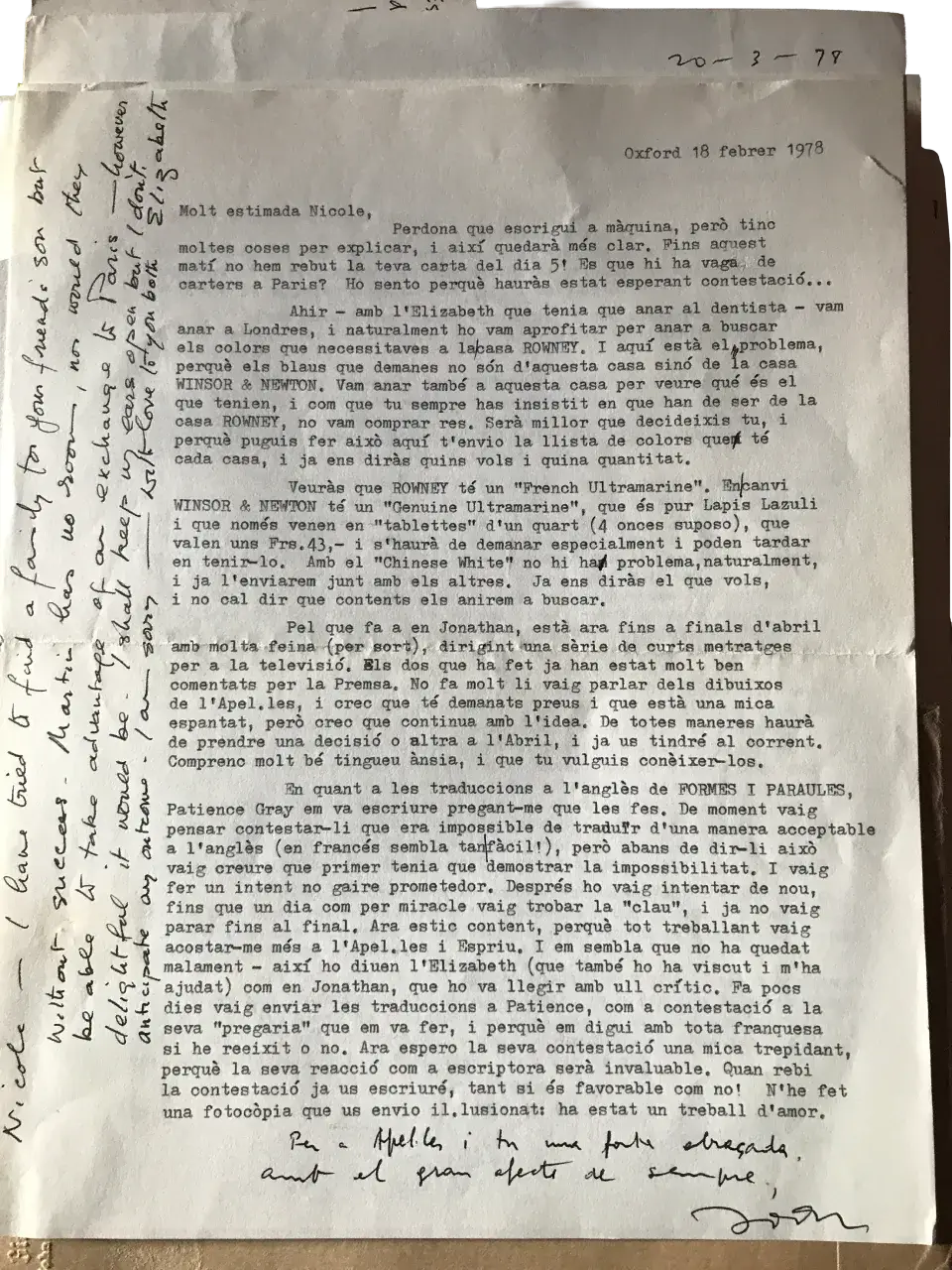
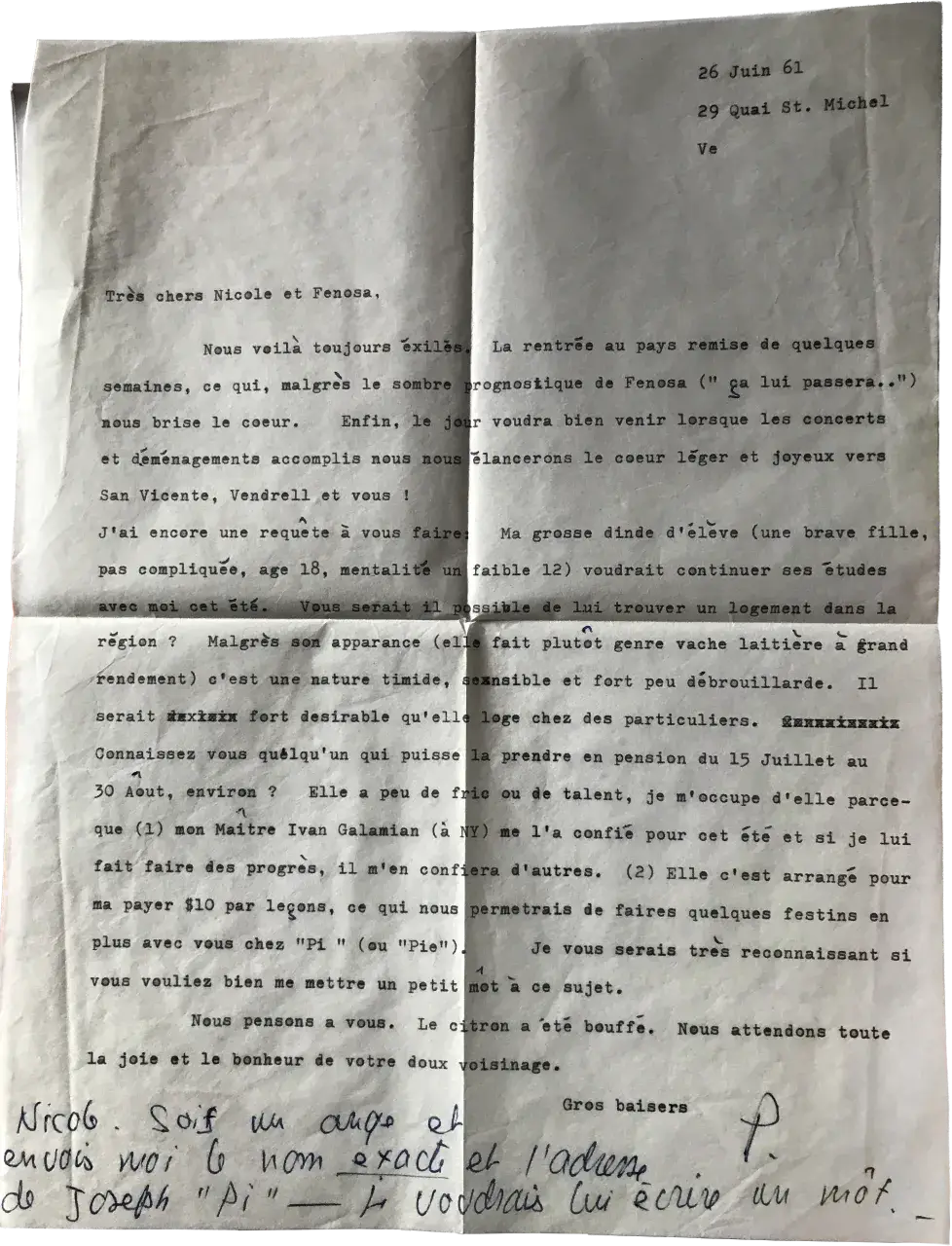
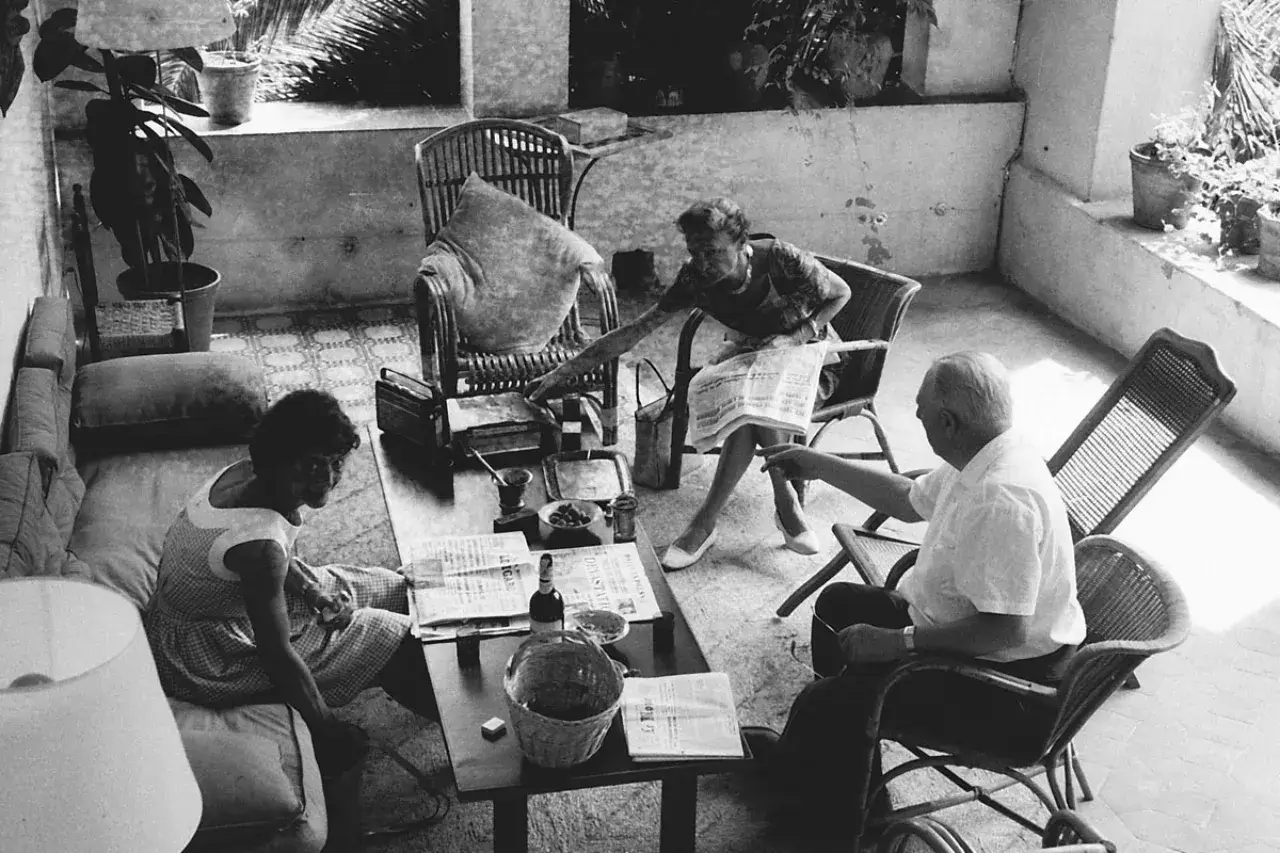
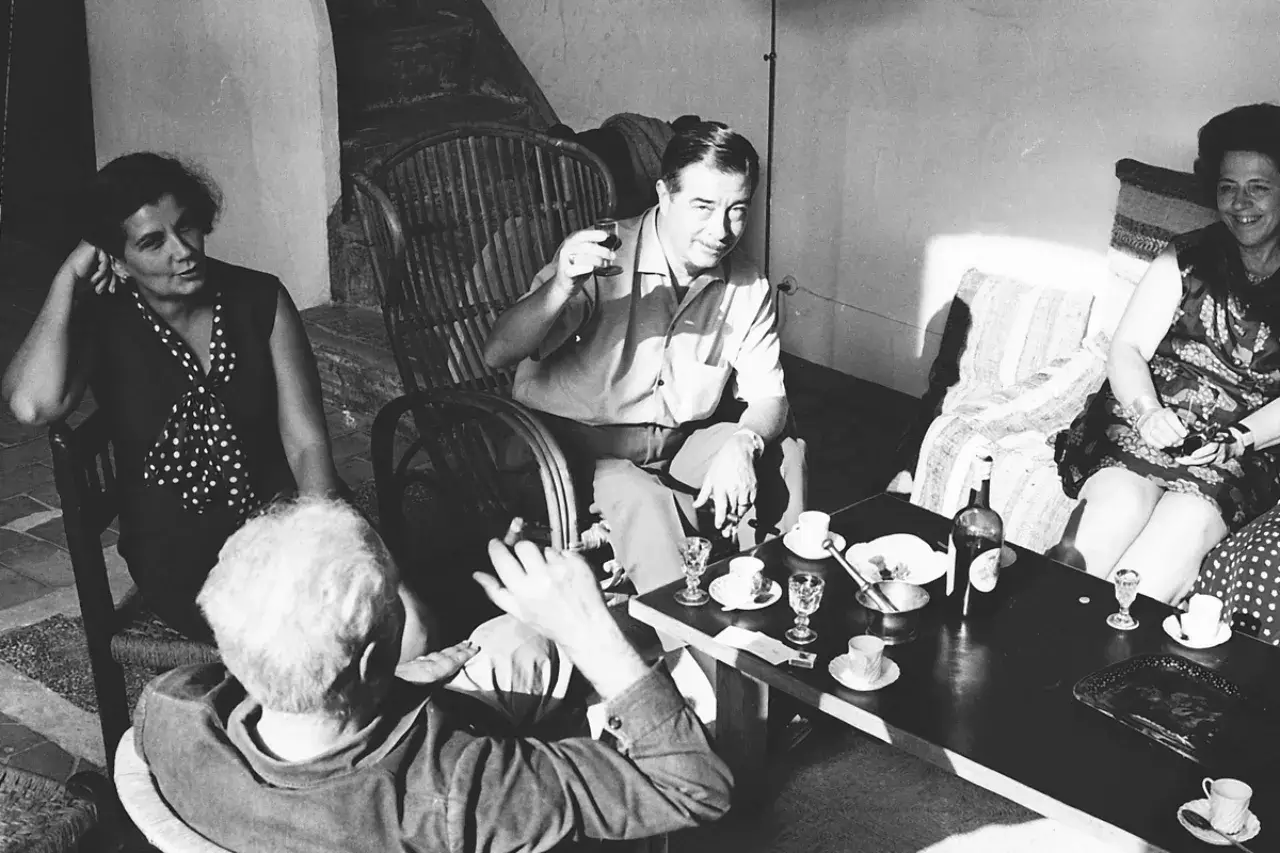
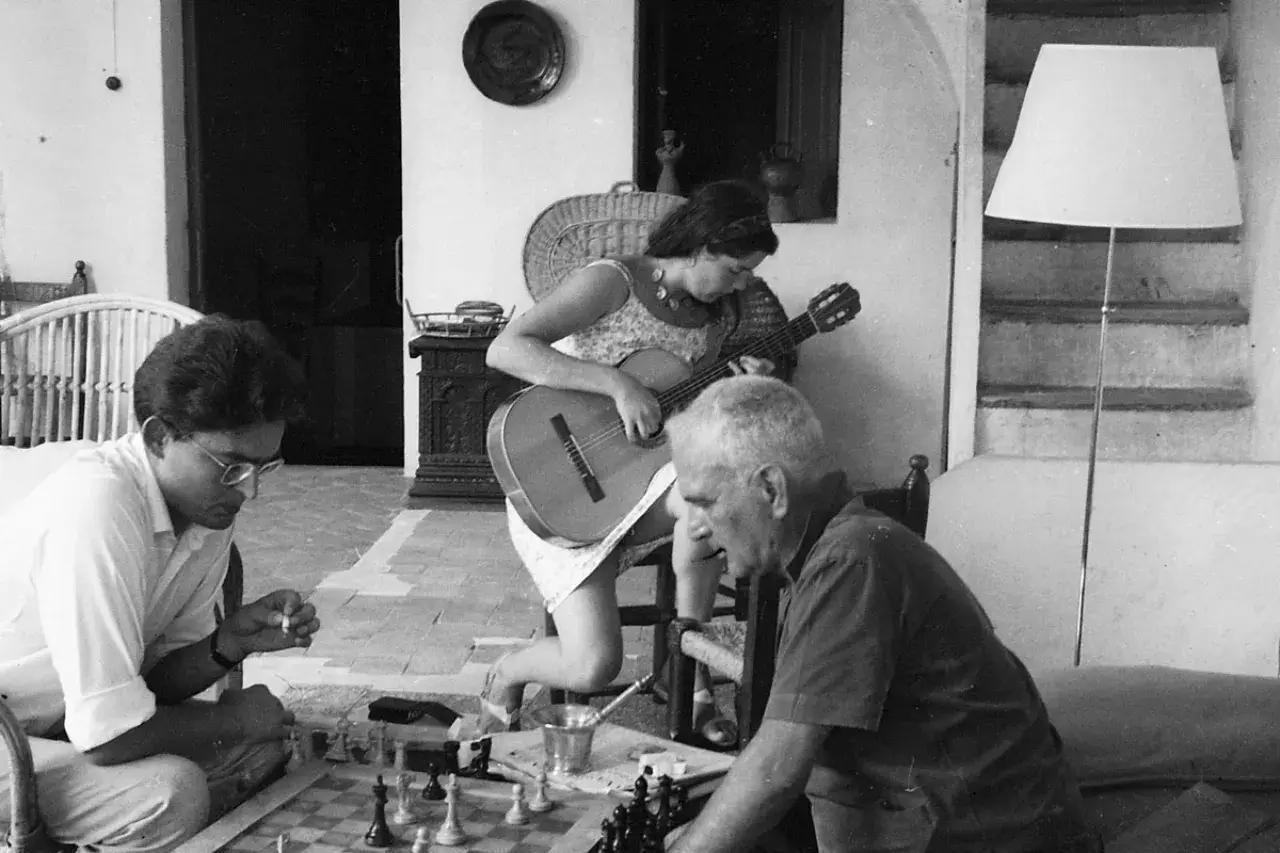
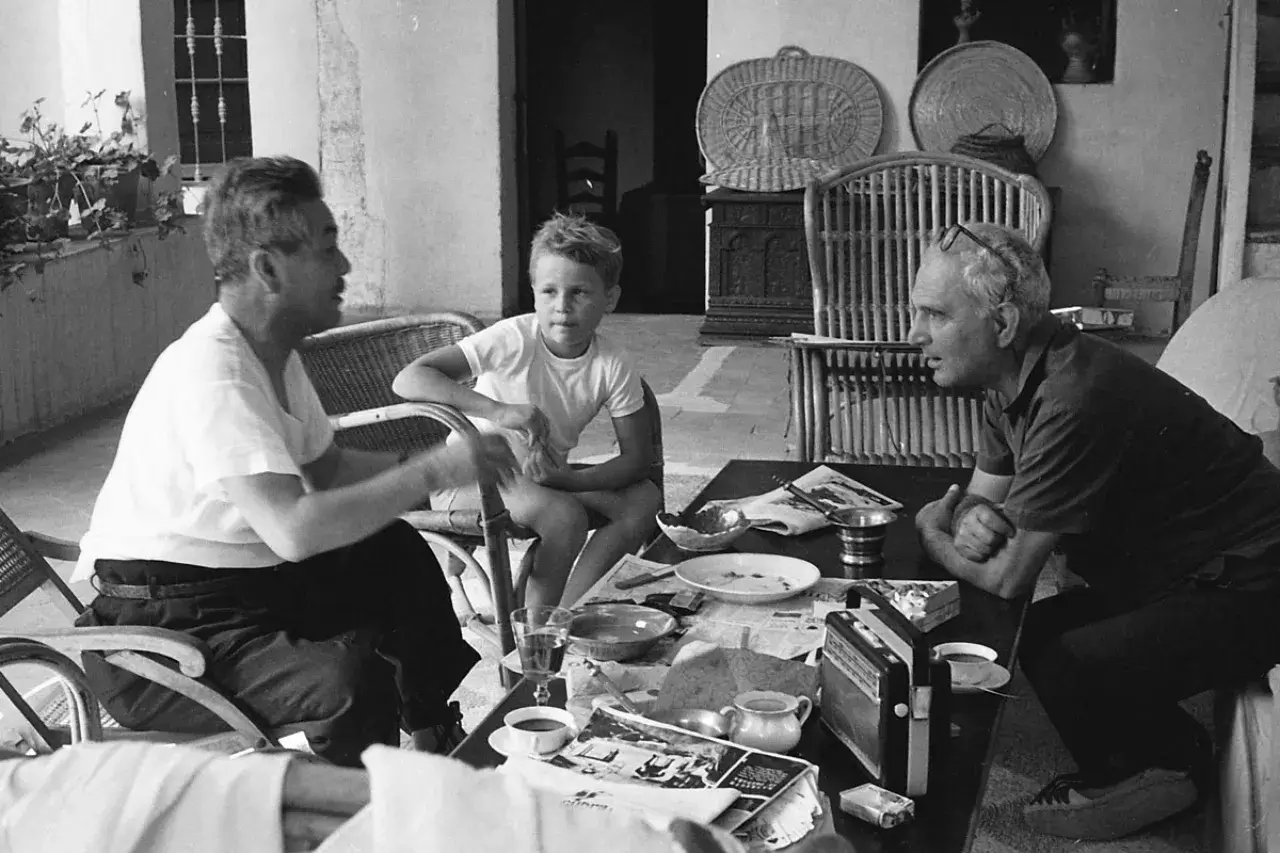
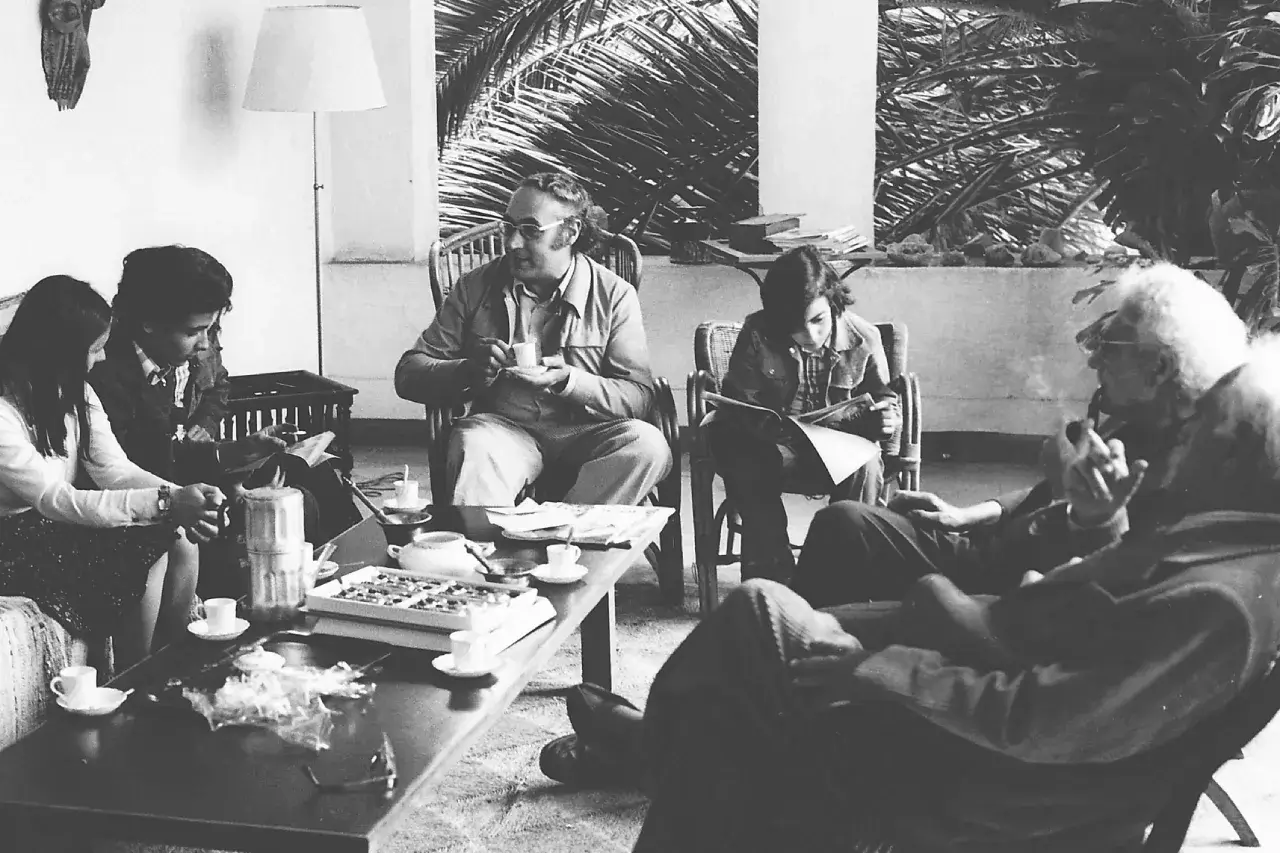
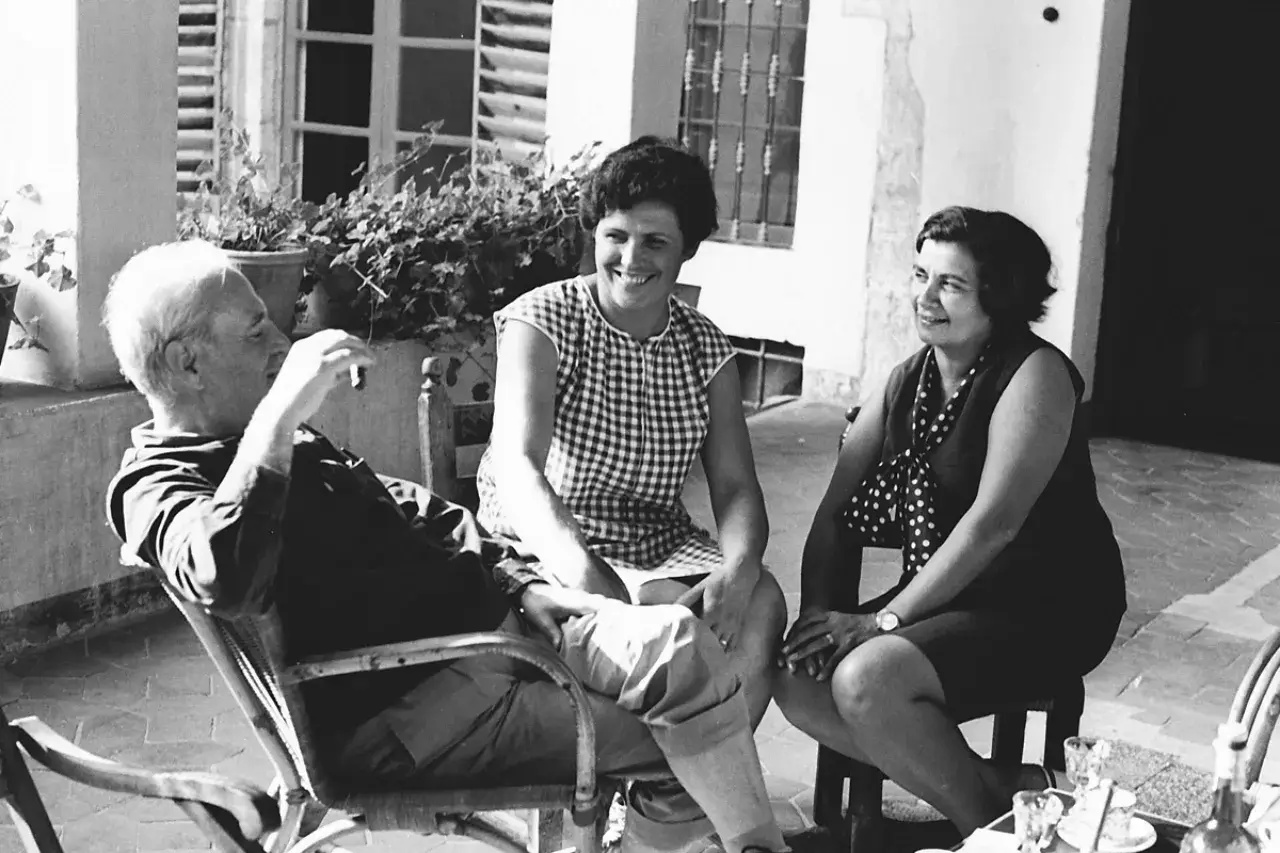
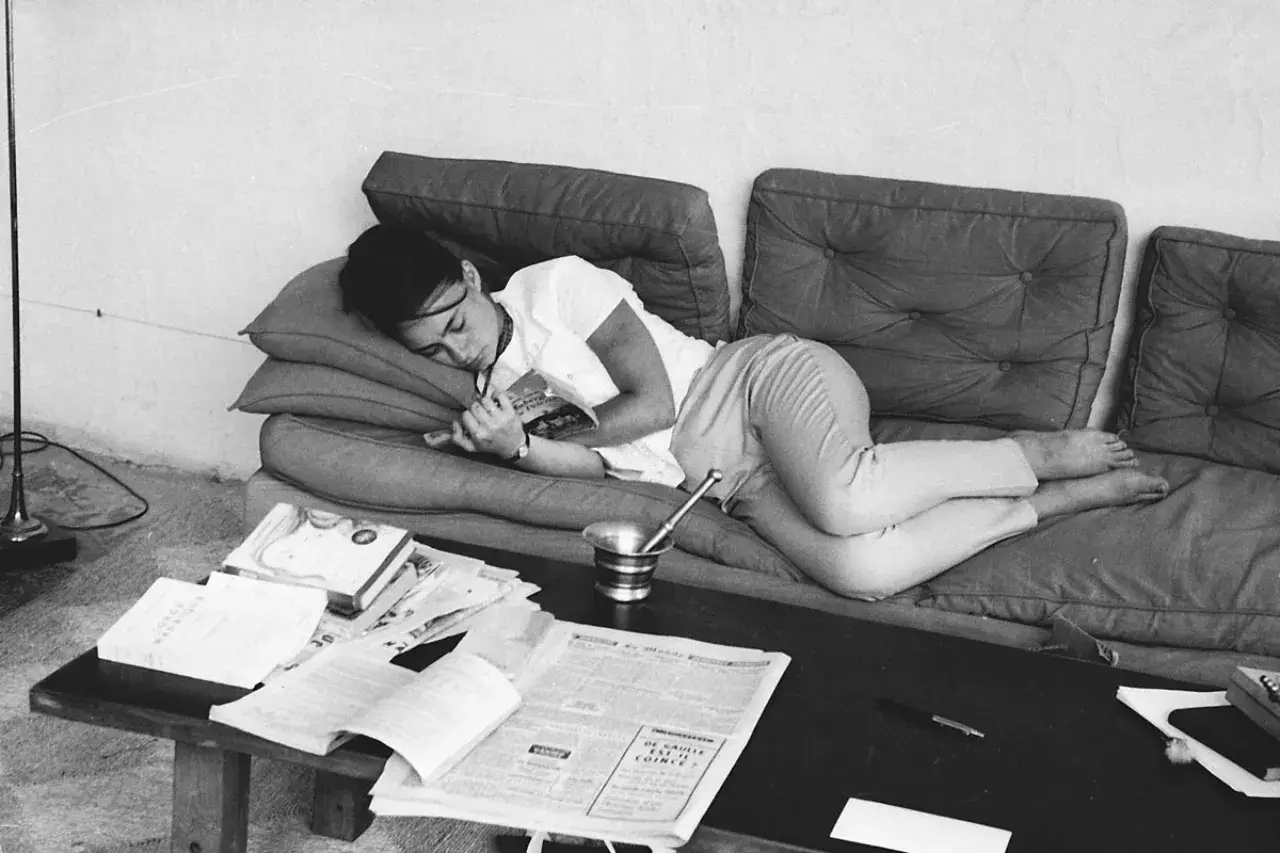
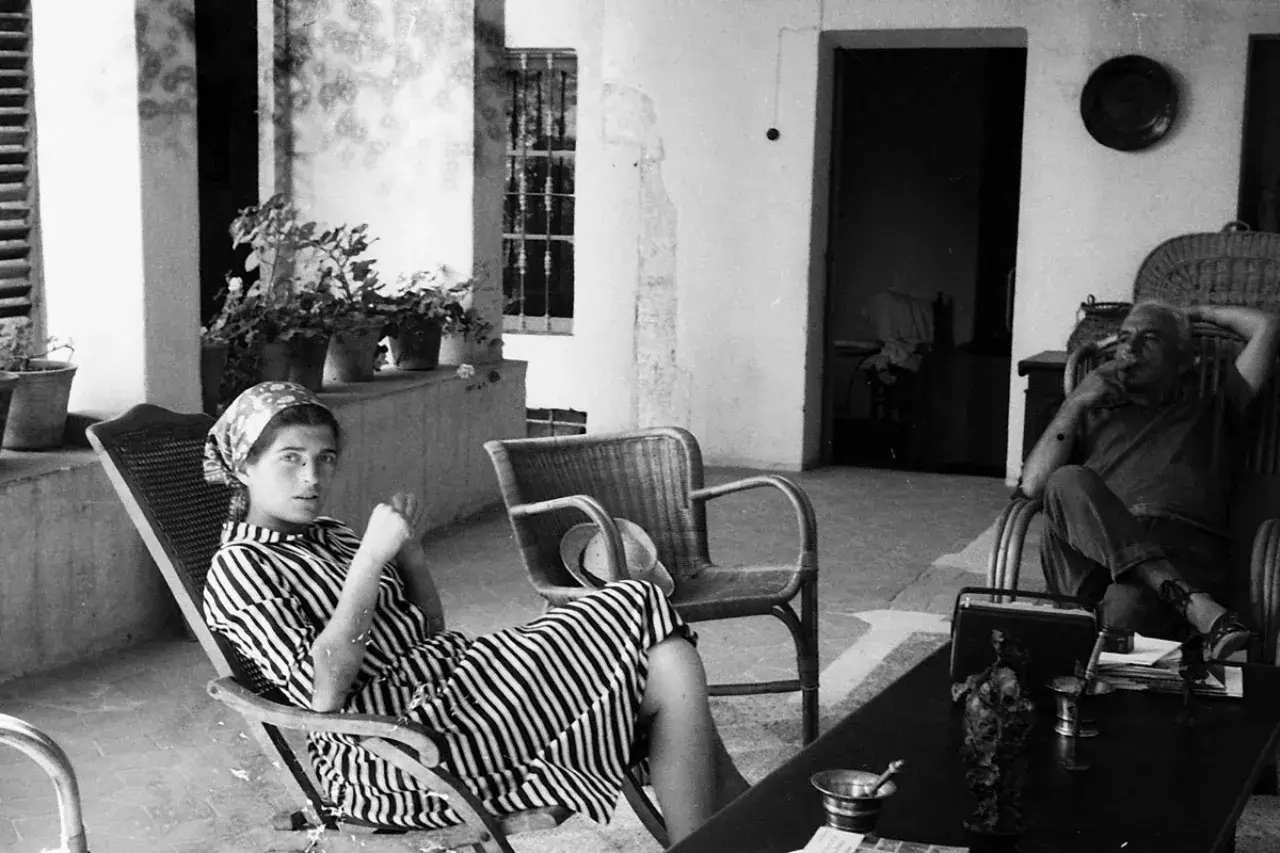
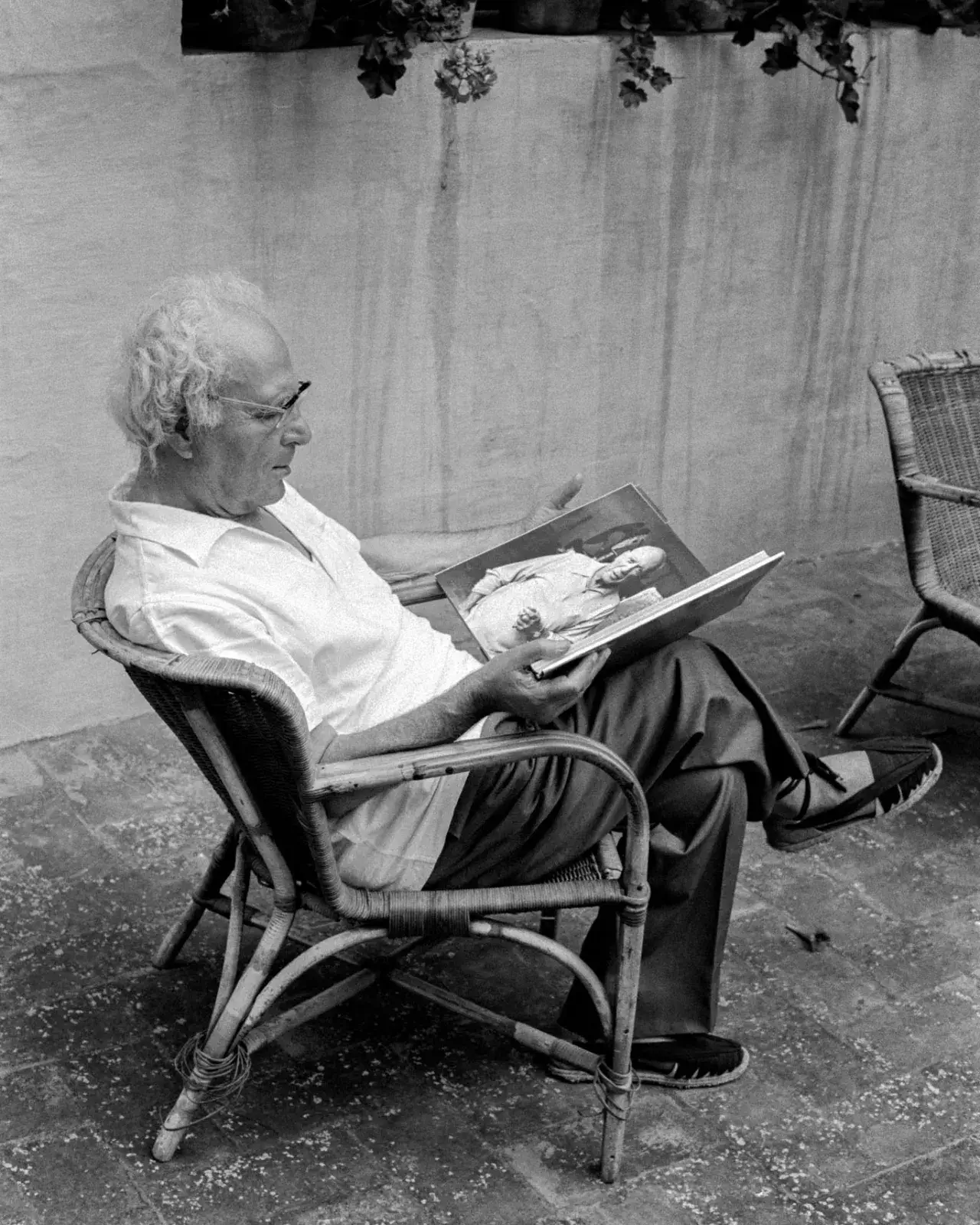
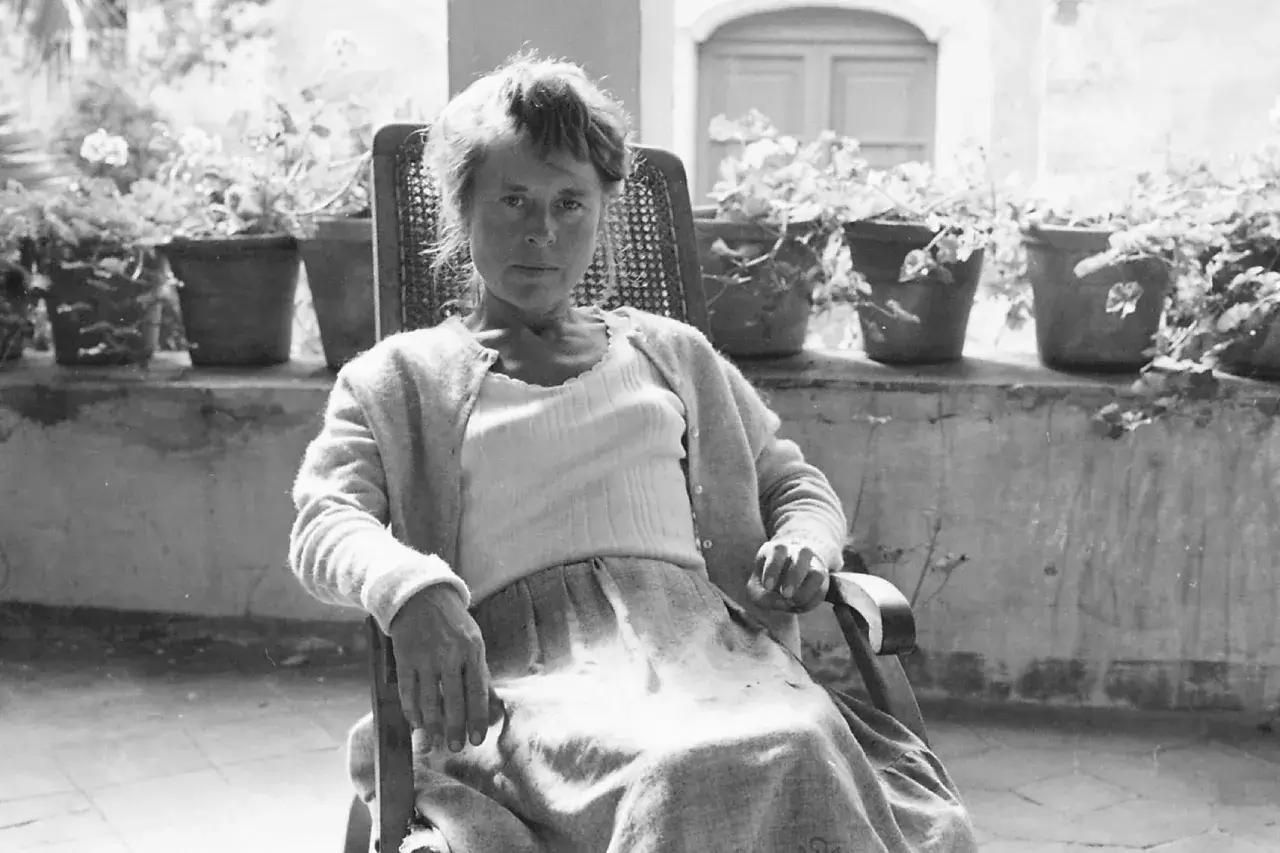
On 8 May 1958, Apel·les Fenosa and Nicole Florensa signed the deed for the manor house of the Guimerà family, the old Palau dels Nin in El Vendrell. For thirty years the couple spent their summers there, creating a space where art, literature and artistic production could converge, where they breathed a very different air from the one that smothered so many Spaniards and Catalans. After the death of Apel·les, Nicole upheld the spirit of the home for close to twenty-five years.
Apel·les had actively participated in the Spanish Civil War by helping to rescue and safeguard works of art from the dictatorship, which led to him going into exile for a second time after the defeat in 1939. In January of that year, he sought refuge in his parents’ house in La Floresta, and he requested safe passage to travel in search of marble which allowed him to cross the border with France and escape Franco’s regime.
We have to take into account that artistic production not aligned with the National-Catholic regime faced great difficulties in the first decades of the dictatorship, and artists in the interior experienced different situations that ranged between “banishment” (deportation to other provinces and a ban on teaching activities), feigning allegiance and fleeing and seeking refuge in the sadly typical folklore style. Nonetheless, names such as Bardasano, Martí i Bas, Manuel Monleón, Quintanilla, Renau, Clavé, Fontseré, Hèlios Gómez and many others have remained in the history of art committed to resistance, despite the misunderstandings and the slanders hurled by Franco’s regime against their names and their art.
After the early years of the post Spanish Civil War, intellectual life began to reopen to a certain extent among a group of liberal-leaning Falangists. Meanwhile, claims by the opposition culture clashed above all with the image of the official policy towards culture during the dictatorship, reiterating the assertion that Franco’s authorities maintained a type of aloofness, or even contempt, towards culture. In this way, it was signalled that Franco’s regime showed all its destructive effectiveness towards the culture of the Spanish Republic and, especially, the different nationalities, yet at the same time failed in building its own culture, characteristics that are considered constituent of fascist regimes.
In the midst of this situation in which culture did not seem excessively dangerous, Apel·les returned to Barcelona for a few days in 1957. This stay involved reuniting with friends and also with his city. This reunion was the stimulus to purchase a house and embark on a new undertaking in his country, which he never stopped loving.
Apel·les and Nicole found this house in El Vendrell, popularly known as “Portal del Pardo”. We know this name caused a certain degree of discomfort due to the possible reference to Franco’s official residence (the Royal Palace of El Pardo), and the couple sometimes called it “Portal del Perdó” (Portal of Forgiveness). They restored the house with the same zeal with which they had purchased it, with the help of friends and in order to offer it to their friends, such as Tristan Tzara. It was no simple task, because the building was in a precarious state, but little by little they went about restoring it to its original appearance.
Bit by bit, the house became a bright and colourful space amongst the predominant grey. Apel·les himself discovered the Renaissance arcades in the attic. His temperament, as well as Nicole’s, however, would never allow him to stay closed off on an island, quite the contrary. Accompanied by Anton and Pilar Andreu, they travelled the entire region and had all the people who visited know it too. They became familiar with the entire region, uniting people from diverse backgrounds with a sense of true, multidisciplinary knowledge.
Nonetheless, we have to understand that Fenosa felt a profound sense of belonging. As such, the actions and even the works produced in Paris and the works crafted in El Vendrell were clearly different.
In El Vendrell he accepted the commission for a monument to Casals. He spent a great deal of time without finishing the sculpture, because he had immense respect for the maestro and considered the piece as an homage to Catalonia, which was a highly significant challenge.
Fenosa completed the monument in 1977. Raimon Carrasco explained in his text “Portal Fenosa”: “It is not his best work; one can feel the anguish, both artistic and otherwise, that the sculptor suffered while creating it. But once he was freed from it, from that same creative impulse, from the remains of the monument’s wings, two splendid pieces emerged: Good weather chasing the storm (1978-79) and Good weather (1978-1985).”
However, what seems the most important part of this austerely beautiful welcoming space was the work and intellectual and loving exchange full of details that wrestled between being both a house and museum as well as a meeting point, between the seriousness of art and the vitality of popular culture, between painful conversation about exile and musical exchange.
Many friends spent time in the Portal del Pardo. The first years featured people like Tristan Tzara, Robert Valette and Cécile Eluard (daughter of the poet and Gala), Henri and Madeleine Monnet, Lucien Sablé, Jack and Ariane Nisberg, John and Ianthe Carswell, Patience Gray and Norman Mommens, Key Sato, Ebihara, Robert Pikelny, and Irving Davis, among many others.
Of course, Catalan friends also visited often. The most frequent visitors included Joan Perucho, Alexandre Cirici, Anton i Josep Andreu i Abelló, the Gaspar siblings, Manuel Humbert, Josep Granyer, Alfred Sisquella, Rafael Benet, Tomàs Garcés, Manuel Ibáñez Escofet, Josep Corredor Matheos, Víctor Hurtado, Joan Cortés, Jordi Maragall, the Maragall family, Joaquim Ventalló, Rafael Santos Torroella, Joan Serra, Joan Commeleran, and Sempronio. I have uncovered all this information through texts and research.
This warm welcome made an impact on his friends’ intentions, so much so that Florence and Jean d’Albis were the first to buy a home in the region. Joan and Elisabeth Gilli and Paul and Bárbara Makanowitzky were also among the many enthusiastic buyers.
Apel·les Fenosa died at his home atelier on boulevard Saint-Jacques in 1988. That was the same year that Josep Tarradellas passed away, an iconic exile who had returned to Catalonia in 1977, two years after the dictator’s death. Fenosa and Tarradellas had enjoyed an important relationship, and that’s possibly why in 2019 the Fundació Apel·les Fenosa handed over a group of documents concerning exile and the Democratic Transition belonging to the Catalan sculptor to the Arxiu Montserrat Tarradellas i Macià. The archive, located in Poblet, thus expanded its documentary collection about the Spanish Republic, Civil War, and the Democratic Transition.
The documentation provided by the Fundació Fenosa features a set of pamphlets published in Catalonia between the nineteen sixties and seventies by various Catalan groups, as well as publications created by Catalan exiles, including: Bulletin of the Unión de Intelectuales españoles; Informative bulletin of “Solidarité catalane”; Canigó: informative bulletin of the “Societé française des amis de la Catalogne”; Catalònia: bimonthly Catalan publication; Catalunya: publication of the Aliança Nacional de Catalunya in Paris and the North of France; Informative pamphlets / Assemblea de Catalunya; Quaderns de l’exili; Sem i serem: quarterly bulletin of the Grup de Catalans Exiliats a París; Som!!: monthly publication of the Joventuts d’Esquerra Republicana Estat Català; La Veu de Catalunya: internal bulletin of the Lliga Catalana.
I think I would have preferred the Fenosa archives to have stayed at the Fundació. We have to seek the examples of political dissent within his work, letters, relationships, friendships, texts, conversations on the blue porch of the house and the life of Apel·les and Nicole, full of commitment and truth.
The Taller-Escola as a space of freedom in times of educational repression
-
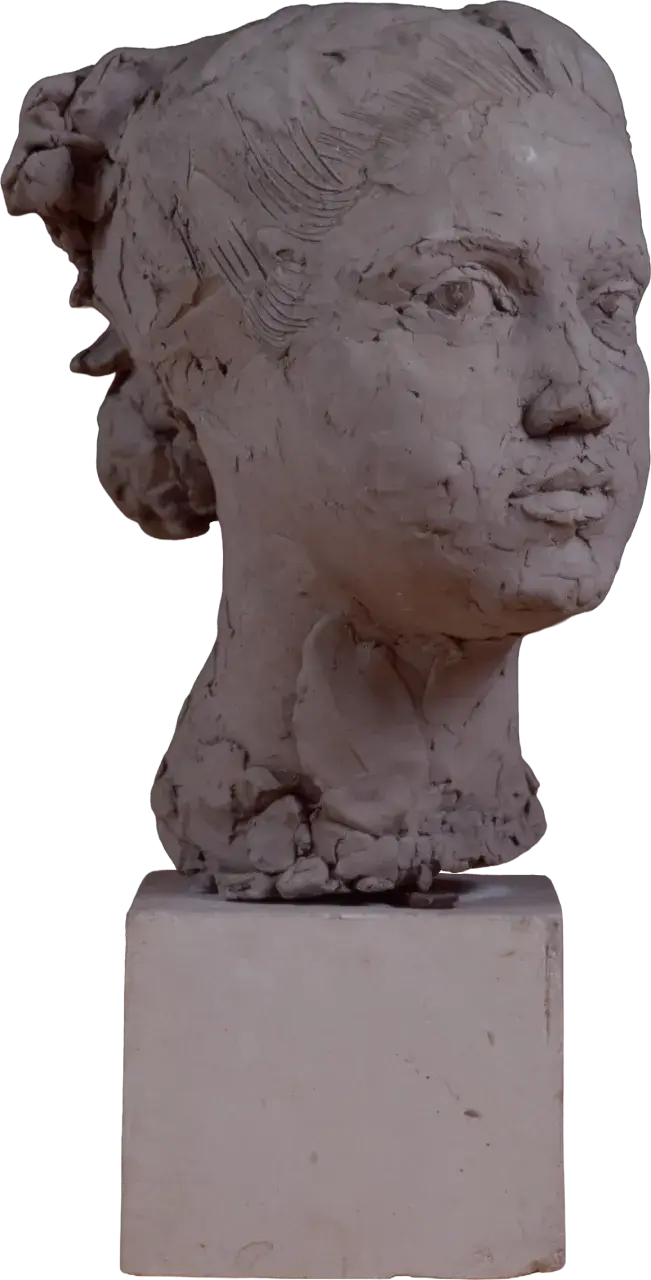
Maria Teresa Ripoll
Maria Rosa Pellicer bust
s. XX
Museu d’Art Modern de la Diputació de Tarragona -
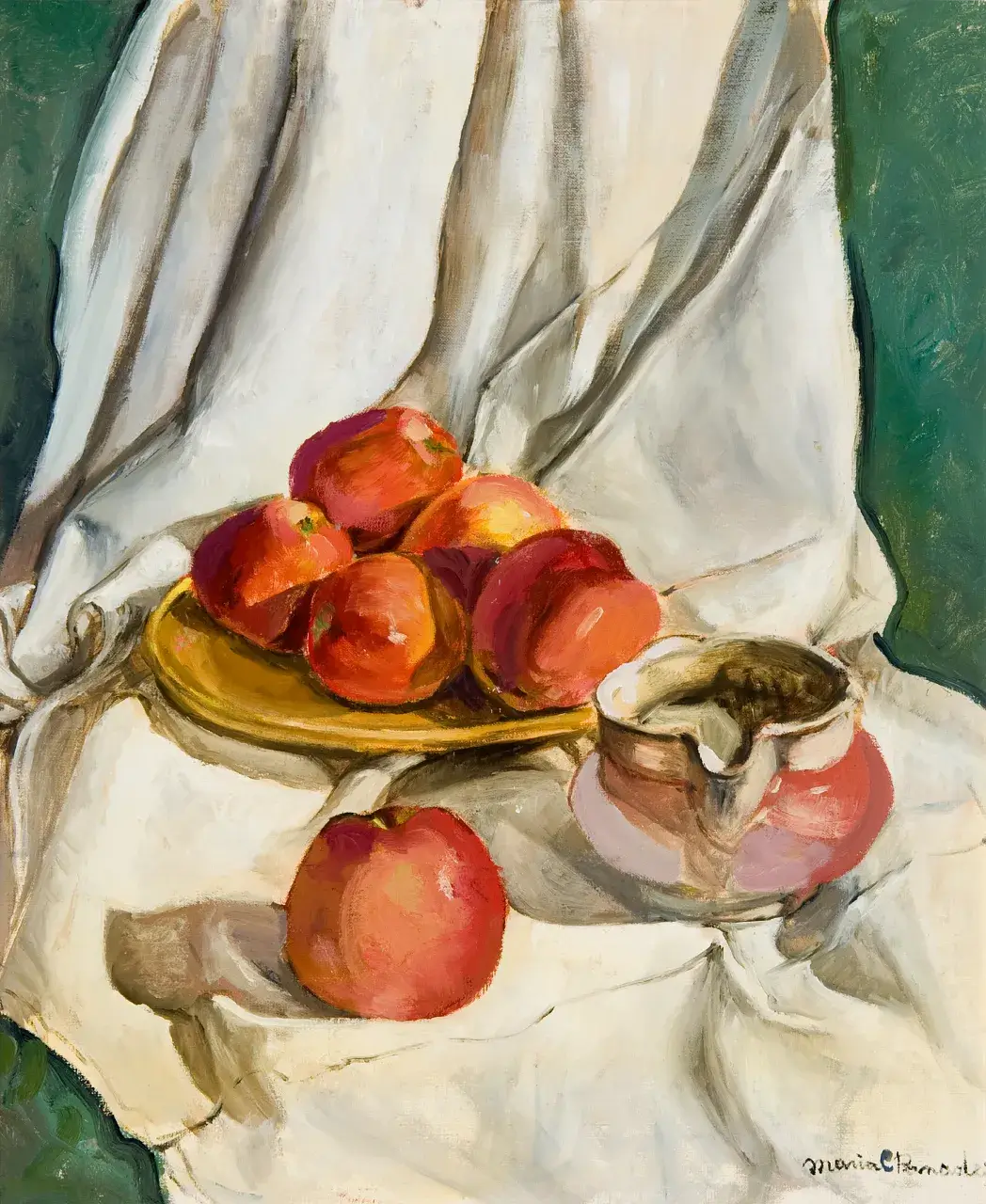
Maria Claustre Panadés
Still Life
1980
Museu d’Art Modern de la Diputació de Tarragona -
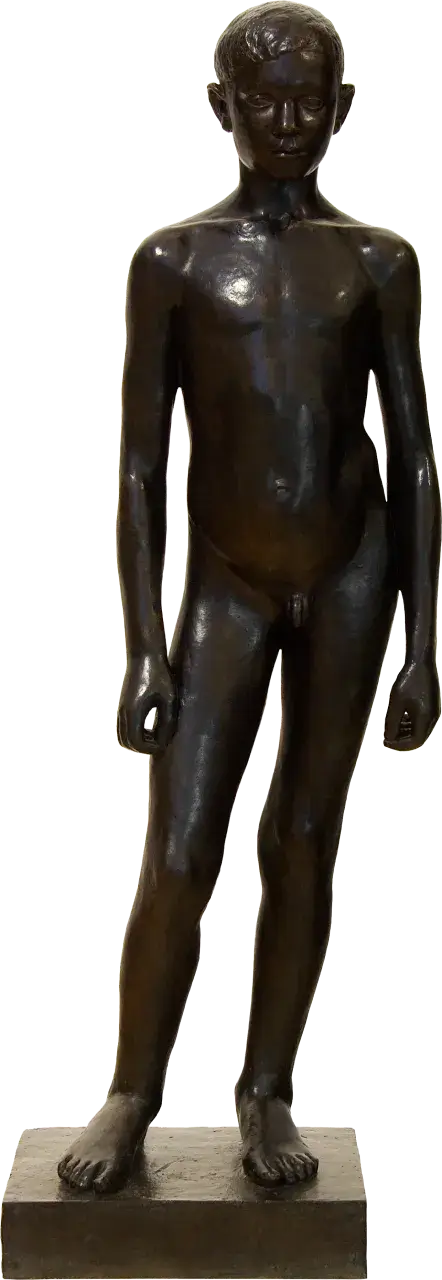
Maria Teresa Ripoll
Nicodemus
s. XX
Museu d’Art Modern de la Diputació de Tarragona
The advent of the Spanish Republic in 1931 and the restoration of the Generalitat in 1932 entailed a revision and revival of teaching in general and art specifically. The creation of the Escola Superior of Landscape Art in Olot and the Taller-Escola of Painting and Sculpture in Tarragona were the two most significant actions in the field of art. The programme promoted by Ignasi Mallol and Joan Rebull was based on the students’ creative freedom in three progressive nine-month courses in which sixteen-year-old students attended courses on sculpture, painting and “general culture” (art history) five hours a day, with extra summer courses held in different locations.
The Taller-Escola of Painting and Sculpture of Tarragona had a short, but intense existence. The first school year was inaugurated in January 1935: the hardships of the Spanish Civil War brought about the physical destruction of the school during the bombings that the city of Tarragona continuously suffered throughout 1937-1938. Nevertheless, its spirit and its lessons remained present in the people who studied there, leaving an indelible impression that has remained in society’s memory throughout the years.
Although it has often been said that the Escola d’Art of the Diputació de Tarragona created in 1946 was the heir to the tradition of artistic education ushered in by the Taller-Escola created in Tarragona by the Generalitat de Catalunya during the Spanish Republic, nothing could be further from the truth. On 2 July 1946, Manuel de Montoliu, in accordance with the wish expressed at the time, sent the document entitled “Report on the Founding of the Escuela-Taller de Arte de Tarragona”, to the Cultural Liaison Manager of the Diputació de Tarragona, the direct predecessor of the institution’s current Escola d’Art i Disseny.
This five-page text starts with an introduction that clearly sets out the need for an art education centre in order to define the type of school that the society in the Tarragona region required at that time. The text refers to the aforementioned Report on culture from December 1945, and transcribes verbatim a part that refers to the Taller-Escola of the Generalitat in Tarragona:
“The Taller of Painting and Sculpture disappeared;
despite the modesty of its name, it suffered
from excessive ambition, as creating
a School of Fine Arts in Tarragona
capable of competing with the one established
long ago in Barcelona is a level of difficulty
slightly less than insurmountable.
We understand that a School of this
kind in Tarragona would have to limit itself to
more modest aspirations or would have to have above
all a more practical nature aimed at providing
an artistic education for the working classes.”
Hence, there was a clear and obvious desire to distance itself from the parameters established for the Taller-Escola and to promote teaching more suitable for the applied arts than the fine arts. In order to reaffirm this posture, a solution was quickly proposed that included directly connecting the future Escola d’Art to the existing Escola del Treball trade school, something which enabled the school to be set up simultaneously in Tarragona as well as in Reus, Valls, and Tortosa.
Manuel de Montoliu also noted how he and the Cultural Liaison Manager, Enric Olivé Martínez, were interested in finding the documentation of the former Taller-Escola of the Republican Generalitat in Tarragona so that it could serve as the foundation for organising a new school. This search was bound to fail, as the destruction of part of the building during the bombings of Tarragona in 1938 and the dispersal of students and teachers due to the widespread insecurity in the city caused the school to suspend its activities. One part of the school’s documentation disappeared, while another part was salvaged by one of its directors, Joan Rebull. Once Rebull went into exile, he left the documents in the hands of his disciple M. Teresa Ripoll. Faced with the impossibility of finding this material, Mr Rodríguez Codolà, secretary general of the Real Escuela de Bellas Artes de Barcelona, met with them, providing advice and the regulations of this school.
The aim to directly link the Escola d’Art with the Escola del Treball was proposed at the Patronat Local de Formació Professional (Local Professional Training Board) in its plenary session held on 22 May of the same year. The Cultural Liaison Manager of the Diputació and member of the Board, Enric Olivé, invited Manuel de Montoliu to present the project.
It is evident that the intent to redirect the Taller-Escola of Painting and Sculpture of Tarragona into a professional training centre for “workers” falls within Francoist biopolitics, which discards and erases all traces of critical and reflective thought that might emerge from an art school. Transferring the expertise towards a more artisanal place did not aim to bring back artisanal traditions, but rather to make artistic speculation disappear. This was all done based on the excuse that art schools in the region had to remain humble, and that thought had to be linked only to “central” spaces, which were evidently much more closely controlled and managed.
Despite that, educational spaces for artisanal and artistic creation have always been spaces for a certain degree of dissent and acceptance. A crack in the regime.
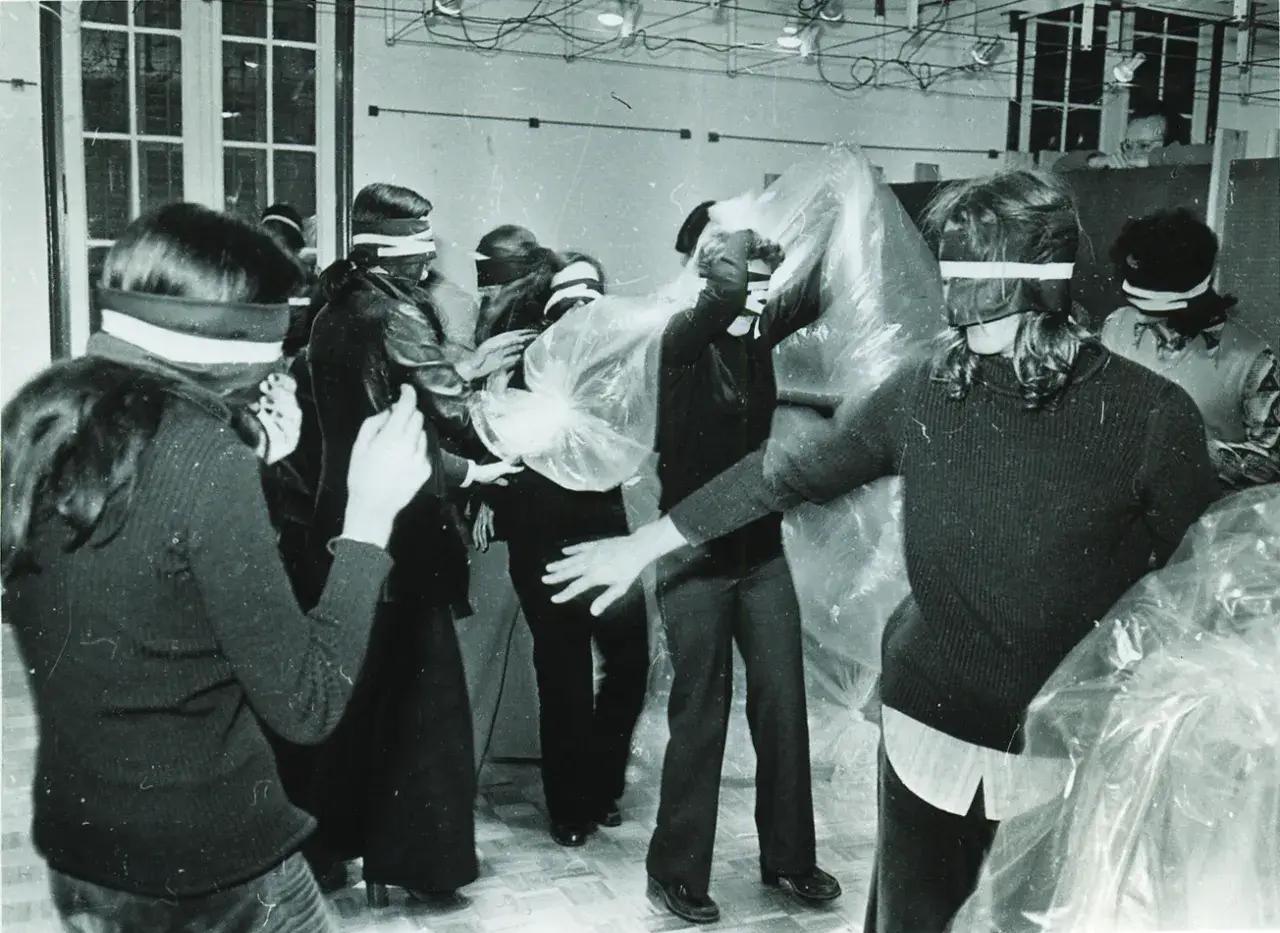
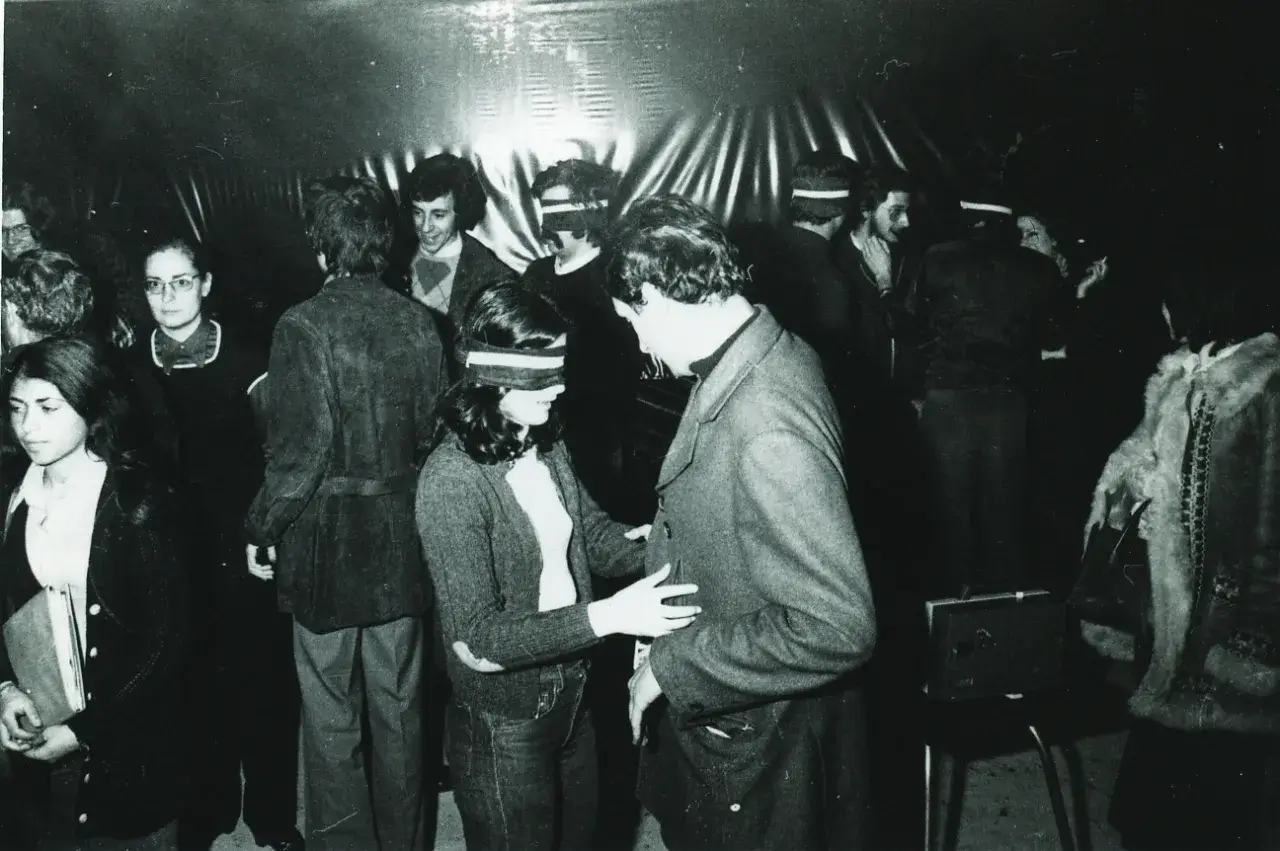
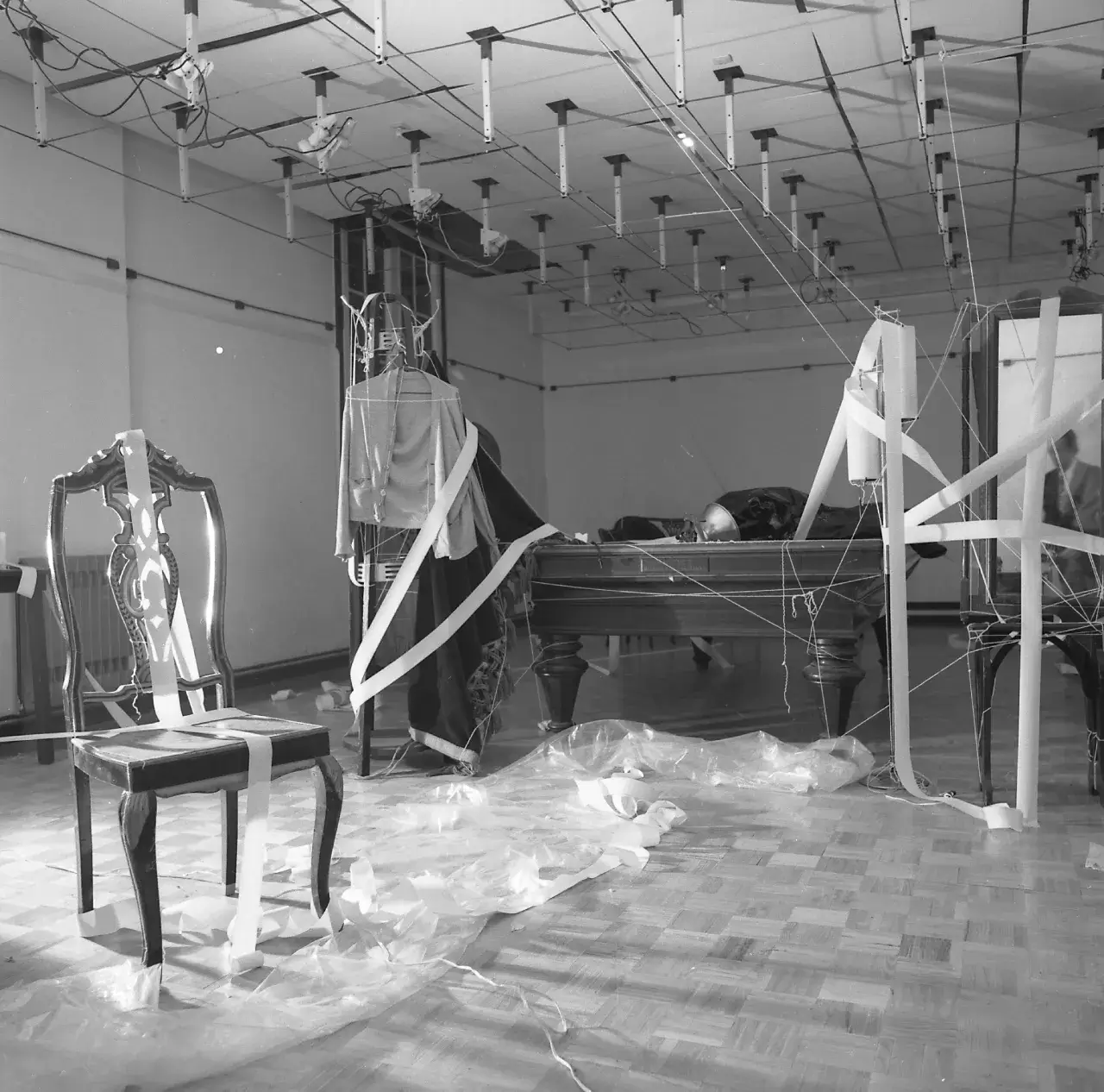
Sala Tres in the projection of time
-
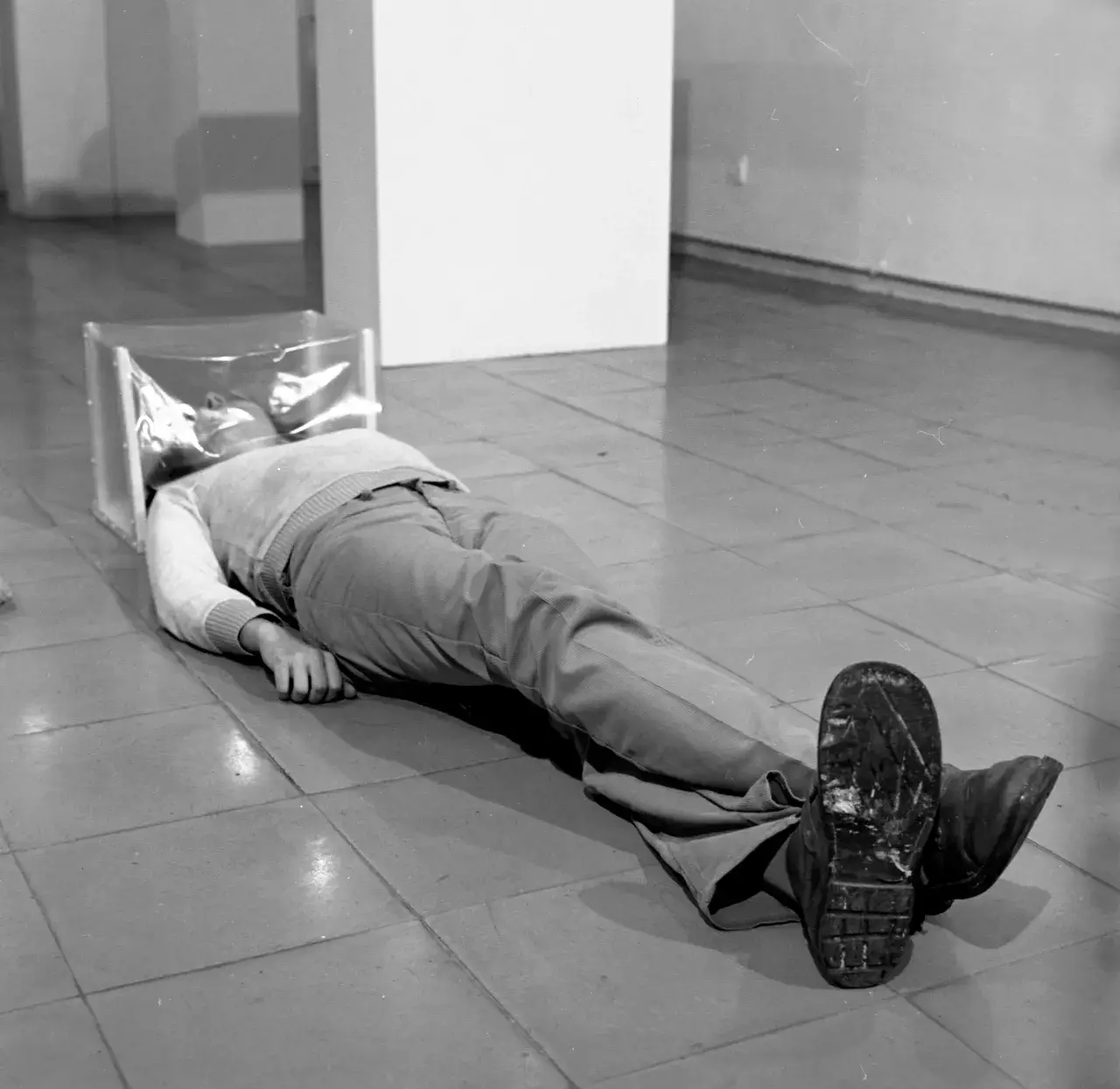
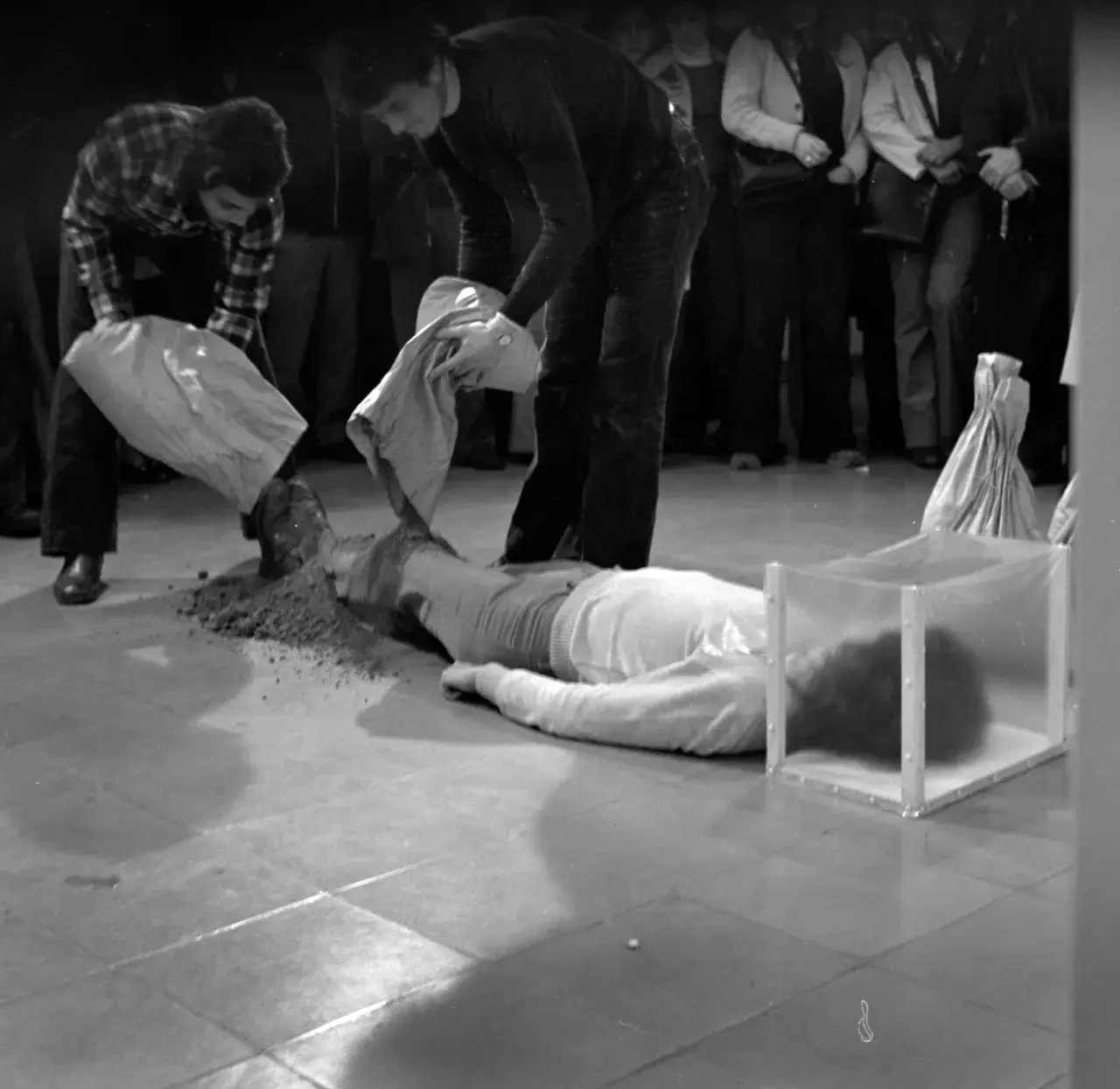
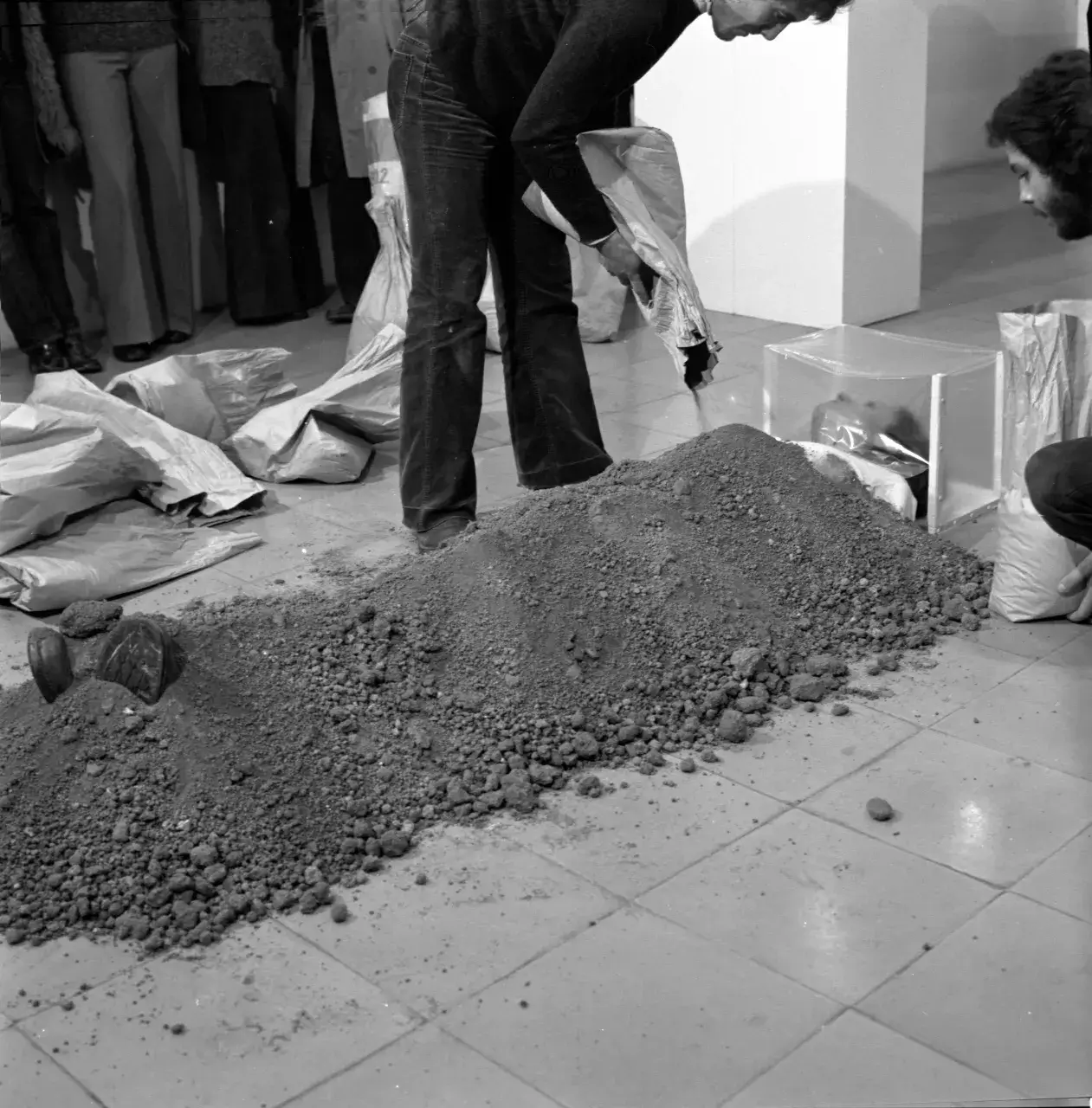
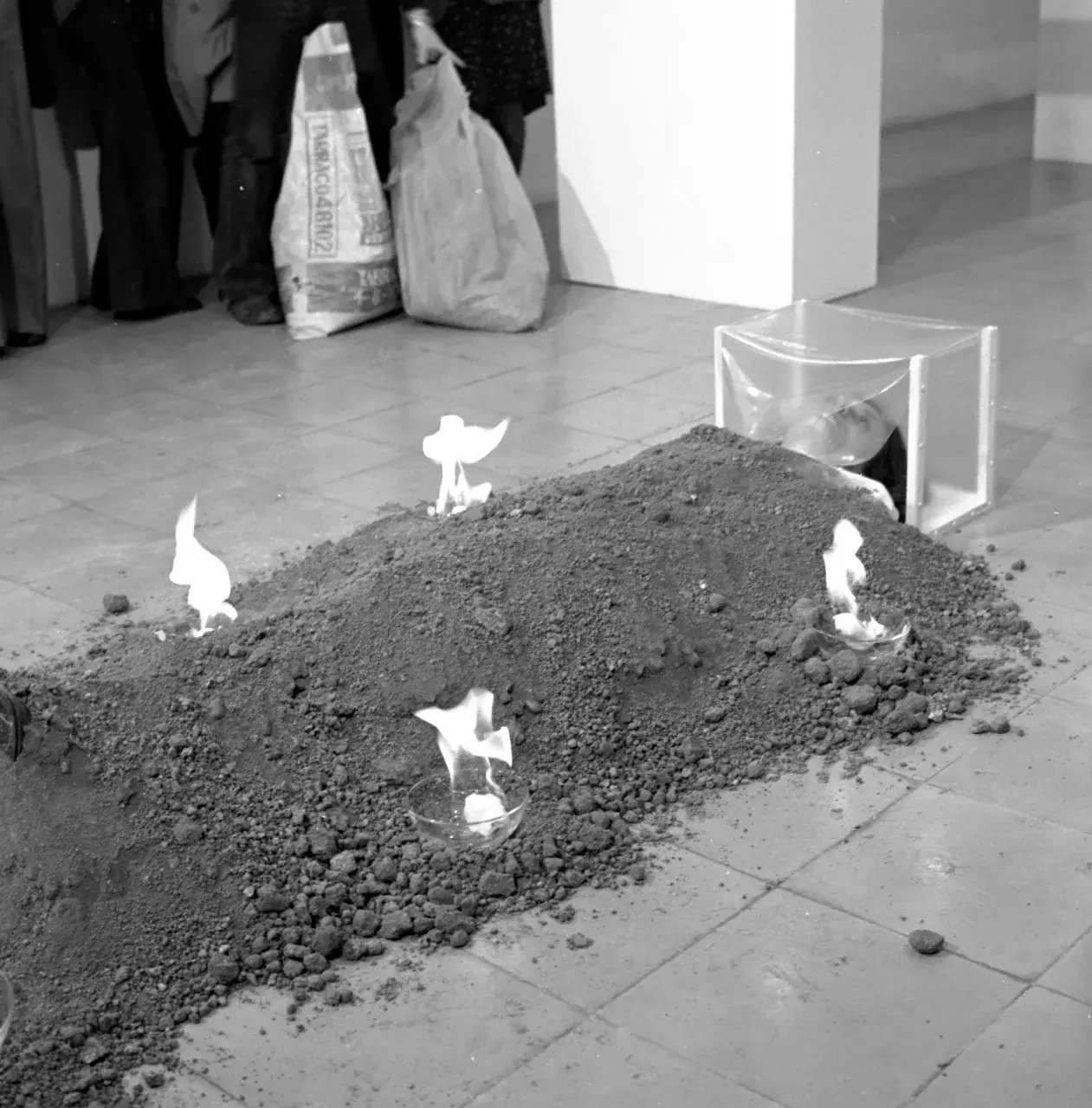
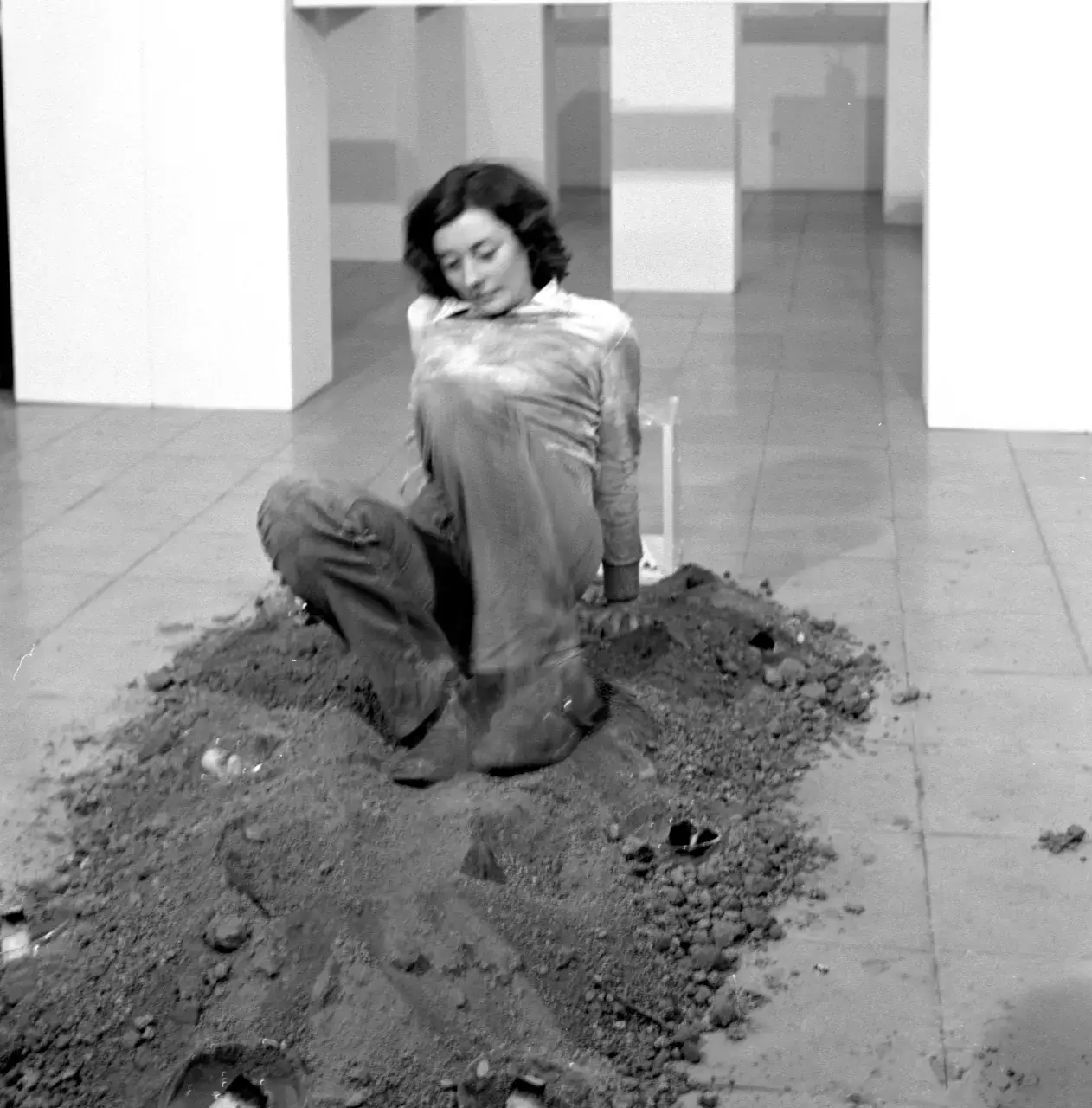
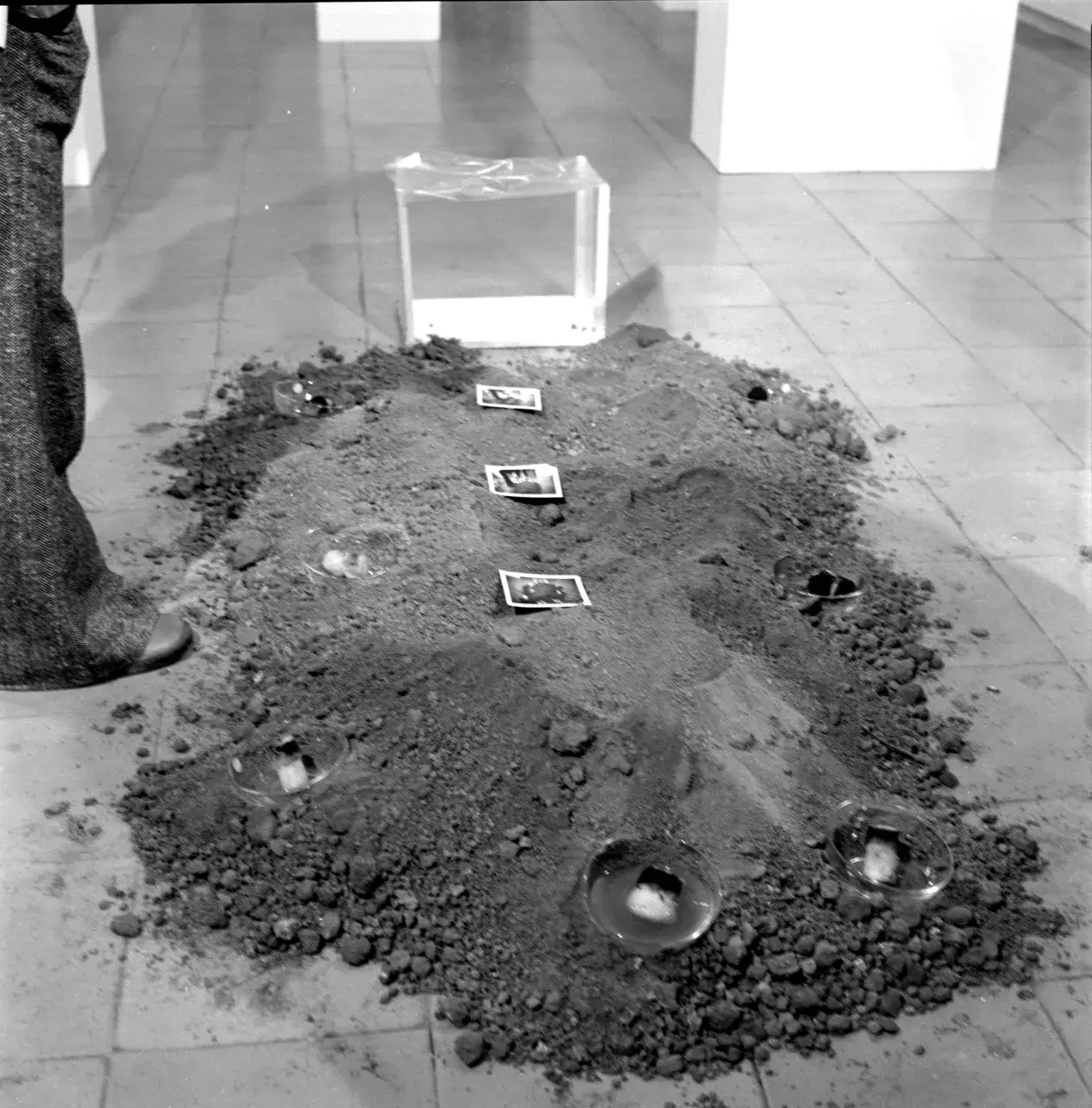
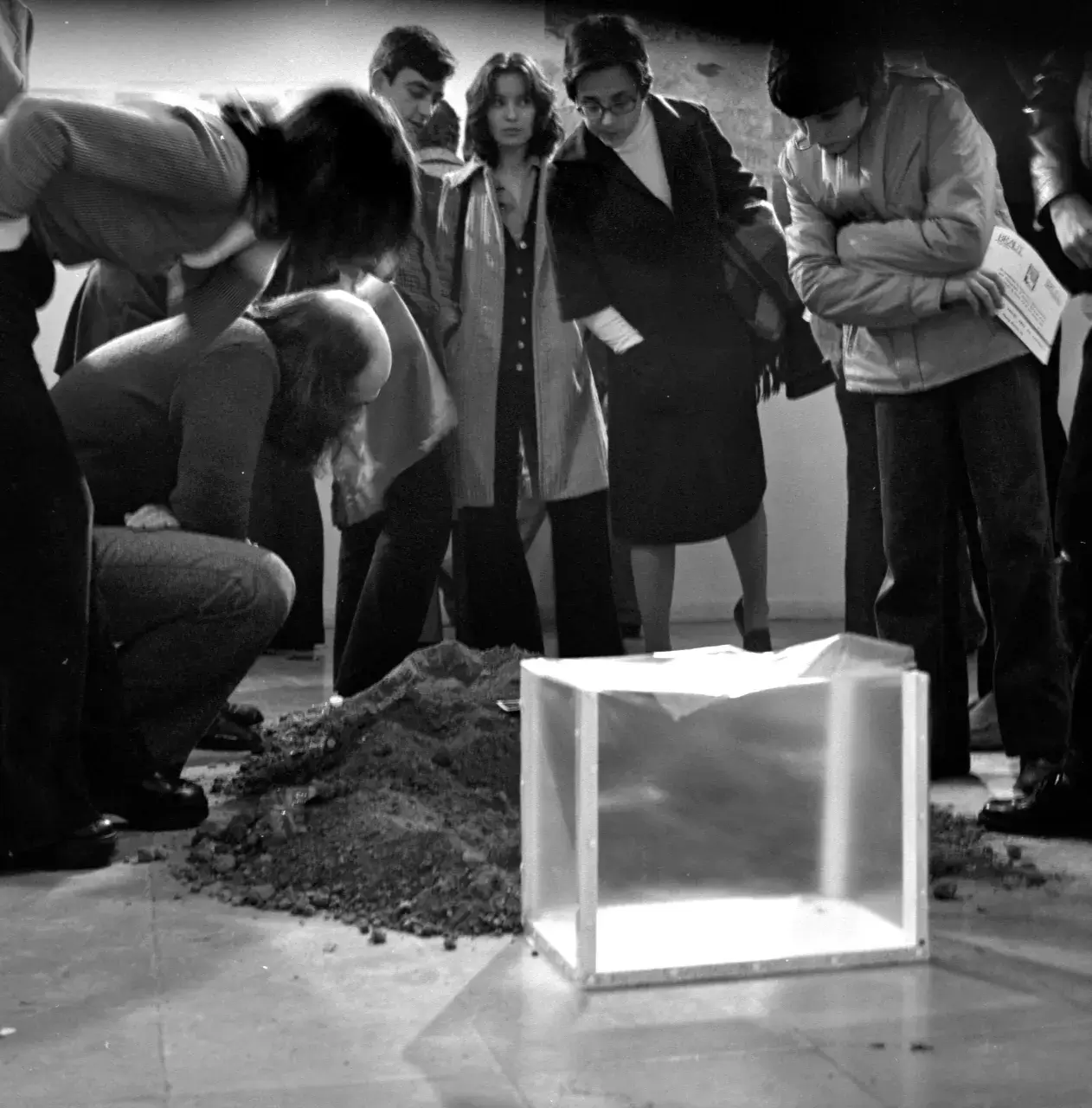
Lluís Utrilla, Grotesque Labyrinth, 1972
Fina Miralles, Relationships. The four elements, 1975
Museu d’Art de Sabadell -
-
-
-
-
-
-
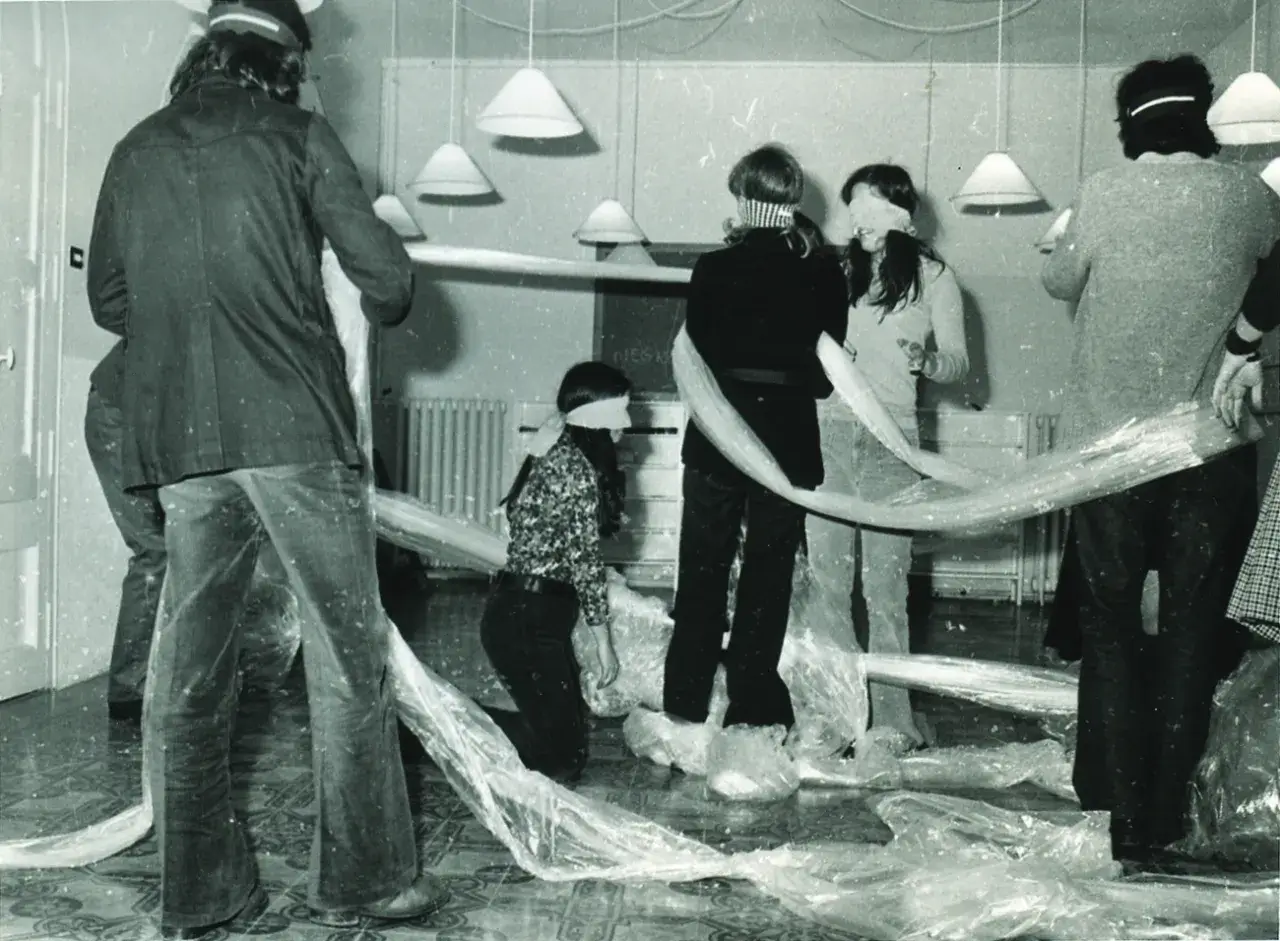
Lluís Utrilla, Grotesque Labyrinth, 1972
Museu d’Art de Sabadell -
-
-
-
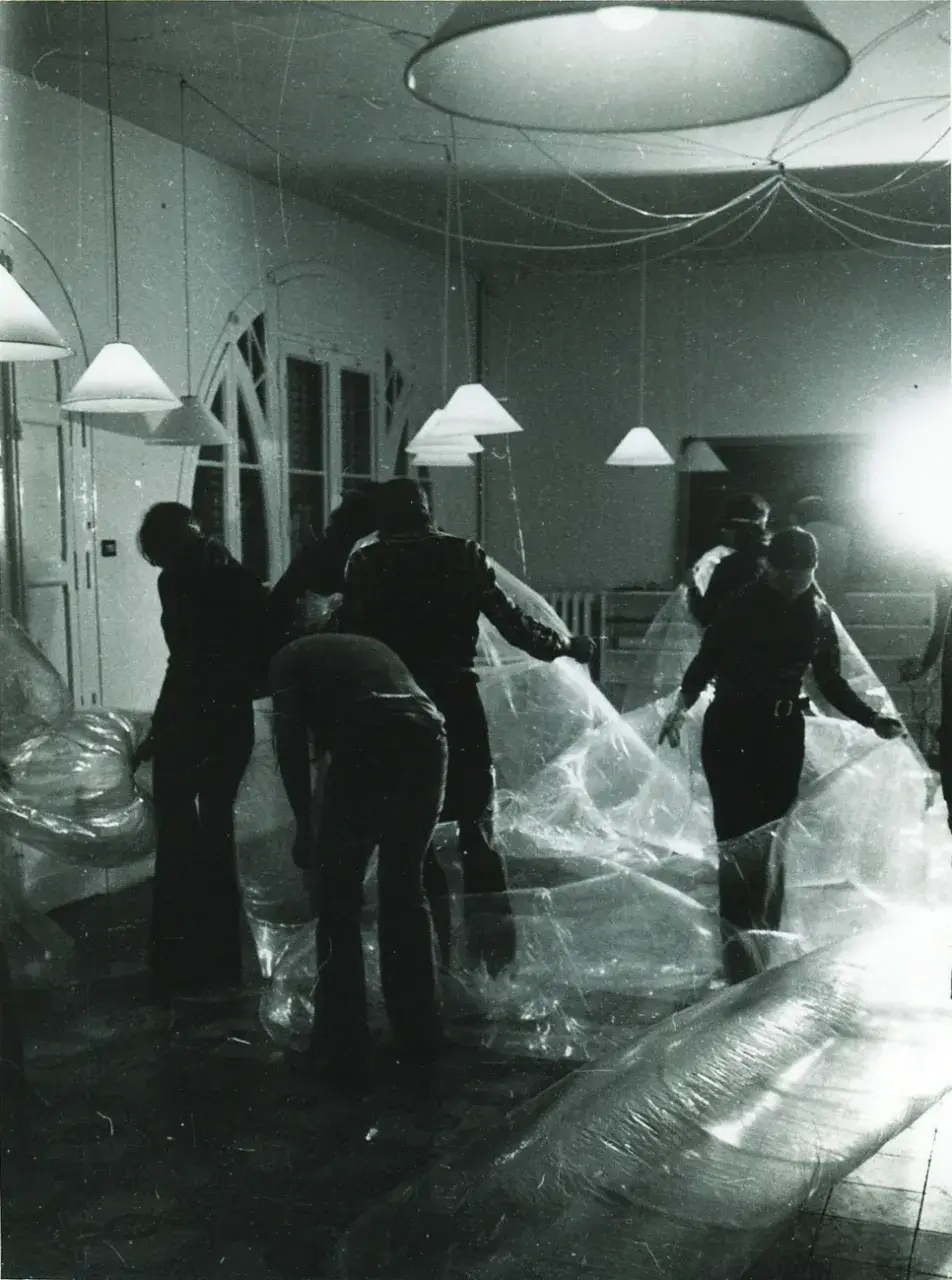
“The task of recovering, studying, and reconstructing the activities of Sala Tres was one of the pending matters on the road to recovering and appreciating the cultural history of Sabadell. It is also of vital importance in the development of alternative Catalan art. With the exhibition entitled La Sala Tres (1972-1979) on the route of alternative art in Catalonia, we have sought to fill this gap with a two-pronged approach. On the one hand, the initiative involves a historical exhibition presented in the halls of the Acadèmia de Belles Arts and in the two temporary halls of the Museu d’Art, with a selection of documents and representative works from one of the most dynamic and creative periods of Catalan art. On the other hand, it entails a publication that analyses the intense activity of Sala Tres from a wide array of records and perspectives provided by the authors of the texts of this publication, with an analysis of the artistic, cultural, political, and social context as concrete and decisive frameworks when understanding and appreciating the historic hall.
Furthermore, the exhaustively documented chronicle of its activities, which we have organised in parallel to the development of conceptual art in Catalonia, provides highly significant information on the close-knit relationship that Sala Tres maintained with Catalan alternative art over the course of seven years, across three recognised stages (background, emergence, and institutionalisation). It also addresses other practices and attitudes concerning art that came about as an expression of a combative era immersed in a state of shared euphoria that had its root in that distant Parisian May of 1968. After a certain delay, the expanding wave of that fateful period nurtured a generation that sought to take the reins of art, culture and politics in Catalonia throughout the 1970s with a new imagination and new energies, though we cannot overlook a series of revolts that were perhaps too spontaneous and disorganised and which also drew from often contradictory discourses that shared the same yearning for freedom by confronting all figures in power.
In the midst of this polyphony, artistic practices experienced an unprecedented degree of freedom, responsibility, and commitment. It took decades for this liberating explosion to achieve the recognition it deserves and for it to be studied and analysed by critical theory and art history in Catalonia. This work builds on that recognition and provides documents and texts that speak of an era in which art and its system of distribution and circulation emphasised meaning and content over form and aesthetic value, as opposed to the prevailing commercial values in today’s global society. Contrary to what was expected, these practices have not lost their critical potential, rather quite the opposite has happened, as witnessed in the latest explosion of independent creative groups who are reinterpreting and rejuvenating the liberating and political potential of art when it is integrated into the networks of everyday life.”
This text by Maia Creus*, which you can read in greater detail here*, makes it explicitly clear that there was, and still is, a need to recover places where dissent, political advocacy and art produced spaces for critical thinking and rigorous creation in times of repression.
Many of these spaces were created around Catalonia in the 1960s and 70s promoted by young and not-so-young Catalan bourgeoisie artists who made the most of a certain detente of the repressive apparatus. It is important to show how this entire network of spaces and actions disappeared starting in the 1970s, swallowed up by a democracy that promised something that it could never deliver: shaking up a society mired in forty years of Francoism and creating truly participatory and transformational institutions.
The exotic gaze
(colonists and collectors)
“The 165 ‘black art’ pieces that make up Expediente 71 of the Museu Etnològic i de Cultures del Món de Barcelona belong to the collection of General Miguel Núñez de Prado, the governor of Equatorial Guinea between 1926 and 1931. This stage was characterised by a craze for expansionism, modernisation, forced labour and the extreme violence carried out against the Fang people.”
⏤Trafricants
An “exotic” gaze is the one that created a specific perspective of otherness, setting out the stereotypes of the “others” at a time in which Europe was expanding and establishing relationships based on dominance around the world.
The appropriation of cultural goods arose, in part, because these other cultures had been considered the origin of Europe’s own in a distant past or due to a boastful colonising fever that made Europeans feel like the owner of everything in their paternalistic and sometimes criminal perspective.
Until relatively recently, no one even considered the dark side of Sabater Pi’s expedition, who found the albino gorilla in Equatorial Guinea, or what effects Egyptomania had in Catalonia.
“No anthropology or ethnology museum should exist if it does not critically address the social and cultural reality that surrounds it”, claims the director of Museu Etnològic i de les Cultures del Món, Pep Fornés, who also acknowledges that it is not easy to put this transformation into practice. In many cases a choice has been made to create critical temporary exhibitions that could counteract or compensate for the most controversial topics.
Art museums also possess countless works that are the products of spoils gained through purchases that were essentially looting, normally under highly unequal conditions. But what builds a truly significant imaginary are the countless works that represent women of “exotic beauty”, a product of the male imagination that demands mystery in their boring desires, as well as “primitive natives” which serve as the basis to justify colonialism, looting, or, in the most extreme cases, slavery and genocide.
In our time, countries like Germany have opened the door to the possibility of returning colonial art while many others, including Spain and Catalonia, are considering the topic in certain museum sectors. What is evident is that this colonial, authoritarian, and sexist imaginary is what western culture has built, and that a great deal of work and joint efforts will be required to revise and transform it.
NOTE: This has little to do with the merely political and opportunistic claims that certain communities are making, while alleging that they are legitimate claims.
-
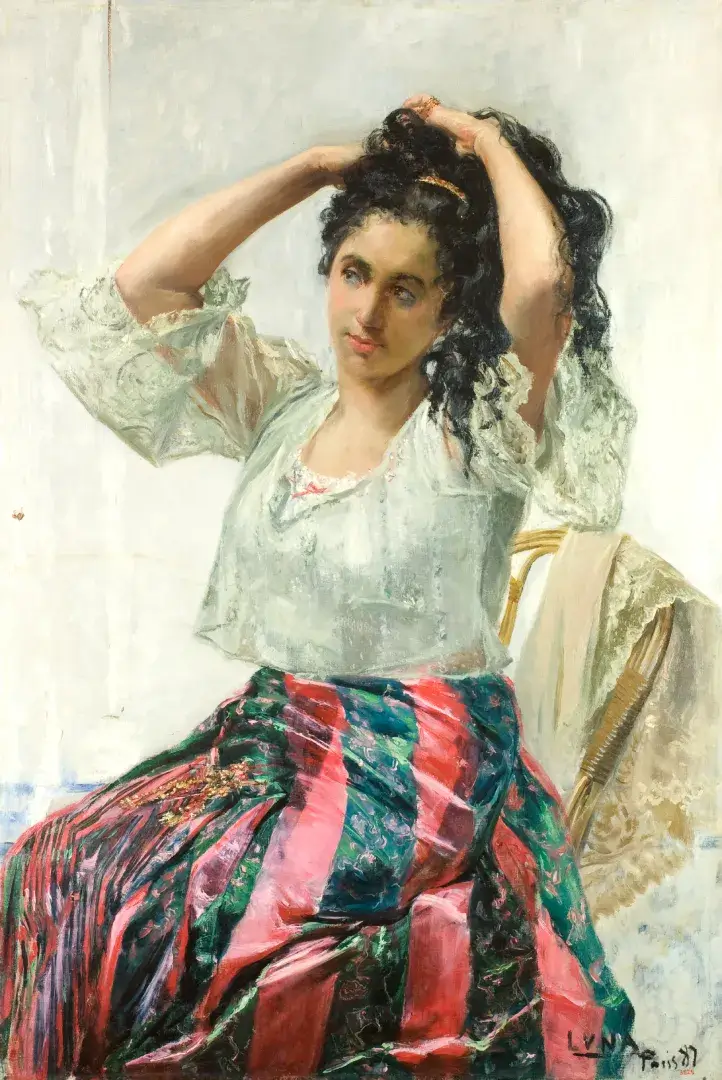
Joan Luna i Novicio, Badoc, Philippines, 1857 – Hong Kong, 1899
La Mestiza
Oil painting on canvas. Wooden frame
111.8 x 75.2 cm
France, 1887
Biblioteca Museu Víctor Balaguer“The famous Filipino painter Mr Luna y Novicio, creator of the famous canvases Spolarium and The Battle of Lepanto, has given to the founder of this Institute, intended for our art gallery, his great work La Mestiza, a gorgeous piece that greatly aroused the admiration of the intellectuals in the Philippine products competition held in the court and has been awarded first prize in the arts by the Jury. La Mestiza will be the rich ornament that will shine as the crown jewel of our museum.”
Bulletin of the Biblioteca Museu Balaguer, 26 December 1887, page 2-3.The painter Anglada Camarasa made a reproduction of this painting.
-
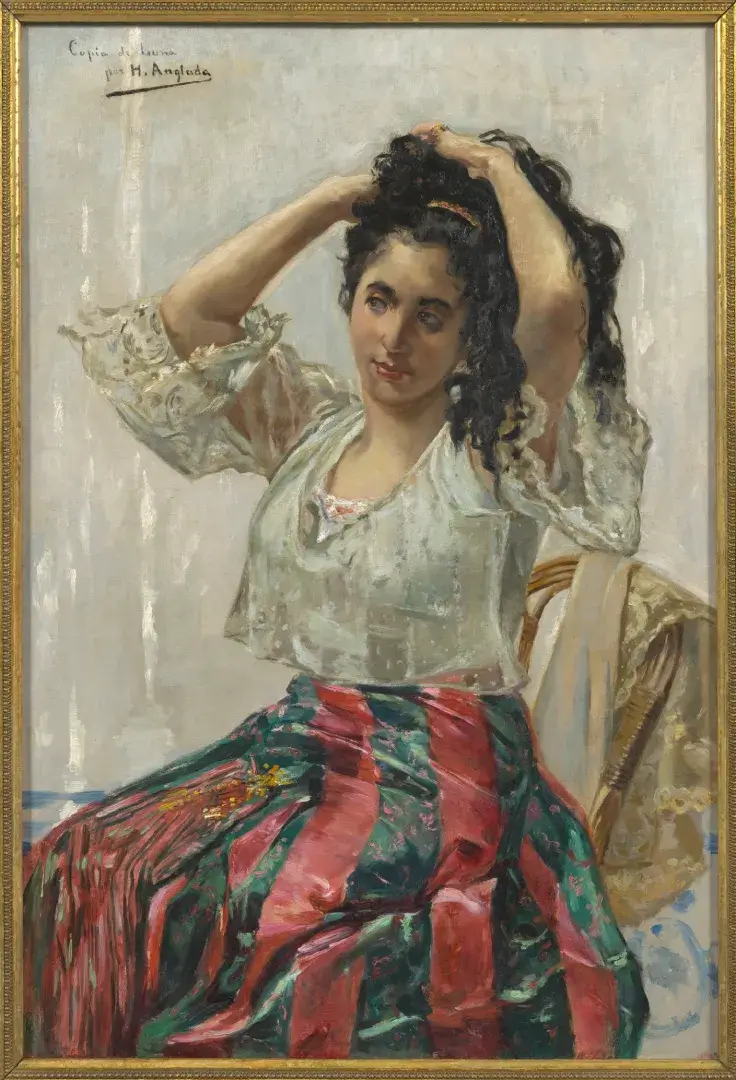
Hermen Anglada Camarasa, Barcelona, 1871 – Port de Pollença, Mallorca, 1959
Mestiza
Oil painting on canvas
110 x 74 cm
1890
Biblioteca Museu Víctor Balaguer -
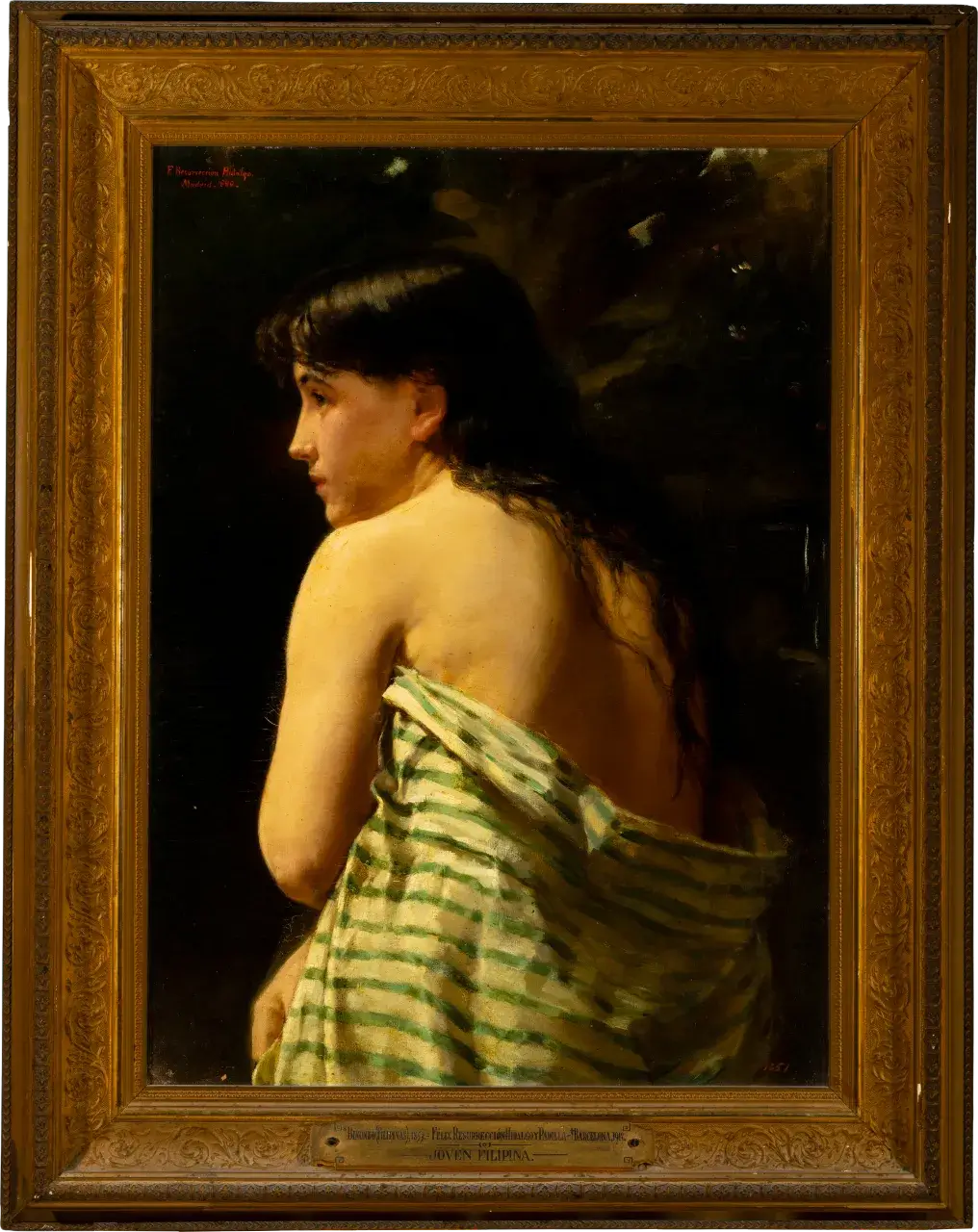
Félix Resurreción Hidalgo Padilla, Manila, 1855 – Barcelona, 1913
Young Filipino Girl
Oil painting on canvas
70 x 50.5 cm
1885
Biblioteca Museu Víctor Balaguer -
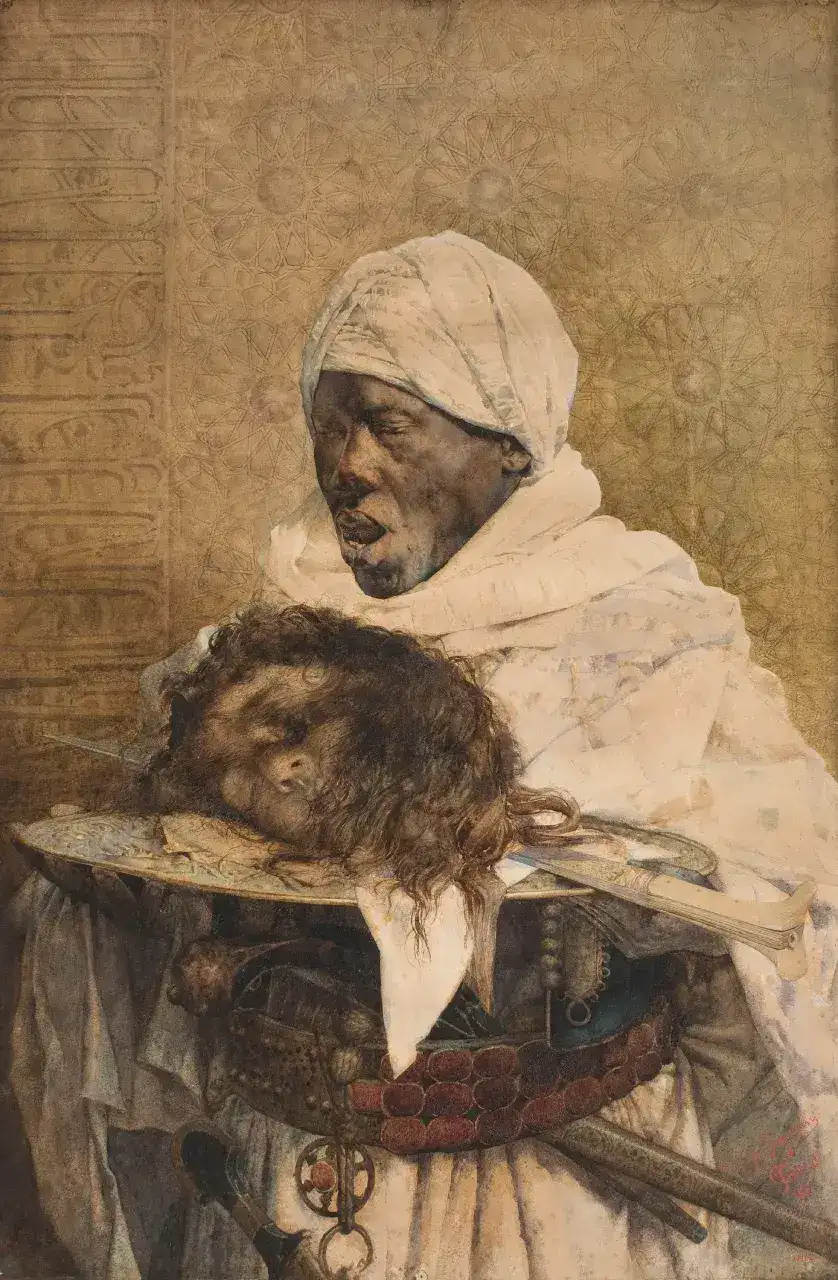
Giuseppe Signorini, Justice in Morocco, 1890
Museu Nacional d’Art de Catalunya (MNAC)
Purchased at the “First General Exhibition of Fine Arts”, Barcelona, 1891
Public domain -
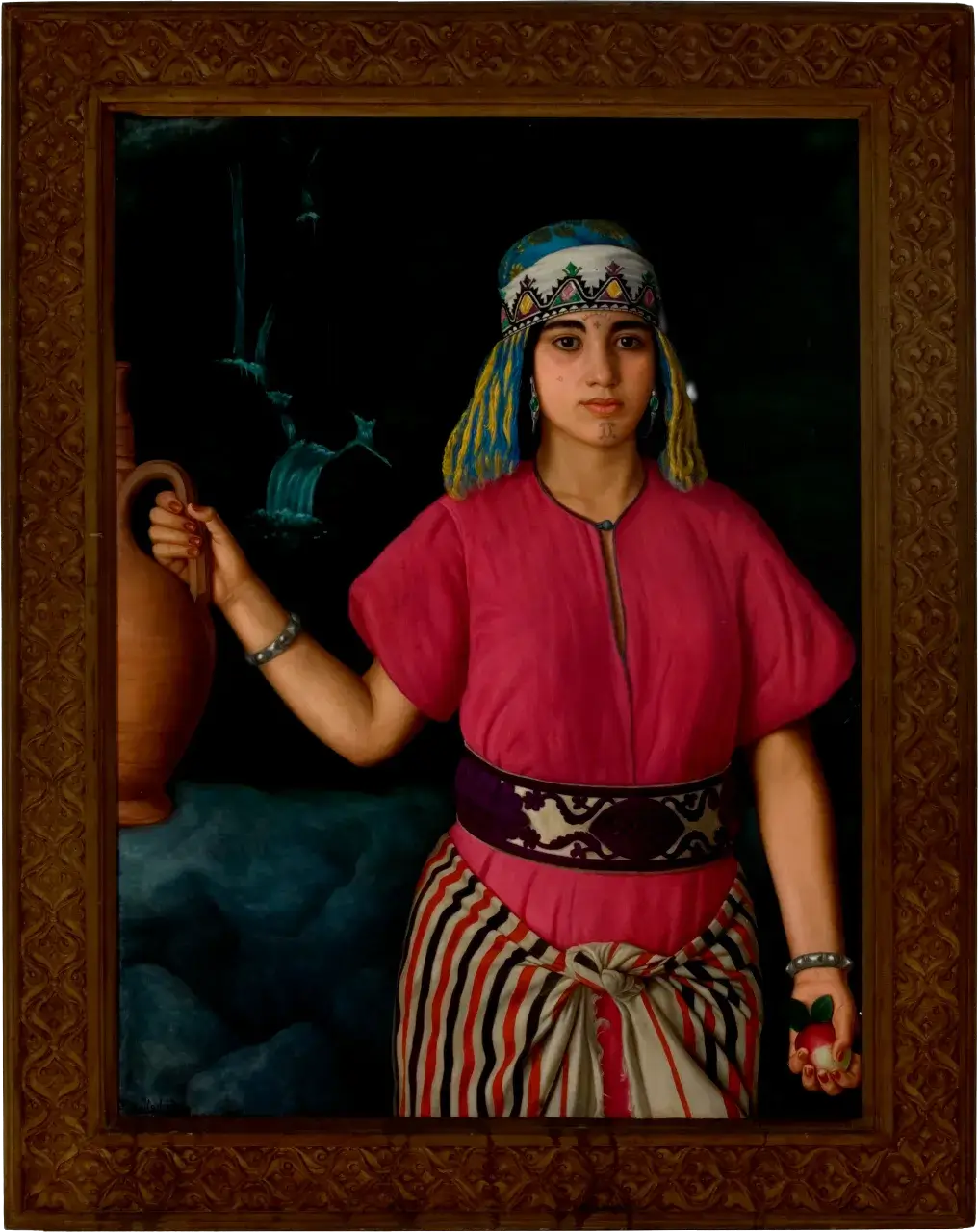
Miquel Viladrich, Moorish Girl Carrying Water, 1933
Oil on wood, 100 x 73.5 cm
MORERA. Museu d’Art Modern i Contemporani de Lleida, 0558
Acquisition, 1974“For a long time, my aim was to exalt the work of the noble trades. Nowhere can one find types of artisans and craftsmen as perhaps one does in the area of our protectorate in Morocco. After finishing my project, I left Tétouan with a bitter feeling […]. Tétouan seemed to me the place where the Muslim world that one dreams Andalusia would be has survived. I have now spent the two happiest years of my life as a man and as an artist, because there I found warm and frank friendships, in addition to magnificent models while frequenting the districts of blacksmiths, weavers, dyers, merchants, etc.”
That is how Viladrich himself described his pictorial work in Morocco, where he painted a total of thirty pieces depicting Sephardic crafts and topics: twenty works of the former and ten of the latter, all imbued with his taste for realism and the meticulous detail emblematic of his work. In the case of the trades, however, the painter’s attraction towards a quasi-ethnographic matter is more evident than ever, along with his intense fascination for creating characters of a specific culture and region.
-
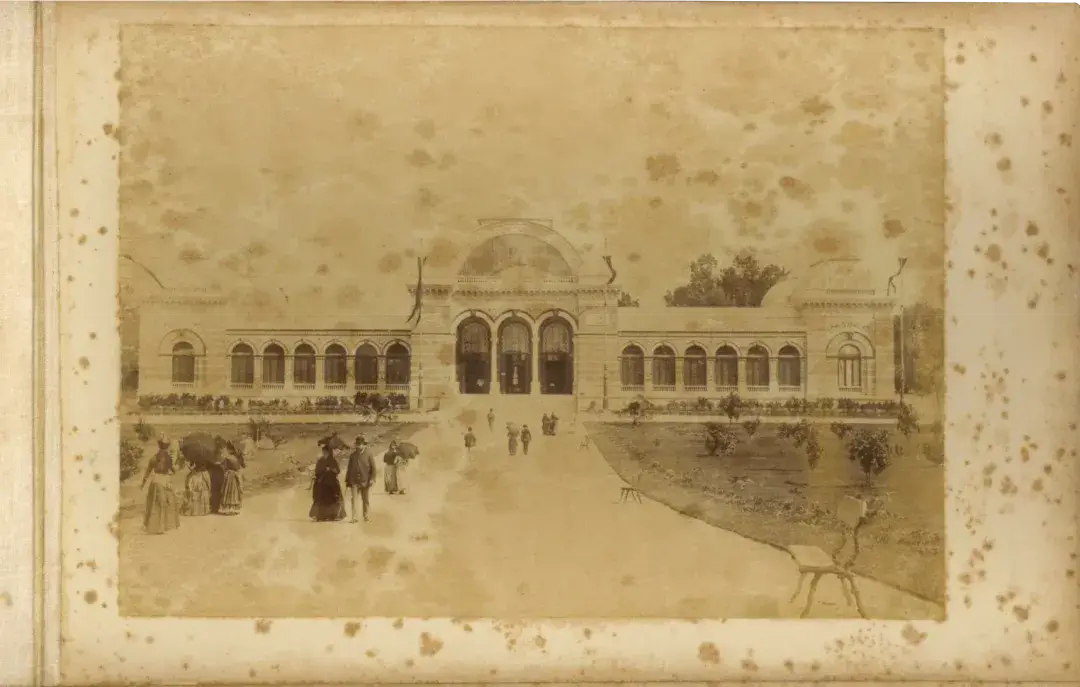
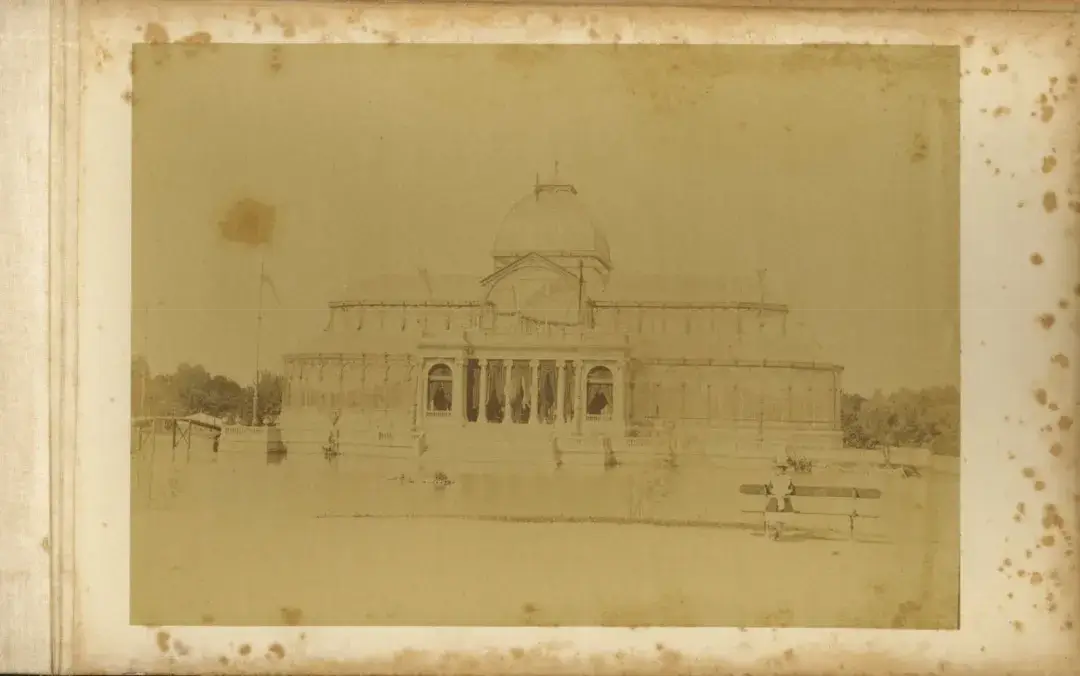
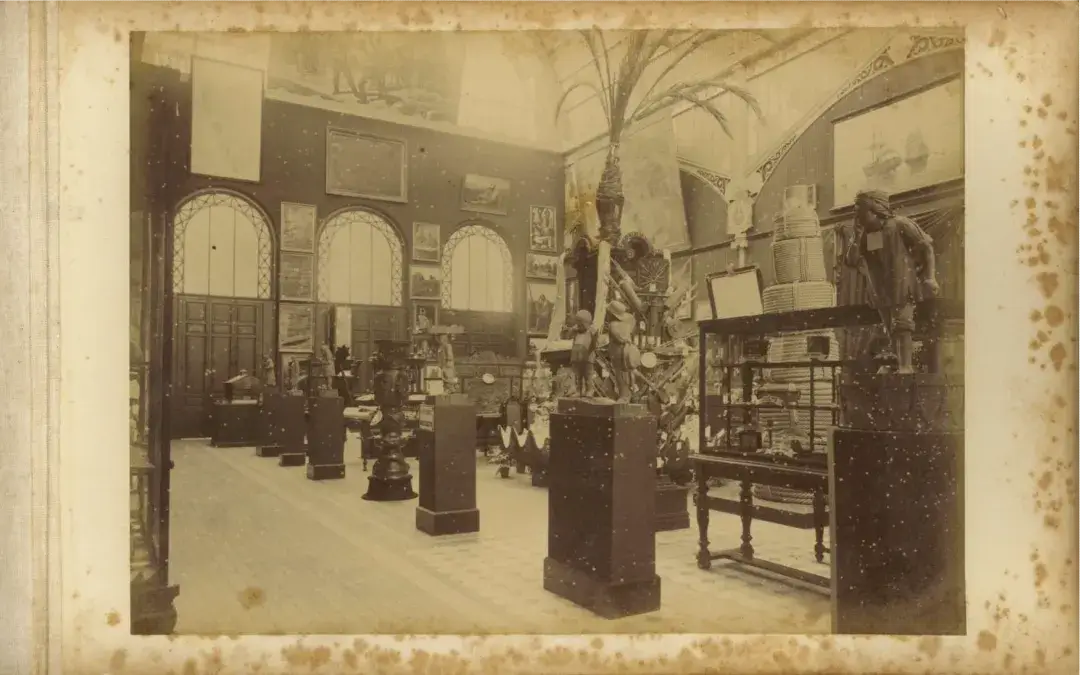
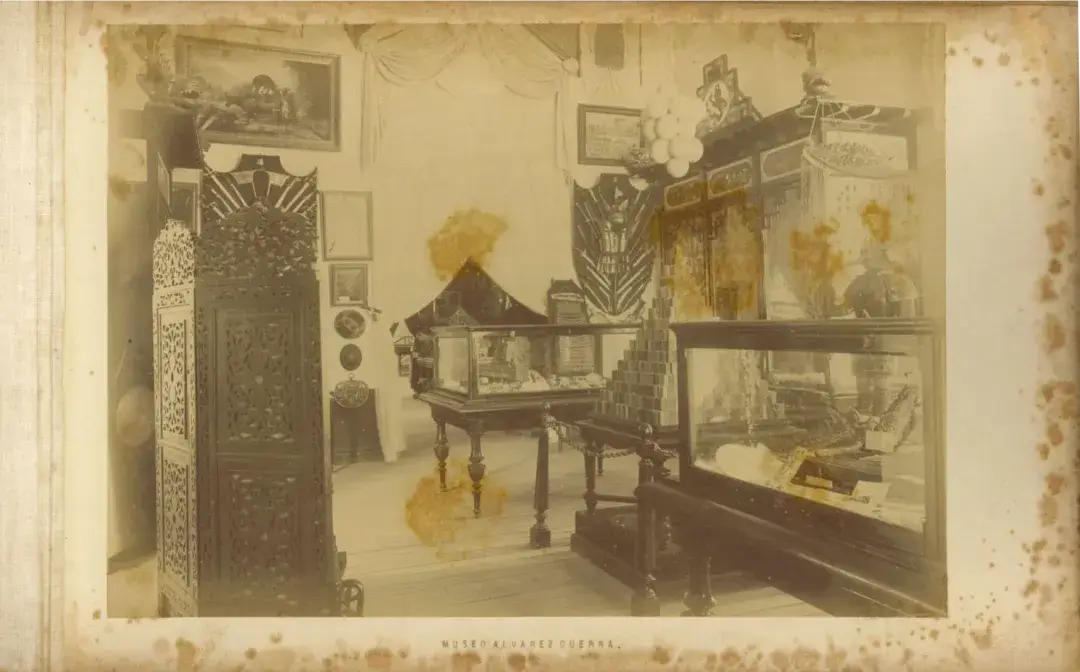
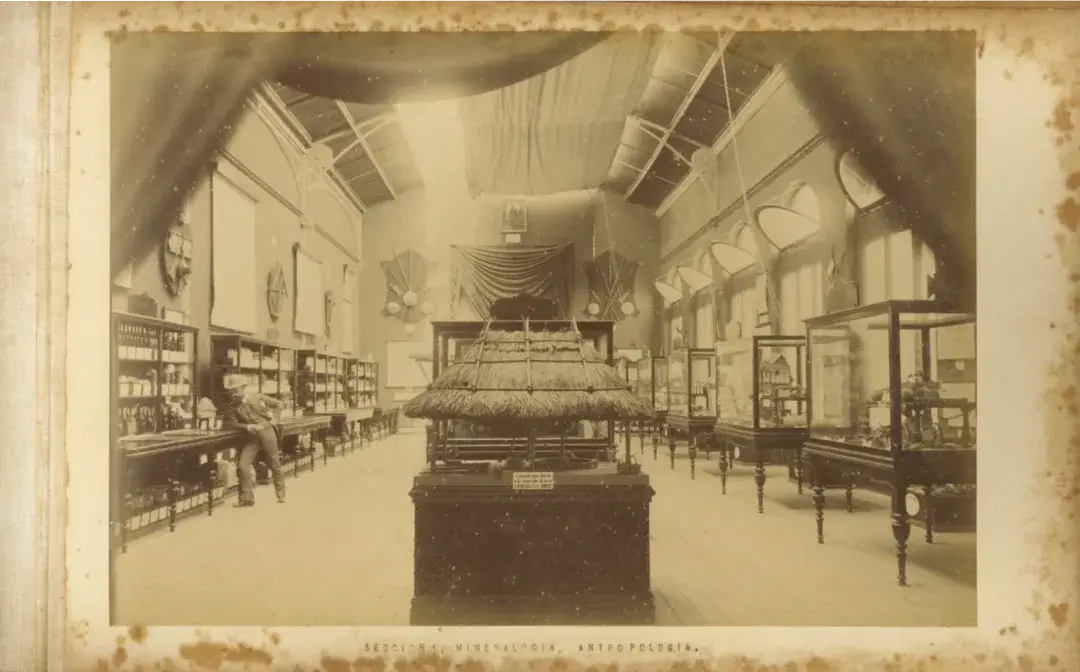
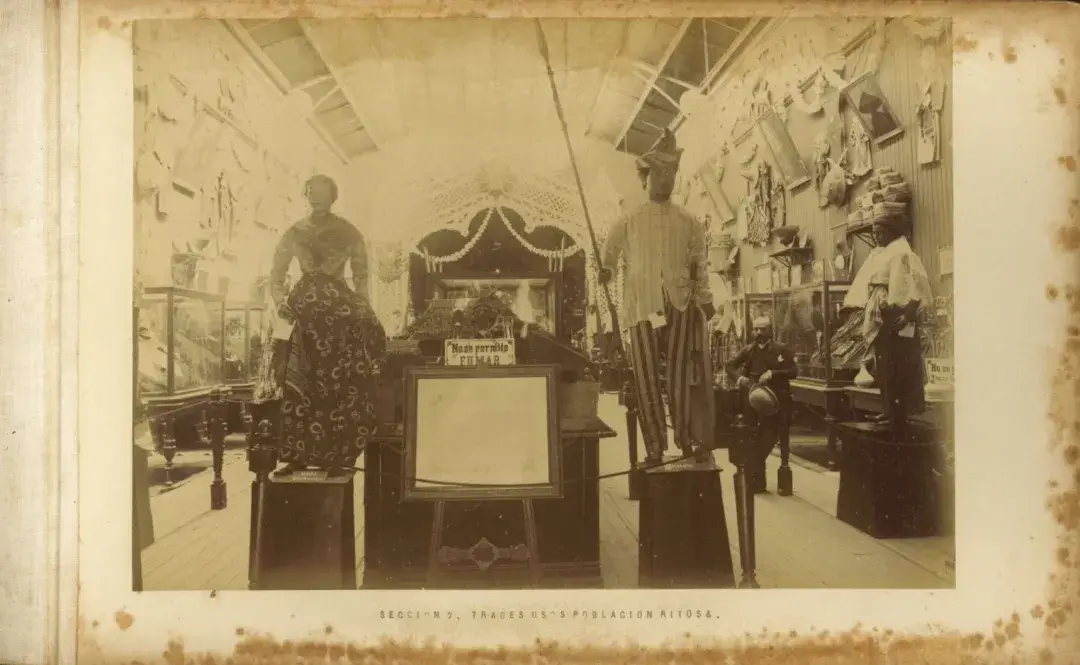
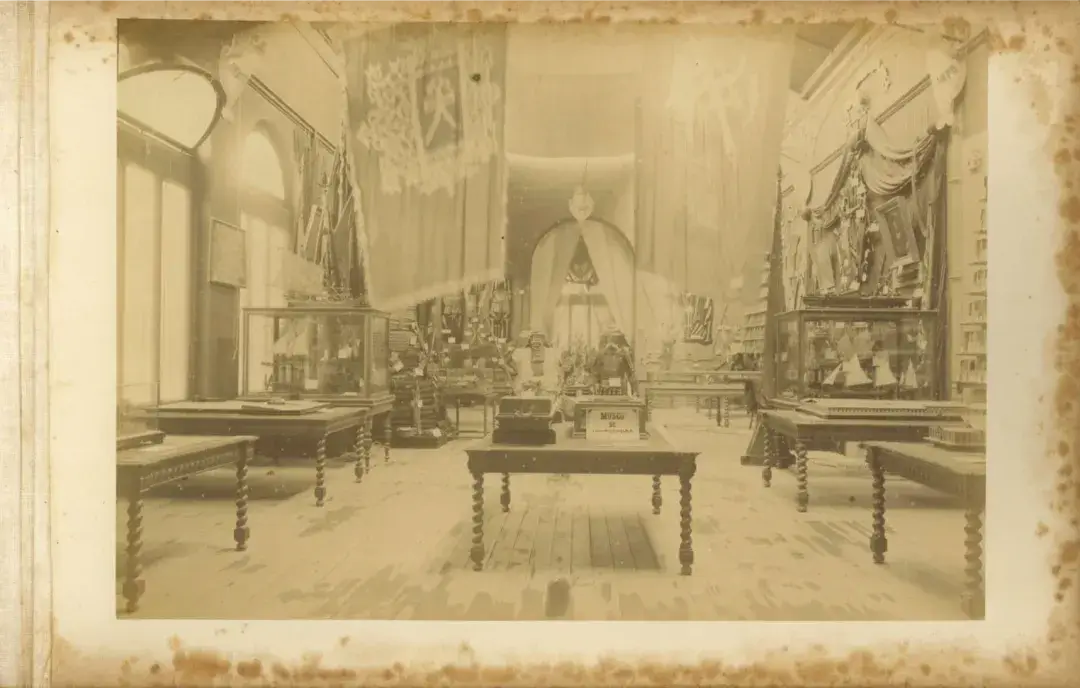
Documents, pictures and letters
Biblioteca Museu Víctor Balaguer -
-
-
-
-
-
-